Re-thinking the need for a pulley saver or friction-less tie in point.

How many make the ascent SRT then work down DdRT?


  • Total voters
    41
You're doing some good work, Richard. Keep it up.

I have had the idea that the adjustable bollard should be at the upper body slick pin rather than on the bird. I really feel that would allow better bird control by putting the friction elsewhere.

All that being said, I don't see where the lack of control comes from. My blue RR operates like an absolute dream in ascent and descent. Perhaps I've just used it enough to get used to how it feels. Could it feel a bit more modulated?...Yes. Does it need to be?...No, IMHO.
 
Thanks for sharing the info Richard.
I would add frictionless as in RopeGuide,Pulley saver is best when progressing/ascending and when
gravity is already doing the work for you it is nice to change to the appropriate descender like adding the RW, figure eight, Rack, leg wrap, or grip it firmly etc.

Oh yeah you should add YoYo that includes SRT,DRT,Ddrt etc to your survey.
Point being made is it is never in my case simply go up come down. Its up down up down in out all around.
Cheers
 
Last edited:
Is there a 2nd half to this video I can't find?
not a second half to this video but what prompted the study was my interest in how much friction the control device, the bird, is applying to the Rope runner. There is a video on that but I realize it may not be of interest to others.
It also appears I got sloppy, I need to add a comment, "the end"
 
Ok no problem just hate to not finish things. With that knowledge you could start moving the gauge around to see if/ how force changes at your safety snap, tip, etc you could come up with real numbers for the entire system.

A couple questions.
Do the numbers change with the: hitches for example vt vs blake?
Rope dia. 7/16" vs 1/2"?
Static vs non static?
Does distance from tip and stretch change any results?

Great info so far way to get the ball moving. Thanks
 
I tried the load cell between the HH and the hitch cord on a single line, and the load on the hitch was about a third of my total weight (one third being around 50+ lbs.). The hitch would release nicely at about 30 lbs. or less. ( about 1/6 of my weight) The HH seems to hold various weights in a fairly porportional way so I would imagine this percentage would hold up under different weights,
 
I tried the load cell between the HH and the hitch cord on a single line, and the load on the hitch was about a third of my total weight (one third being around 50+ lbs.). The hitch would release nicely at about 30 lbs. or less. ( about 1/6 of my weight) The HH seems to hold various weights in a fairly porportional way so I would imagine this percentage would hold up under different weights,

That is about what I came up with back when I did the test and before I had the Rock. I also came up with some numbers for the dog bone, biner and hitch and some shackle numbers, that was what I was studying at the time.

 
Excellent test. I must have missed this video. I was just outside testing the HH with a line over a 5" dia. pine tree limb. The forces seen by the hitch cord with this setup were barely 1/3 of the numbers generated on a single line. The hitch cord would last a long long time I would think, with a DdRT setup, even with a pulley above.
 
A fella in my area was climbing on a one-way ratcheting pulley. I think it was a sailing pulley. Because the sheave only rotated in one direction, ascent was nearly frictionless, but the descent experience was like that of natural crotch climbing. He didn't have it configured into a friction saver, but instead tied it to the end of a single line (with a separate doubled climb line through the pulley. He pulled the single line through a T.I.P. crotch and raised the pulley up to the top and tied the single line off at the base with a porty for emergency lowering (similar to SRT base tie set ups). Hope all that made sense. The only down-side was that the pulley's weight rating was quite low (if memory serves me correctly - this was 5 or more years ago) - so low, he probably shouldn't have been using it. But, the idea was a good one. There...........someone market that in friction saver form and make a mint.
 
Chewy, I was just looking at doing the same thing. Yes it was most likely a sailing pulley, that is about the only spot I can find them also. The weight limits have come up some also. I have been trying to figure out how to make a rated pulley ratchet but I am just getting started with the idea. I am sure the one of the big manufacturers could figure it out if they new we would like to see that. Hopefully they will look in on this thread.
 
The guy I was referring to had supposedly contacted Rock Thompson (of Rock Exotica) about manufacturing an arboriculture industry-specific version. He was hoping the same thing - for one of the bigger manufacturers to build a rated device. Like I said, that was a handful of years ago. This whole thing's kinda making me think he was ahead of his time.
 
Richard, this is great work. Thanks for the vid. I have to say that I'm in agreement with the general discussion here. Pulleys aren't necessarily the "best and final" answer to every type of climbing. In my very first vid on the U-SAVER, I remark at how surprisingly well the three-ring saver configuration works. And AJ Moss has been quietly 'killin it' for years with his conduits and special ends.

The trick is generous bend radius and smooth friction, not necessarily zero friction.

There is, however, a clear exception to the rule: climbing in a loop. The old "O-Ring" configuration benefits hugely from a pulley above and below, not because it changes friction at the climbing hitch but because it reduces adjusting friction. Check out the following adjustments under load and imagine the user friendliness WITHOUT the two pulleys ...

 
Richard, this is great work. Thanks for the vid. I have to say that I'm in agreement with the general discussion here. Pulleys aren't necessarily the "best and final" answer to every type of climbing. In my very first vid on the U-SAVER, I remark at how surprisingly well the three-ring saver configuration works. And AJ Moss has been quietly 'killin it' for years with his conduits and special ends.

The trick is generous bend radius and smooth friction, not necessarily zero friction.

There is, however, a clear exception to the rule: climbing in a loop. The old "O-Ring" configuration benefits hugely from a pulley above and below, not because it changes friction at the climbing hitch but because it reduces adjusting friction. Check out the following adjustments under load and imagine the user friendliness WITHOUT the two pulleys ...
Excellent points you make with an excellent video. The loop or floating prusik is an excellent concept for putting your climbing device where you want it when you want it there and maximizing that valuable length of rope real estate in front of your shoulders. Your addition of a second pulley at your bridge makes that very efficient. Nicely done! Climbers making DdRT ascents and working the tree would gain greatly from this. Hell, it might even help some poor bugger that is still climbing on at Blake's hitch. (Poke)
Personally I am 95 percent SRT ascent so my adjustable tethers are left to other means.
It is all about putting the tool you need in front of your shoulders when you need it, whether it is the rope or your climbing device.
Again nice job I totally agree and those ascending and working DdRT would greatly benefit.
 
Last edited:
Richard, this is great work. Thanks for the vid. I have to say that I'm in agreement with the general discussion here. Pulleys aren't necessarily the "best and final" answer to every type of climbing. In my very first vid on the U-SAVER, I remark at how surprisingly well the three-ring saver configuration works. And AJ Moss has been quietly 'killin it' for years with his conduits and special ends.

Again, great info you provide OF, I watched your video again just because it has such good info.
Both the Pinto (smooth) and the Omni (shape) are great for jamming the line. I had not heard that the shape of the Omni was specifically made for that, it just made sense. Is that actually published?
I was still a little nervous with that limb walk, such a small limb and definitely in the kill zone! It's tough making your own videos sometimes isn't it.

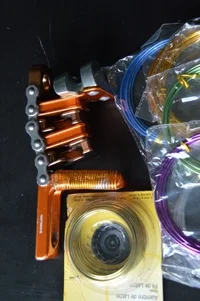
My in-spite of saving wear in other places my Uni started to get a deep grove in the L bracket. Notice you have a little wear going on there too.
Here is a little thing I have been using to save the wear. Soft craft aluminum wire available eBay or hobby type stores, tight wrap and a little epoxy at each end to keep it tight.

SaveTheUni (Small).webp
 
Nice wrap! Thanks for the tip.

The little tab is specifically for prussic minding. The 1.5" and the 1.5" double don't have it for some reason.

In this application, I'd favor the Omni over the Pinto particularly if I had a rope bridge. I'd mount the Omni into one of those Petzl split rings and pretty much leave it there. Now you get a pulley, a swivel and a double locking "carabineer" all in the same five inches. With the web bridge, I attach directly to an HMS bineer on the bridge. The video shows me snapping the HMS onto a Saddle O ring but that's only to get the assembly up into the frame of my helmet cam.

At my age, anything higher than the coffee table is the kill zone ... ;-). Without a helper on the camera, it's just impossible to know what you're going to get up in the tree unless you're wearing the camera but sometimes you need other views. I know you know ... you do your own camera work too.
 
I liked that Loop concept so much I immediately tried to duplicate it with a Zigzag, I could not make it work. Rich or Tom if one of you have a Zig and can figure out a working loop method you would be more wonderful than you already are.
 
Monkey,

I have the ZZ, tried it, and this is a definite NO GO.

Petzl says don’t use it for SRT. I believe this is NOT due to the usual “hitch release” issues. Watch carefully when you release the lead end of your climbing line from the “normal” connection hole. You will see the ZZ re-orient itself and drive the connection eye up against the end of its travel. In that configuration. You are literally trying to “bend the pin”. No, no, no.

I like the ZZ, particularly for a lanyard/climbing line combo. But definitely not for this.

OF
 
I love both my Uni and my Zigs, but I hrdley ever use the Uni for anything but ascent. I can never get it to tend smoothly from below so SRT limb walks are still out for me. Thank God for a floating tie in pulley and my Zig Zag.
 

New threads New posts

Back
Top Bottom