
Thank you for responding. I have my bridge set up like this now. I,m just looking for a detachable bridge end. It would make this saddle much easier to put on as it requires stepping into the leg pads after the bridge all the wile trying to hike it up my waste. It's the ONLY part I don't like on this saddle. Am I supposed to buy a TM now? I actually have an old industrial Singer. I can always just make another saddle again.The Petzl ring open works well with the style of rope clamp, rollnlock or Kong.

Navigation
Install the app
How to install the app on iOS
Follow along with the video below to see how to install our site as a web app on your home screen.
Note: This feature may not be available in some browsers.
More options
You are using an out of date browser. It may not display this or other websites correctly.
You should upgrade or use an alternative browser.
You should upgrade or use an alternative browser.
Petzl Adjustable Rope Bridge
- Thread starter Richard Mumford-yoyoman
- Start date

Greg_L
Participating member
- Location
- Bloomington, IN
I asked Treestuff about it on the product page under "Ask an Expert"; they stated that the Roll 'n Lock is simply not rated for shock loading, and could sever the rope.
Now, I take that as when applied on a single rope as intended for an ascender, whereas being applied on only one side of a bridge in basket configuration would, I believe, reduce the force on the ascender by as much as 1/2. Severing still technically possible by their lack of rating/testing, but I'd consider the odds marginal at very best.
Interesting, though, that my "Ask an Expert" question was not made public. Must've been an oversight.
Now, I take that as when applied on a single rope as intended for an ascender, whereas being applied on only one side of a bridge in basket configuration would, I believe, reduce the force on the ascender by as much as 1/2. Severing still technically possible by their lack of rating/testing, but I'd consider the odds marginal at very best.
Interesting, though, that my "Ask an Expert" question was not made public. Must've been an oversight.
ghostice
Been here a while
- Location
- Way west of Lake ONTARIO
Folks might find this interesting regarding falls and rope integrity:
https://vimeo dot com/145012490
(Tried the link thing, but you'll have to go to Vimeo (copy/ paste URL) in your web browser because of their privacy settings)
https://vimeo dot com/145012490
(Tried the link thing, but you'll have to go to Vimeo (copy/ paste URL) in your web browser because of their privacy settings)

Thanks for posting that, ghostice.Folks might find this interesting regarding falls and rope integrity:
https://vimeo dot com/145012490
(Tried the link thing, but you'll have to go to Vimeo (copy/ paste URL) in your web browser because of their privacy settings)

Richard Mumford-yoyoman
Been here a while
- Location
- Atlanta GA
Indeed, great video and backs up other tests that I've seen on these devices.Folks might find this interesting regarding falls and rope integrity:
https://vimeo dot com/145012490
(Tried the link thing, but you'll have to go to Vimeo (copy/ paste URL) in your web browser because of their privacy settings)
Be careful with that pocket knife when your having lunch, for sure! Chilling thru the core if you know what I mean.
Richard Mumford-yoyoman
Been here a while
- Location
- Atlanta GA
So, to address this thread, who has tested the
Petzl Adjustable Rope Bridge under these circumstances?
Petzl Adjustable Rope Bridge under these circumstances?
Greg_L
Participating member
- Location
- Bloomington, IN
One of my first thoughts.
The device was originally marketed as a single-leg adjustable lanyard for rock climbers, and claims that it "is suitable for any situation encountered in sport climbing and mountaineering." Which, I would assume, includes fall arrest. My eyebrows are up since it appears VERY similar to the Tibloc, using a carabiner to push a rope up against a friction device, which performed in the above video tests rather miserably.
In this technical notice, section 7, it shows that the climber being above the anchor point is considered dangerous. Fall arrest = not so much.
The device was originally marketed as a single-leg adjustable lanyard for rock climbers, and claims that it "is suitable for any situation encountered in sport climbing and mountaineering." Which, I would assume, includes fall arrest. My eyebrows are up since it appears VERY similar to the Tibloc, using a carabiner to push a rope up against a friction device, which performed in the above video tests rather miserably.
In this technical notice, section 7, it shows that the climber being above the anchor point is considered dangerous. Fall arrest = not so much.
ghostice
Been here a while
- Location
- Way west of Lake ONTARIO
When free fall can exceed over two feet, industrially they use energy absorbing lanyards:
MSA Safety Lanyard 1
MSA Safety Lanyard 2
EZ Stop(R) II Shock Absorbers
These work on zip stitching to spread out impact force over time, similar to zip-it slings (on those “Are we having fun yet” ice climbs to ease things up on sketchy screw placements . . .” ): Yates Screamers
I wonder if something using rope could be made up with screamer on one end to connect to your tibloc-y thingy to the ring, then the lanyard on the other end. Idea would be to spread out the force of any fall on the gold metal bit to rope interface. I’m picturing the sort of thing found on the TEUFELBERGER ANTISHOCK CHAINSAW LANYARD with the zip parts in a little unobtrusive bag, also like above industrial examples, but shorter. Certifying it for falls so it passes the inspector test when OSHA Comes 'A Callin would be another thing - this is life support.
And you’re right (Greg’s second link), the Petzl adjustable lanyard wouldn’t be good for Via Ferratta where a fall can easily generate very high fall factor/ shock loading forces, so I’m not surprised of Petzl’s warning. I wouldn't want to take a lead whipper on it.
For me, this all recalls August’s comments in his Monkey Beaver Harness youtube video about people in high places not blessing mechanical adjustable bridges (at present).
MSA Safety Lanyard 1
MSA Safety Lanyard 2
EZ Stop(R) II Shock Absorbers
These work on zip stitching to spread out impact force over time, similar to zip-it slings (on those “Are we having fun yet” ice climbs to ease things up on sketchy screw placements . . .” ): Yates Screamers
I wonder if something using rope could be made up with screamer on one end to connect to your tibloc-y thingy to the ring, then the lanyard on the other end. Idea would be to spread out the force of any fall on the gold metal bit to rope interface. I’m picturing the sort of thing found on the TEUFELBERGER ANTISHOCK CHAINSAW LANYARD with the zip parts in a little unobtrusive bag, also like above industrial examples, but shorter. Certifying it for falls so it passes the inspector test when OSHA Comes 'A Callin would be another thing - this is life support.
And you’re right (Greg’s second link), the Petzl adjustable lanyard wouldn’t be good for Via Ferratta where a fall can easily generate very high fall factor/ shock loading forces, so I’m not surprised of Petzl’s warning. I wouldn't want to take a lead whipper on it.
For me, this all recalls August’s comments in his Monkey Beaver Harness youtube video about people in high places not blessing mechanical adjustable bridges (at present).
Greg_L
Participating member
- Location
- Bloomington, IN
The petzl connect-adjust (the petzl adjustable bridge device) requires the ring to pass through it to function, holding the rope in-position. For this screamer to be a part of the system, it'd have to be able to expand, which means that the adjuster would have to already be slipping on the rope, with potentially catastrophic results to the cope sheath and core already, as seen in the above video. To absorb the shock, the screamer would have to be to the inside of the adjuster, which would negate as much as 1/2 of the usable width of the bridge...
ghostice
Been here a while
- Location
- Way west of Lake ONTARIO
Greg any thoughts about the bridge length (and hence angle between the legs) affecting the forces on the bridge too? I imagine angle here makes a difference like it does in using rigging sling? So longer lanyard out in case of a fall is better?
Greg_L
Participating member
- Location
- Bloomington, IN
Yes, I believe the force exerted on each leg of the bridge would be less the further out the bridge would be extended...but the further out the bridge, the less practical it is for climbing as well, apart from extended body-thrusting (and I'm pretty sure most of us are in this thread for SRT reasons). Win-lose.
Does anyone know if the Petzl Connect Adjust hardware is toothed, ribbed, or what? I've never gotten my hands on one (though I SHOULD have...just saw one in a glass case at an outdoor rec store) so don't have that kind of information handy.
Does anyone know if the Petzl Connect Adjust hardware is toothed, ribbed, or what? I've never gotten my hands on one (though I SHOULD have...just saw one in a glass case at an outdoor rec store) so don't have that kind of information handy.

Greg_L
Participating member
- Location
- Bloomington, IN
Well that right there's what makes the difference, then. That also explains its slow tendency to creep I've had described to me by a user; wouldn't happen in a static hanging situation on rock, but all the movement in a tree and occasional slacking when re-crotching, etc. could cause this without teeth.No teeth or ribs just the pressure from the carabiner against the Adjust and the sharp bend of the rope.
At least I don't have to worry about the rope shredding, any case.
I've had mine for over a year, took the rope off right away, found out its limitations and it has sat on my desk ever since.
On the plus side, it tends slack extremely easy by pulling up on the tail of the rope when used in DdRT method. I have only used it on HTP and had no slipping.
To descend the device has to be rotated around the carabiner, which is extremely hard, due to its small size. There is also a small sweet spot that allows you to descend under control. You struggle to release it and next you're in free fall.
You can't use foot or knee ascenders, that locks up the device and you can't advance it.
So, if you want one to set on your desk or bench definitely get one!
On the plus side, it tends slack extremely easy by pulling up on the tail of the rope when used in DdRT method. I have only used it on HTP and had no slipping.
To descend the device has to be rotated around the carabiner, which is extremely hard, due to its small size. There is also a small sweet spot that allows you to descend under control. You struggle to release it and next you're in free fall.
You can't use foot or knee ascenders, that locks up the device and you can't advance it.
So, if you want one to set on your desk or bench definitely get one!
Richard Mumford-yoyoman
Been here a while
- Location
- Atlanta GA
Mine hangs on my inspiration wall. (or reminder of what does not work well...wall)So, if you want one to set on your desk or bench definitely get one!

- Location
- Westminster
What I mean by pass through is the ct is installed PAW style.
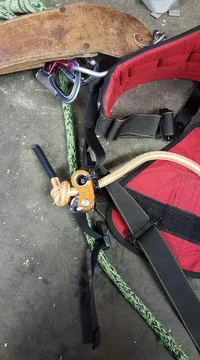
What about this not life support passes threw the paw before the lock n roll and the zip ties help keep it in line with the hole in the paw
Greg_L
Participating member
- Location
- Bloomington, IN
What treestuff is getting at is that, in the event of shock loading, the roll 'n lock in that setup on your paw could technically cut off your stopper knot completely rather than just slipping/shearing the sheath only and letting the knot catch you, resulting in an uncontrollable fall.
There are plenty here who would argue that it's a moot point...I'm just reporting the facts. Watch the video several posts up that shows ascenders being tested to failure on rope, and make your own informed decision.
There are plenty here who would argue that it's a moot point...I'm just reporting the facts. Watch the video several posts up that shows ascenders being tested to failure on rope, and make your own informed decision.
- Location
- Westminster
Can't find the video! I didn't even think about it that way. How often do we really shock load our bridge? I don't think very often at allWhat treestuff is getting at is that, in the event of shock loading, the roll 'n lock in that setup on your paw could technically cut off your stopper knot completely rather than just slipping/shearing the sheath only and letting the knot catch you, resulting in an uncontrollable fall.
There are plenty here who would argue that it's a moot point...I'm just reporting the facts. Watch the video several posts up that shows ascenders being tested to failure on rope, and make your own informed decision.
- Location
- Westminster
What if I had another stopper knot in front of the lock n roll?What treestuff is getting at is that, in the event of shock loading, the roll 'n lock in that setup on your paw could technically cut off your stopper knot completely rather than just slipping/shearing the sheath only and letting the knot catch you, resulting in an uncontrollable fall.
There are plenty here who would argue that it's a moot point...I'm just reporting the facts. Watch the video several posts up that shows ascenders being tested to failure on rope, and make your own informed decision.
New threads New posts
-
test
-
 Alternatives to standard asphalt around roots
- Started by southsoundtree
- Replies: 4
-
-

-

-
 For Sale: 2018 Vermeer BC1000XL Chipper | 918 Run Hours | Deutz Diesel
- Started by Blue Ribbon Tree
- Replies: 2
-

