
Navigation
Install the app
How to install the app on iOS
Follow along with the video below to see how to install our site as a web app on your home screen.
Note: This feature may not be available in some browsers.
More options
You are using an out of date browser. It may not display this or other websites correctly.
You should upgrade or use an alternative browser.
You should upgrade or use an alternative browser.
New Technique for Tree Removal.
- Thread starter RopeShield
- Start date


Daniel
Carpal tunnel level member
- Location
- Suburban Philadelphia (Wayne)
given the (really small) size of the pieces you are rigging, drier and lighter makes no difference..
You have no data to show that the pieces are significantly lighter, nor does it make sense to anyone familiar with trees that they should be, especially the wood..
you have no way of figuring the amount of damage done to the strength of the trunk, and are advocating sending a climber up and rigging after intentionally damaging the integrity of the trunk, wood.
I'd like to be wrong here, but that's not likely.. Come up with some data or let it go!
You have no data to show that the pieces are significantly lighter, nor does it make sense to anyone familiar with trees that they should be, especially the wood..
you have no way of figuring the amount of damage done to the strength of the trunk, and are advocating sending a climber up and rigging after intentionally damaging the integrity of the trunk, wood.
I'd like to be wrong here, but that's not likely.. Come up with some data or let it go!

- Location
- Orange, MA
It would be lighter if you removed deciduous trees in the winter time! I might be on to something here. 

RopeShield
Carpal tunnel level member
- Location
- Ontario, Canada
A Text Book of General Botany - Smith Gilbert Bryan Evans Stauffer 5th Edition The Mac Millan Company
This is elementary Botany and was taught in 1st year University at the University of Wisconsin.
There is whole chapter devoted to The Water relationship Of Plants.
This book covers the
mechanics of transpiration,
the amount and rate of transpiration,
external and external factors influencing transpiration
movement of water in plants
Forces concerned in sap flow
cohesion of water molecules
root pressure
Loss of wate in a liquid form
sap flow and the conduction of solutes
water balance in plants
You all question amount of and rate of transpiration.
Here is an example from this book. On the basis of the rate of water loss of apple shoots observed in Illinois during July, it appears that a single mature apple tree may loose 95 gallons of water per day
Experiments show that the amount of water transpired by a plant fluctuates from hour to hour, from day to day and from season to season.
External factors influencing the rate of transpiration are light, relative humidity, air movement, and soil moisture.
The factor that we have controlled(using the Xylem/girdle technique) to the best of our ability is the moisture from the root traveling up the stem to the leaves.
We have created a water deficit in the leaves, stems and wood. If you feel I am stating an untruth with this method.
I apologize for not providing more information and hope that you will seek more.
One last thing to consider is the tree structure.
We have Xerophytes, mesophytes and hydrophytes and some tree that do not fit into any one category completely.
Each type is adapted by their structure and function to live in a set environment.
What I have experienced with Ash may not be applicable to Juniper.
A tree in a drought condition will show a deficit of water and by applying our technique will manifest a greater deficit because of the loss of Xylem and the ability to transport water.
This is elementary Botany and was taught in 1st year University at the University of Wisconsin.
There is whole chapter devoted to The Water relationship Of Plants.
This book covers the
mechanics of transpiration,
the amount and rate of transpiration,
external and external factors influencing transpiration
movement of water in plants
Forces concerned in sap flow
cohesion of water molecules
root pressure
Loss of wate in a liquid form
sap flow and the conduction of solutes
water balance in plants
You all question amount of and rate of transpiration.
Here is an example from this book. On the basis of the rate of water loss of apple shoots observed in Illinois during July, it appears that a single mature apple tree may loose 95 gallons of water per day
Experiments show that the amount of water transpired by a plant fluctuates from hour to hour, from day to day and from season to season.
External factors influencing the rate of transpiration are light, relative humidity, air movement, and soil moisture.
The factor that we have controlled(using the Xylem/girdle technique) to the best of our ability is the moisture from the root traveling up the stem to the leaves.
We have created a water deficit in the leaves, stems and wood. If you feel I am stating an untruth with this method.
I apologize for not providing more information and hope that you will seek more.
One last thing to consider is the tree structure.
We have Xerophytes, mesophytes and hydrophytes and some tree that do not fit into any one category completely.
Each type is adapted by their structure and function to live in a set environment.
What I have experienced with Ash may not be applicable to Juniper.
A tree in a drought condition will show a deficit of water and by applying our technique will manifest a greater deficit because of the loss of Xylem and the ability to transport water.

- Location
- rhode island
...so where do you get the notion that it makes rigging points stronger?
RopeShield
Carpal tunnel level member
- Location
- Ontario, Canada
What are you trying to say? Significant for the climber and the rigger and the guy draggin the brush and the truck hauling it all away. If I had skid steer/bucket truck and crane it may not matter but with my operation any significant gain is most welcome.
It all adds up.
I am applying the science. What is the point you are trying to make.
A stem here in a mixed hardwood forest/Carolinian zone 4/5 is lighter when it is dried.
Mb upto 1/2 as much.
The girdle technique to the stem is simple computation based on stem diameter, sterength of wood(sapwood or heartwood) and knowledge of species(structural) and conditions presence. I am removing less than ten percent of the total stem diameter. Peanuts IMO.
We work in structurally compromized tree daily with no solid data as to its strength( amount of decay, internal hidden defects etc)
Here we are applying technique in which we controal some of variables.
Again my apologies for letting you down by not providing enough background info and quantitative observations.
I do the best I can with the time and resources i have available.

It all adds up.
I am applying the science. What is the point you are trying to make.
A stem here in a mixed hardwood forest/Carolinian zone 4/5 is lighter when it is dried.
Mb upto 1/2 as much.
The girdle technique to the stem is simple computation based on stem diameter, sterength of wood(sapwood or heartwood) and knowledge of species(structural) and conditions presence. I am removing less than ten percent of the total stem diameter. Peanuts IMO.
We work in structurally compromized tree daily with no solid data as to its strength( amount of decay, internal hidden defects etc)
Here we are applying technique in which we controal some of variables.
Again my apologies for letting you down by not providing enough background info and quantitative observations.
I do the best I can with the time and resources i have available.
- Location
- rhode island
What is the simple computation and where is the source for strength of wood. Where do you get the notion that drying out a stem to make it lighter increases its strength???? It seems to me that removing the trees natural elasticity is going to make it weaker.

RA - don't have a lot of time here this morning but a couple of points need to be covered as you are using bits and pieces of science and not their collective and accumulative properties.
Transporation rate is regulated by the tree and influenced by the environment. When more moisture is going out than coming in, lenticels close, it is like your body going into starvation mode when you cut calories. It is not quite that simple but you get the idea. Trees react the fastest to mechanical injuries so they will have a relatively quick response to a girdling cut into the xylem compared to a slower environmental, such as a weather or seasonal change.
Dry wood strength. You are still being mislead by charts and science depicting deflection rates on structural lumber. Wood beams compress and deflect less when dry. A tree, on the other hand, gains much of its strength by being able to move. If a tree could not sway in the wind or against stress....
Also a tree is not a board or beam. As a matter of fact, in the production of beams and boards, much of the tree is discarded. All of these other components are considered defects in lumber but they are part of a tree. When a tree dries, it dries from the outside in. This means shrinkage occurs first on the outer layers creating increased stress. This weakness will appear first at the outer unions of branches and attachments. This is not good for improving the safety of a removal.
When you use science, you can't pick and choose which portions of it you are going to use without creating an imbalance or a lack of understanding of what you are trying to accomplish.
Dave
Transporation rate is regulated by the tree and influenced by the environment. When more moisture is going out than coming in, lenticels close, it is like your body going into starvation mode when you cut calories. It is not quite that simple but you get the idea. Trees react the fastest to mechanical injuries so they will have a relatively quick response to a girdling cut into the xylem compared to a slower environmental, such as a weather or seasonal change.
Dry wood strength. You are still being mislead by charts and science depicting deflection rates on structural lumber. Wood beams compress and deflect less when dry. A tree, on the other hand, gains much of its strength by being able to move. If a tree could not sway in the wind or against stress....
Also a tree is not a board or beam. As a matter of fact, in the production of beams and boards, much of the tree is discarded. All of these other components are considered defects in lumber but they are part of a tree. When a tree dries, it dries from the outside in. This means shrinkage occurs first on the outer layers creating increased stress. This weakness will appear first at the outer unions of branches and attachments. This is not good for improving the safety of a removal.
When you use science, you can't pick and choose which portions of it you are going to use without creating an imbalance or a lack of understanding of what you are trying to accomplish.
Dave
RopeShield
Carpal tunnel level member
- Location
- Ontario, Canada
Agreed regarding wood flexibility!But flexibility can not be relied on as much as wood strength can be alone, they work together and at times against, the difference between sap wood and heart wood is understood
Tree will dry. Remove the roots or water or xylem h2o a deficit will occur.
A tree cannot stoP tranpiring, it can slow it down but the end resuLt is the same. An h2o deficit.
Once again many variables and opposing thoughts
I will accept a truth.
No pissing match here
Sharing info is all.
Tree will dry. Remove the roots or water or xylem h2o a deficit will occur.
A tree cannot stoP tranpiring, it can slow it down but the end resuLt is the same. An h2o deficit.
Once again many variables and opposing thoughts
I will accept a truth.
No pissing match here
Sharing info is all.
RopeShield
Carpal tunnel level member
- Location
- Ontario, Canada
Wood is very complex light, heavey, brittle or tough and is dependent on the kind and arrangement of the Xylem.
Flexibility can not be relied upon solely for support as is also applied to the strength of wood.
We are attempting a balancing act of flexibility and strength and weight reduction. All i am doing is experimenting and learning what can an cannot be done.
And my attempts will not put me, others or property at risk.
I understand how a Sycamore can be one of the largest trees in Eastern north America yet be one of the trees with extensive heart rot leaving only a ring of sapwood. Sapwood can be "strong". If you consider a species like Willow or Poplar well it is the opposite.
How about Sequioa largest living organism and some of the oldest living things on the planet. Heartwood filled with rot resisting compounds as its mechanical support.
The point is we all have something to share towards understanding the botany of trees around us.
I am learning from your observations and will do my best to apply the gained knowledge in a meaningful way.
Flexibility can not be relied upon solely for support as is also applied to the strength of wood.
We are attempting a balancing act of flexibility and strength and weight reduction. All i am doing is experimenting and learning what can an cannot be done.
And my attempts will not put me, others or property at risk.
I understand how a Sycamore can be one of the largest trees in Eastern north America yet be one of the trees with extensive heart rot leaving only a ring of sapwood. Sapwood can be "strong". If you consider a species like Willow or Poplar well it is the opposite.
How about Sequioa largest living organism and some of the oldest living things on the planet. Heartwood filled with rot resisting compounds as its mechanical support.
The point is we all have something to share towards understanding the botany of trees around us.
I am learning from your observations and will do my best to apply the gained knowledge in a meaningful way.
RopeShield
Carpal tunnel level member
- Location
- Ontario, Canada
Another variable to the issues of working in trees.
Frozen or mb just cold plant parts.
How do we understand this.
Well I know most times I prefer splitting wood if it is frozen. Southern Ontario.
I have split dry wood and it was the toughest go.
Wet wood splits somewhere in between dry and frozen but requires narrow tapered maul.
Again depending on the species of tree you are working with this may not apply at all.
What do you make of this?
Frozen or mb just cold plant parts.
How do we understand this.
Well I know most times I prefer splitting wood if it is frozen. Southern Ontario.
I have split dry wood and it was the toughest go.
Wet wood splits somewhere in between dry and frozen but requires narrow tapered maul.
Again depending on the species of tree you are working with this may not apply at all.
What do you make of this?
Daniel
Carpal tunnel level member
- Location
- Suburban Philadelphia (Wayne)
Good on you for thinking out of the box and experimenting with something new. my mind is open if you can show some data to support this technique. Seems like it wouldn't take much to get some..
cut a large limb, weigh it, let it hang from a pulley, drop a scale in line at the ground anchor, and weigh it every day until it wilts..
Try it on several different species and sizes of limbs, try it with wood.. if you wanted to get even more precise you could uproot a small tree with rootball in tact, (you might have to wait for one to go over in a storm), then wrap the root ball in plastic to slow evaporation directly from the soil, weigh the tree for a some days, then girdle it and keep weighing it until it wilts..
I wonder if you can show a reduction in weight of 25%+ at wilting. Since you have yet to girlde a tree to wilting, it seems logical that your weight reduction is going to be sinificantly less than the reduction at wilting. Significantly less than 25%, is not going to worth the trouble IMO..
For many, even 25% reduction is not going to be worth the trouble, but much of that depends on how you handle and dispose of the material.
I do not share your lack of concern for removing 10% of the wood at the base of a tree. First of all measure it and make sure that is all it is.. Secondly, there are many things in this business that are counter-intuitive, so just becasue we don't often run into problems with trees failing at the base, and 10% "SOUNDS" like a very small amount, I would not be to sure about it, especially if my life depended on it. Worst case scenario.. tree looks solid at the base, with no signs of decay ( not everyone has a resistograph) BUT the tree has significant decay.. your 10% might become 50% or more of the strength of the trunk..
I like to rig big. To do that safely, I need to judge a number of variables and how they all effect each other. The less variables I have to account for the better, and the more efficiently I can operate. If I have a defect in the overhead rigging point, or a defect in the lowering line, or an inexperienced groundie, or decay on the main stem or roots, it totally messes up my style, making the work far more stressful and dangerous. I do not enjoy having to account for any extra variables. So the idea of intentionally damaging the structure of a tree I intend to rig off is very distatesful to me.
So please come up with some data to further the discussion. It seems as though a number of others find your continued postings (with no supporting data) annoying.. If I had a dyno, I'd set it up myself..
cut a large limb, weigh it, let it hang from a pulley, drop a scale in line at the ground anchor, and weigh it every day until it wilts..
Try it on several different species and sizes of limbs, try it with wood.. if you wanted to get even more precise you could uproot a small tree with rootball in tact, (you might have to wait for one to go over in a storm), then wrap the root ball in plastic to slow evaporation directly from the soil, weigh the tree for a some days, then girdle it and keep weighing it until it wilts..
I wonder if you can show a reduction in weight of 25%+ at wilting. Since you have yet to girlde a tree to wilting, it seems logical that your weight reduction is going to be sinificantly less than the reduction at wilting. Significantly less than 25%, is not going to worth the trouble IMO..
For many, even 25% reduction is not going to be worth the trouble, but much of that depends on how you handle and dispose of the material.
I do not share your lack of concern for removing 10% of the wood at the base of a tree. First of all measure it and make sure that is all it is.. Secondly, there are many things in this business that are counter-intuitive, so just becasue we don't often run into problems with trees failing at the base, and 10% "SOUNDS" like a very small amount, I would not be to sure about it, especially if my life depended on it. Worst case scenario.. tree looks solid at the base, with no signs of decay ( not everyone has a resistograph) BUT the tree has significant decay.. your 10% might become 50% or more of the strength of the trunk..
I like to rig big. To do that safely, I need to judge a number of variables and how they all effect each other. The less variables I have to account for the better, and the more efficiently I can operate. If I have a defect in the overhead rigging point, or a defect in the lowering line, or an inexperienced groundie, or decay on the main stem or roots, it totally messes up my style, making the work far more stressful and dangerous. I do not enjoy having to account for any extra variables. So the idea of intentionally damaging the structure of a tree I intend to rig off is very distatesful to me.
So please come up with some data to further the discussion. It seems as though a number of others find your continued postings (with no supporting data) annoying.. If I had a dyno, I'd set it up myself..

- Location
- Longmont, CO
So, I was thinking of this thread today. I suppose some studies could be done pretty easy.
Let's say a small tree (under 10 years old) had to be removed. If you had a neighboring large tree you could install a block above the smaller tree, make one stump cut, lift the whole tree with a GRCS, while having a rope dynamometer attached between the rigging of the tree and the block.
Then, you could record the green weight, come back every day and see how much it looses weight each day.

Let's say a small tree (under 10 years old) had to be removed. If you had a neighboring large tree you could install a block above the smaller tree, make one stump cut, lift the whole tree with a GRCS, while having a rope dynamometer attached between the rigging of the tree and the block.
Then, you could record the green weight, come back every day and see how much it looses weight each day.
- Location
- Longmont, CO
[ QUOTE ]
AWESOME! YES!!! that would be great if mainstream life did not dictate that you needed to work and produce every day.
I will do this test if I win 1.5 billion dollars in the lottery.
[/ QUOTE ]
Exactly.

AWESOME! YES!!! that would be great if mainstream life did not dictate that you needed to work and produce every day.
I will do this test if I win 1.5 billion dollars in the lottery.
[/ QUOTE ]
Exactly.
RopeShield
Carpal tunnel level member
- Location
- Ontario, Canada
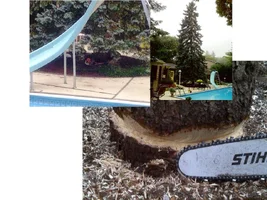
Here are the results from the evergreens.
Picea pungens var gluaca girdle.
Colorado Spruce Girdled33.2lbs and 50.4lbs not girdled.
Both trees saw significant rain the days before the removal.
Girdled tree was left standing for approx. 3 weeks.
Both trees approximately same age, height and health.
Girdled tree specifics ~ 20'diameter bed with some annuals planted and muclched, Back yard with pool and surrounded by concrete in root zone, typical root flare all intact, surrounded by large mature trees and sheltered by the home, SW exposure, not ideal for drying conditions.
Spruce not girdled was in front yard in turfless landscape with many ornamentals, street exposure with minor sheltering on the west side otherwise full exposure. Some rot on the stump cut.
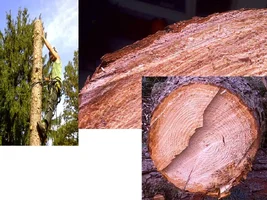
I cut pieces 12" diameter by 12" long and weighed on a bathroom scale. The girdle piece was cut with a bit of slant so was a bit bigger and the non girdled was a bit fatter towards one end. All in all I wood say the measures are plus or minus a few pounds. Oh well I did my best.
Other observations;
The girdled tree had far less resin at most of the cuts oozing out and the top 10' seemed closer to typcial weight. Bit curious but seems as the top was drying out more slowly. Not sure? Added benefit here is less sappy wood to handle.
Definitely much lighter wood and the branch handling in the tree was pretty easy and many times cut and handled tow at the same time.
I like this and will continue with the practice.
The big freeze is on its way and so the new technique may not be applied till 2012.
BTW I found this best tool for cleaning up the sap from the body is the sanding sponge. Works almost to well as it takes the hair off the arms and makes the skin a little tender. Works great and watch the skin!
Thanks all.
Picea pungens var gluaca girdle.
Colorado Spruce Girdled33.2lbs and 50.4lbs not girdled.
Both trees saw significant rain the days before the removal.
Girdled tree was left standing for approx. 3 weeks.
Both trees approximately same age, height and health.
Girdled tree specifics ~ 20'diameter bed with some annuals planted and muclched, Back yard with pool and surrounded by concrete in root zone, typical root flare all intact, surrounded by large mature trees and sheltered by the home, SW exposure, not ideal for drying conditions.
Spruce not girdled was in front yard in turfless landscape with many ornamentals, street exposure with minor sheltering on the west side otherwise full exposure. Some rot on the stump cut.
I cut pieces 12" diameter by 12" long and weighed on a bathroom scale. The girdle piece was cut with a bit of slant so was a bit bigger and the non girdled was a bit fatter towards one end. All in all I wood say the measures are plus or minus a few pounds. Oh well I did my best.
Other observations;
The girdled tree had far less resin at most of the cuts oozing out and the top 10' seemed closer to typcial weight. Bit curious but seems as the top was drying out more slowly. Not sure? Added benefit here is less sappy wood to handle.
Definitely much lighter wood and the branch handling in the tree was pretty easy and many times cut and handled tow at the same time.
I like this and will continue with the practice.
The big freeze is on its way and so the new technique may not be applied till 2012.
BTW I found this best tool for cleaning up the sap from the body is the sanding sponge. Works almost to well as it takes the hair off the arms and makes the skin a little tender. Works great and watch the skin!
Thanks all.
RopeShield
Carpal tunnel level member
- Location
- Ontario, Canada
RopeShield
Carpal tunnel level member
- Location
- Ontario, Canada

frashdog
Branched out member
- Location
- Champlain valley, adirondack coast
Sorry I do not buy it.
You girdle tree, three days later it is not wilted and you think it is significantly lighter? Stab it with a moisture meter and get back with us. If water poured out when we cut trees you might be on to something and you probably would be telling us something we already knew.
I cut a lot of ash. Going to be cutting a lot more when the eab shows up. I will not ever trust dead ash holding wood. Too brittle. I have had it fail so many time prior to notch closure I simple can not ask much of it. Dead elm would be the opposite. I'll ride an elm to the ground with some thick holding wood left.
You girdle tree, three days later it is not wilted and you think it is significantly lighter? Stab it with a moisture meter and get back with us. If water poured out when we cut trees you might be on to something and you probably would be telling us something we already knew.
I cut a lot of ash. Going to be cutting a lot more when the eab shows up. I will not ever trust dead ash holding wood. Too brittle. I have had it fail so many time prior to notch closure I simple can not ask much of it. Dead elm would be the opposite. I'll ride an elm to the ground with some thick holding wood left.
New threads New posts
-
test
-
 Alternatives to standard asphalt around roots
- Started by southsoundtree
- Replies: 4
-
-

-

-
 For Sale: 2018 Vermeer BC1000XL Chipper | 918 Run Hours | Deutz Diesel
- Started by Blue Ribbon Tree
- Replies: 2
-
