
New Technique for Tree Removal.

I think it's too bad that there is so much initial adversity to this idea. I mean, you won't cut holes in any of my removal trees, but there is a high potential for merit from this type of creativity.

I had a couple of thoughts:

1) Ash probably isn't the best species for any preliminary experimenting because it retains such a low amount of water in the stem. I know folks who heat their homes with firewood and burn w. ash right off the stump. I have attached a speadsheet I made quickly using values from http://www.engineeringtoolbox.com/weigt-wood-d_821.html. You can see that for white ash, the dry weight is 85 percent the green weight. Taking a quick look across all of the species (I only chose a few to represent some sort of spectrum), you'll see that nothing else really comes close (not even cedar!). I would be more impressed if there were noticeable differences after your treatment on a species with a higher green moisture content.


2) A quick search for "water volume transpiration" on scholar.google.com found several applicable scientific documents. The first being http://treephys.oxfordjournals.org/content/3/4/309.short which in the abstract indicates that there are measurable volumes of water (or sap) moving on a daily basis and tree physiologists are interested in this stuff. I am sure there is quite a lot more information out there and if you wanted to do more detective work you could probably determine some rough value for the amount of weight you might actually be saving.

That being said, these are a couple of things that had immediately come to my mind following the discovery of this discussion. Book smarts won't ever substitute experience when it comes to engineering a tree removal; there are a horde of reasons why cons might not [yet] outweigh the pros with this treatments. I hope this is interesting and/or valuable in some way.
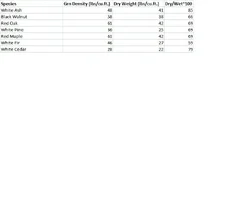
 

Attachments

  • 301144-Weight.webp
    301144-Weight.webp
    11.5 KB · Views: 60
Here is the post about the Spruce girdled and not girdled with weights. [ QUOTE ]
Here are the results from the evergreens.
Picea pungens var gluaca girdle.
Colorado Spruce Girdled33.2lbs and 50.4lbs not girdled.
Both trees saw significant rain the days before the removal.
Girdled tree was left standing for approx. 3 weeks.
Both trees approximately same age, height and health.

Girdled tree specifics ~ 20'diameter bed with some annuals planted and muclched, Back yard with pool and surrounded by concrete in root zone, typical root flare all intact, surrounded by large mature trees and sheltered by the home, SW exposure, not ideal for drying conditions.

Spruce not girdled was in front yard in turfless landscape with many ornamentals, street exposure with minor sheltering on the west side otherwise full exposure. Some rot on the stump cut.

I cut pieces 12" diameter by 12" long and weighed on a bathroom scale. The girdle piece was cut with a bit of slant so was a bit bigger and the non girdled was a bit fatter towards one end. All in all I wood say the measures are plus or minus a few pounds. Oh well I did my best.
Other observations;
The girdled tree had far less resin at most of the cuts oozing out and the top 10' seemed closer to typcial weight. Bit curious but seems as the top was drying out more slowly. Not sure? Added benefit here is less sappy wood to handle.

Definitely much lighter wood and the branch handling in the tree was pretty easy and many times cut and handled tow at the same time.

I like this and will continue with the practice.
The big freeze is on its way and so the new technique may not be applied till 2012.

BTW I found this best tool for cleaning up the sap from the body is the sanding sponge. Works almost to well as it takes the hair off the arms and makes the skin a little tender. Works great and watch the skin!

Thanks all.

[/ QUOTE ]
 
^^That's pretty interesting. Nice methods, if you increase your sample size you could have some publishable results!
 
Hey, thanks Shanker for the input it is much appreciated!
Welcome to the buzz!

The new year will be interesting and I will definitely keep on girdling.
I remember my first girdle other than the thousands of purging buckthorns. I really questioned the whole thing, was this something I really wanted to do? Alot like spurring up a tree and with knees knockin and adrenaline pumpin. And armed with a bit of info and practical knowledge I just went for it.Gettin the 260 out of truck and walkin up to the split Ash then cuttin past the 3 or so rings of Xylem seemed really rebelious.

At this stage of my life I do not need to see more road blocks just interested in making my work a bit easier.

I am sure this technique will help, mb not all the time, mb just enough and mb better than I expect.
Either way it has been a pleasant suprise and I mean not only the technique but communicating with thoughful people like yourself, Shanker.
smile.gif


Cheers
beerchug.gif
 
http://www.engineeringtoolbox.com/weigt-wood-d_821.html

Key point to remember is when the difference between green and dry is say only 10lbs for 12" piece than the handling or rigging of a 10' piece is 100lbs.
This is what is significant for me.
Apply the weight savings with this technique over a large removal and then over a few removals.
If you handle, cut, rig and truck wood and mulch than 10, 20, 30 and in some woods 45% less weight can amount to 100 to 1000lbs or more over the whole removal.
Also what i understand now is if you are engineering a removal and the dynamic bending strength of the wood is a variable then what most are saying here is that this needs to be or should be included into the equation especially on species of trees where the difference between wet and dry weight and wet and dry dynamic wood strength is great.

Another lost factor in the equation is cycles to failure of the wood(dry or wet mb even frozen)?

See, initially I decided to do this technique to make things easier for myself/back and in away I have.
All things in life are elemental and ruled by energy.
Being proactive or applying energy early into a system generally affords saving towards the final outcome.
Be prepared

http://www.youtube.com/watch?v=S7RyiwHVZdQ
laugh.gif
 
Dr Paul Cooper sharing some of his experince with predrying wood with us.
http://www.forestry@utoronto.ca/treated_wood


Thanks Thomas:

A few thoughts from our experience: Many years ago I did a study on "transpiration drying" of aspen. In this case, trees were completely severed and weighed over a period of a few days. The leaves pulled the water from the sapwood quickly for 3-4 days, then the leaves started to wilt and there was no further gain. In one case, a tree weighing 900 pounds lost 200 pounds of water in 3 days. These trees had relatively thick sapwood and the effect will be less in trees with thin sapwood and especially in ring porous species like ash since most of the sap flow is through only a few outer rings. So I can believe significant mass loss can occur, especially in the limbs/top where the sapwood makes up a much greater part of the total volume and the leaves will also lose moisture.
However, it is unlikely that strength would be affected since wood starts to become stronger only below "fibre saturation point" moisture content (about 30%MC) when the wood starts to shrink and this will not be reached by this effect and over such a short time.
By the way, this will not work nearly as well in softwood trees.
Regards
Paul Cooper
Professor
Wood Science


Depending on your depth of interest you may want to look at Panshin and deZeeuw Textbook of wood technology (very detailed) or an excellent reference is the USDA Wood Handbook (available free on line but I do not have the URL handy as I am out of Toronto on Research leave).
All the best.
Paul

Quoting thomas <thomas@kingtree.ca>:

> I was searching U of T and thought this may interest you.
>
> My tree girdling technique
>
> http://www.treebuzz.com/forum/showflat.php?Cat=0&Number=293740&page=0&
> fpart=
> 1&vc=1
>
> Cheers
>
> Thomas
 

New threads New posts

Back
Top Bottom