New Technique for Tree Removal.

RopeShield

Carpal tunnel level member
Location
Ontario, Canada
http://www.treebuzz.com/forum/showflat.p...true#Post293726

Above is the original post for your background information. The technique has taken alot of criticism but I felt it necessary for further experimentation.
No quantitative observations and our qualitative observations suggest to continue experimenting because the findings are as predicted.
Lighter and stronger wood for rigging off of and for climbing/working on.
Here it is, our video of girdling a tree to make it lighter and stronger.

http://www.youtube.com/user/Ropearmour#p/u/5/P59L8lOxklY

What do you think?


As well the use of the Belay Spool/OLDs(thanks TB), LockJack and my favorite big saw the Stihl O66
grin.gif
.

Lets all play nice and have a buzz.
smile.gif
 
Rope,
You seem like a good guy, so hope you take this as constructive criticism. There is no way that the weight of the wood was significantly reduced in 3 days.. nor did the leaves show any sign of wilting, which would seem to indicate that there was no significant loss of moisture in the limbs. You need a little more something than the groundies thought the pieces felt lighter to support the technique.. I'd start by cutting a green limb and weighing it.. then weigh it again three days later to see if even that makes a significant difference..

Your claim that this somehow makes the tree stronger, makes no sense to me.. Clearly the base of the tree has become MUCH weaker from the cut. You were rigging very small pieces to begin with.. If I was rigging big pieces in a similarly compromised tree, especially ash which splits easily, I'd always have one more factor of the compromised base to contend with, which is not something I would care to do. If you are going to rig small pieces what difference does a small percentage of their weight really make??

I cut a tree a few years ago, that had been completely girdled by the customer, yet it was looking 100% OK in the canopy.. I later heard that girdling a tree takes some time, a year or more to kill it. So I doubt that three days is making any difference at all.

I commend the creative thinking, but have to vote NO on this one..
 
I haven't followed the other thread. I don't have much of an opinion one way or the other yet. But a few things definitely concern me.

First is having a climber in a tree with an intentional defect in the trunk. I suppose on a case by case basis this could be done safely provided great care was taken to cause only wounding just deep enough for the desired effect.

Also, you say the tree is stronger because it's dry. I dunno about that. I'd have to see some break test data to confirm that. One things for sure though, the tree will be much less flexible. And, to me, that sounds/feels a whole lot like saying the tree is more brittle. I'd rather a tree I'm climbing flex a lot and not break rather than flex very little then break in half.

I also was confused by waiting only three days after girdling. Seems to me that wouldn't be much time to dry out. But, you would know better than I, having done the removal. Like Daniel said, some scientific data would help substantiate that.

Also, dry wood fibers act very differently than do green wood fibers. I'm speaking specifically here about hinges (although other instances certainly pertain, simple things like how your gaffs penetrate dead wood versus live wood, species in question, etc.). I'm not sure dead wood characteristics are necessarily desirable very often. Again a case by case determination to be made I suppose.

I think the idea is interesting. Perhaps there's a 1 in 1000 use for this method. Another tool in the box maybe? I'd be interested to see your further experimentation. Just be safe about it.

Daniel, I'm surprised by your response. I fully expected you to commend his thinking outside the box here.
 
Hey Dadio
Thanks for your thoughts.
This is more than traditional girdling. We removed Xylem/rings of wood that is much different than what you are describing.
I used the belay spool/Olds in the tree to get a positive feel for wood weight.
Rigging large or small pieces as you know add to the cycles of failure to the rigging point etc. and most of the time my tie in point.
Reducing weight and adding strength is key to this technique.
I had no splits in the Ash and cut one large limb i expected to split.
Lack of water in the wood would have helped to prevent this because water creates the forces to shear the fibres of wood.
This is practical science not my own theories.
I am only a applying what is known.
smile.gif
 
IF the wood had dried out enough to lighten in weight which could maybe only happen when hot and windy (maybe)doubt it

but if it did dry out that much i would tend to think it would also not react as live green wood , as far as hinging etc.??

BUT in 3 days wouldn't matter one way or another usually a tree that is girdled correctly takes one year to season ; that is
girdle it today , harvest seasoned firewood next year
 
Where is this information coming from?
If dry wood is the cause of SLD than limbs would be falling much more during a drought.
Is there some new study or research being done presently on this subject?
The stem girdling/removal of Xylem either a. dries the wood or b. does not. I have proven to myself it does(significantly). Drier parts of the US may fear this technique more so than wetter states.

I have a client in the hammer that heard a cannon shot go off. 20" dbh Gleditsia limb shed in the heat of the day. The limb was structurally compromised and the shedding followed a rain. Might be Sld. I dunno.

I have two Colorado spruce removals coming up. I will girdle them and Keep y'all posted.

We seem to have alot of opinions at both ends.

This technique could help a researcher to try to force a Limb drop?
 
You know the Ash cut like dry/dead wood from stem to stearn.
More tree gunk on the chain. Less moisture/lubrication than wet wood.
When it hit the ground it sounded more like bonk and less like a thud. Drier than wetter. You know the sound of dead wood being tossed into a pile type of sound.

Not your typical girdle this is.
 
Around here dry trees break easier. Drought dry trees are more prone to T.I.P. breakage from what i was taught by four very experienced arborist with 125 years of experience between the four of them. One worked with Dr. Alex Shigo for a time from what i understand and was the first certified arborist in mempho. His name is John Gaff he is 84, i think, and has been in the business since the start of the sexual revolution. The next is Mark Culver, Mempho's top climber since the mid eighties; he's not a certified arborist, but that is just because he likes to buck the system. Mark started climbing in 1977, he's 52, i think, and still climbing like a rockstar. Wes Hopper, started climbing in 84 for Davey tree and went through dits, and has held all kinds of positions with the tn urban forestry council and the southern chapter, he still climbs on occasion and consults on a daily basis and also teaches the certified arborist classes in mempho; Wes is 48 and still a rockstar. Greg Wiggens started climbing full time in 94 after retiring from custom cabinet making and a long time of doing tree work on the side, Greg is not a certified arborist but could pass the test with ease. Greg is 60 years old and still kicking it hard. When that much experience tells me that dry trees break easier due to voids in the cells filled with air that are normally filled with water (air compresses and water doesn't), then i listen.
 
I'll take a live tree over a dead tree any day to remove. I hate climbing dead trees. Many times dead trees are harder to penetrate with gaffs, and in some trees, can be a lot harder on a chain saw(i.e., dead Pin Oak is way harder and tougher to cut then live Pin Oak)

Like others have said, dead trees are way more brittle also. I always take smaller pieces when working with dead trees, because I don't want to put a ton of force on my rigging point, and plus, with dead wood, hinges can react way differently, and can thus lead to less control of a piece. I'd prefer to be more in control of a piece I'm rigging than less.

Even with the girdle, how much weight do you really lose? Like others have said, try to get some sort of formula or ratio down to back up your theories to show a weight reduction. We need hard evidence, not opinions.

Even with the weight reduction though, you still have to take smaller pieces due to dead wood being more brittle like I said earlier, so you pretty much counter-act yourself there. I'll balance huge limbs and gently swing them into the rope any day on a live tree, but I'll take the time to piece the same limb out on a dead tree. Going that route, you're actually adding time to a job, making you less profitable.
 
[ QUOTE ]
Undoubtedly. Keep on keepin on, dude. Either this will bear fruit or the flower will be gobbled by some evil roaming deer (the kind that eats stargazer lilies from my garden...bassturd).

[/ QUOTE ]

Thanks men!

The trees I removed were still alive and there was still moisture and mb technically they would be considered dead they are actually alive with photosynthetic and respiratory activity and therefore water/water based compounds.

The point about air and water is one I hope to understand fully and completely. If you can share the science behind this statement it would be greatly appreciated.


If we consider the florist who recuts the rose and places it in a tube of sugar solution so that it will last longer. Prolonging the wilting and life of the Rose. Or the removed branches from a pruning that are left for any time will wilt.

I haven't taken a tree to the wilting stage.Yet.
My attempts are to reduce the weight and add strength to a tree or limbs.
I am quite certain that water will add strength to a cell but only to a point. It would depend on the cells primary function and the amount of pressure applied to said cell.

All Wood engineers agree wood is at its stronges with a low moisture content. I can't argue with factual science.

The opposite of drying is also occuring now that I am thinking about this and talking out loud.

There would most likely be greater concentration of sugars/starches and other phytochemicals because the phloem transportation to the roots has been severed.

This may be why the saw chain seemed to have more tree residue than normal.

Interesting. Yes/No

Some real quantitative type observations wood be nice but I am more hands on getr done type than pushin paper type.
I'll do my best with the next ones.

Please accept this figuratively and literally they both apply.

The work we do is a real balancing act. And this new technique will be aswell.

Spent some time on other sites trying to understand SLD. Again alot of debate and nothing conclusive.

Mother nature, a blessed force.
We, Forever to be her humble servant.
With out stretched arms
And a love forever reaching the stars.

A greater understanding of this technique may be in extending the life of a tree rather than its removal.

Thanks DylanClimbs for helping me to get back on the track of what this is really about. The truth in what we trust our lives in and with.
wink.gif
beerchug.gif
 
Your hinge wood point is very real.
I am sorry I couldn't get the video for the fall. I was in the truck and Drew was keepin an eye on things.

Suprisingly or maybe not the tree was very stubborn.
Drew said it may have been 45degrees or less till the hinge wood finally let go.

Ram 2500 5.7l Hemi, 4 high with about a ton of chips in the back and I kinda remember throttling up to around 2500 0r so Rpm.

I have cut alot of Ash over the years and my experience would suggest the hinge held really well. Drier.
It goes back to less water in the wood being compressed and therefor less shearing the fibres and thus stronger wood.

THINKING OUT LOUD. I guess sapwood could be stronger with moisture. Live cells or water conducting cells could be stronger due to elasticity or slipping when tensioned or compressed. Might one consider cutting out the heartwood and using sapwood for the hinge because it is more elastic, flexible?

Interesting thought? Yes or No

When I think of limbs I have snapped or am trying to snap there is no real blanket statement.

When I started my biz with just s truck and trailer I spent alot of time condensing branches into nice brush piles. Still do alot of this because chainsaws are annoying at times.

Alot of times I remember giving up on the dead ones but also clearly remember bending some limbs to the point of giving up.
Species is also an important variable.

I will do my best to be safe and understand that over confidence can lead to misjudgement.
Thanks Chewbacca
smile.gif
 
I've recently come across a large (20"+ DBH) gingko tree that had been mulched for its entire life too deeply. The root flare is completely girdled all the way around, with some callus development, but not much. No water is getting up to this tree, nor has it for several years. The tree is still leafing out by stored water in the trunk and branches, and is exhibiting classic cases of dieback from the tips of all of the branches. Leaf canopy is now down to the inner part of the tree, probably 25% of it's former self, and it is turning early, naturally. It does have somewhat of a bud set for next year, which I'm betting will probably be its last year, if we don't remove it first.

My point here is the tremendous quantity of stored water in the trunk and branches, allowing the tree to keep fighting. Three days of girdling is nothing in my experience. Even in my retail garden center days, a small 2" tree planted the previous year girdled by mice in the winter wouldn't die until the following July.

Tim
 
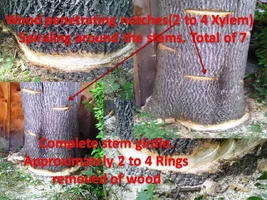
I have attached photos of the girdling we performed.
We did the exact same to two other Ash but left them for a couple more days.
Same results. Drier lighter.

I did a medium size Picea pungens Friday and will be interested to see what a conifer does.

Actual removal of Xylem/growth rings is the key difference to what you have observed.
 

Attachments

  • 294691-AshGirdle.webp
    294691-AshGirdle.webp
    220.3 KB · Views: 136
It's an interesting concept. I think it has valid points.

But, I think the variables/questions that come up outweight the practice.

However, if there were some extensive studies on this to perfect the practice, it may prove to be effective.
 
[ QUOTE ]
I have attached photos of the girdling we performed.
We did the exact same to two other Ash but left them for a couple more days.
Same results. Drier lighter.

I did a medium size Picea pungens Friday and will be interested to see what a conifer does.

Actual removal of Xylem/growth rings is the key difference to what you have observed.

[/ QUOTE ]

by the time you got that girdling done, i could have nearly had the tree removal done, on the first visit!
avid.gif
 

New threads New posts

Back
Top Bottom