My dislike for bradford pear trees

GOD Almighty put trees on this earth for lots of reasons and gave men free will as well.

Amen!

re support and subordination, after reading the March 2011 AUF piece (not attachable here) I switched to swages and aircraft cable; ~$15 in mtls for 2 cables. The research seemed biased agamst through-cabling (see the last pic and Conclusions), but gave a very useful look at the fasteners.
"When two swage stops and a washer were installed on the
cable, the failures occurred near the listed breaking strength of
the cable (7.6 kN) with oaks. This level of force was not significantly
different from the peak force associated with eyebolt
terminations."
So, the same amount of support (1600#) can be added with a fraction of the wounding and cost and time required and brush to manage and, best of all, conserves the appearance and other benefits from a full crown.
 
Last edited:
Nearly all of the pears in the SF bay area are getting munched by fire blight right now, even disease restaurant ones. I have pruned it out on a few, but it doesn't last long with all of the other trees unpruned. Yes, we have a drought on, but it always seems to rain every year when they are in bloom!
 
I'll start by saying...no I won't. But I will say, ...oh I just can't come up with anything nice to say about the Bradford. I have heard that the bradford pear isn't as heinous if it grows as an understory plant. They are not as likely to develop their typical, plethora of weak unions etc. Ironically, I think this dense, clustered, upright growth is what the Bradford was cultivated for. These trees are nothing but a bad idea. For all that is invested in keeping them together, they only live so long and out of that short time they only have a brief window where they look somewhat pretty. They stink in every way.

But as far as topping them... Their 'natural' growth reminds me of a topped tree...so you can't do much worse.;) But, they are a 'fruit' tree and can be pruned low and orchardy... I wouldn't go as far as topping, but taking them short and lateral seems to help. However, this defeats their purpose of being 'suitable' for streets, parking lots, and tight urban settings. I find that I have to use 'bunny ears' a lot when discussing the 'Bradford'.

Anyway, I have plans to go back in time, if I ever get the opportunity, and stop whomever :sir: cultivated this particular Callery Pear.
 
But I must admit, I was a hypocrite once and hat racked one. The client had to beg me though. It was in her back yard, crowded out by other trees, and had already been done once by another contractor.

Nah, haven't been back to see the Bradford but I'll take a look soon.
Same thing happened to me 20 years ago.. 2 big brad pears just off the back patio. Customer talked me into a hard topping prune. 3-4" cuts with a bunch of little stuff growing in between. Maybe 15'+ off the tops... Went back a couple of years later than they looked great. SO pear is a fruit tree and responds much differently to topping than your average hardwood. Think apple tree..... they do well with a hard topping. Went back a coupe times to repeat the procedure and the trees continue to do well.

And I AM with Guy on this one.. We gotta get outside the ANSI box from time to time. Another GREAT MOVE on brad pear is to use retired climbing lines to loosely circle the upper canopy. Not much point in putting in 5 cables in such tight quarters when one old rope works just fine. Materials are about free and its fast and effective. Been doing this for 15 years and have yet to see one fail.
 

I will cut and paste the article here so nobody has to leave this site!:)

http://www.greenvilleonline.com/story/life/2016/03/21/curse-bradford-pear/82070210/

"The Curse of the Bradford Pear
Durant Ashmore
All those white blooming trees you see everywhere... do you think they are pretty? If you knew what they actually represent, you would choke on your morning coffee and gag on your scrambled eggs. All those white blooming trees you see now are an environmental disaster happening right before your very eyes.

I’m talking about every white blooming tree right now, with only the exception of wild plums, which is a short multi-flora tree that seldom reaches over eight feet in height. All the other white flowering trees in today’s environment are an ecological nightmare, getting worse and worse every year and obliterating our wonderful native trees from the rural landscape.

If it’s blooming white right now, it’s a curse. This dictum especially applies to that “charming” Bradford pear your dimwitted landscaper planted in the middle of your front yard. Indeed, lack of smarts is what has led to this disaster. Bradford pear is worse than kudzu, and the ill-conceived progeny of Bradford pear will be cursing our environment for decades or possibly centuries yet to come.

When Bradford pear was introduced as an ornamental in 1964 by the US Department of Agriculture, it was known then that this tree possessed the weakest branch structure in nature. Also, the tree was assumed to be sterile. Bradford pears will seldom last more than 20 years before they bust themselves apart at the seams. That’s actually the good news.

In an attempt to extend the lifespan of this despicable tree, other varieties such as Cleveland Select, etc. were introduced. These trees will live for about 25 years. That’s little consolation for the resulting disasters that happened when these other pear varieties were introduced.

After 25 years the ill effects of the steep v crotch branch structure – which all pears possess - take their inevitable course of action and cause pear limb structures to crack, split and bust. You can’t fool Mother Nature, and people who plant pears will sooner or later regret that choice. Planting pears borders on - if not crosses the line – of negligence.

However, the fact that Bradford pear trees are short lived and dangerous is not the real reason that these trees are such a disaster. The problem is that these trees are in fact not sterile. No two Bradford pears will ever reproduce among themselves, but they do cross pollinate with every other pear tree out there, including the Cleveland Select pear trees that were meant to be the salvation of flowering pears everywhere. The introduction of other pear varieties has compounded the problem to the point where it is almost too late to rectify.

Because of the cross pollination problem, pear trees have now proliferated exponentially across our environment. And, to make matters worse, the evil offspring has reverted to the ancient Chinese Callery pears which form impenetrable thorny thickets that choke out the life out of pines, dogwoods, maples, redbuds, oaks, hickories, etc.

When you see those fields of white flowering trees, please don’t get giddy with excitement over pretty white flowers. What you are looking at are Callery pears destroying nature. Callery pears have 4 inch thorns. They can’t be mowed down. Those thorns will shred John Deere tractor tires. They can only be removed by steel tracked dozers, decreasing the value of agricultural or forest land to the tune of $3,000 per acre.

And, make no mistake about this. That solitary Bradford pear growing in your yard is what caused this problem. Your one tree has spawned hundreds of evil progeny. If you don’t believe that, just take a little ride, and notice all the white flowering trees blooming these days. The closer they are to “ornamental” Bradford pear trees, the thicker they are.

If you want to save the world, cut down your Bradford pear trees. I could not be more serious about this.

For those of you who are regular readers, you have read this before. For you first time readers, welcome to the club. This is my annual “Bashing of the Bradfords” column. I appreciate all the support I have had in this campaign from readers who have sent me pictures of cut down Bradford pears and ground up pear stumps. It does my heart good to know that the message is getting out.

If you ever go visit a plant nursery and want to know if it is a good nursery or not, ask if they sell Bradford pears. All reputable nurseries are well aware of the evils of this tree, and refuse to sell them. Don’t let someone talk you into a Cleveland Select or other pear tree, all varieties of “ornamental” pear trees are equally bad.

Save the world. Eliminate Bradford pear trees. Enjoy your coffee.

Columnist Durant Ashmore, MLA, of Fountain Inn
durantashmore@aol.com"
 
Same thing happened to me 20 years ago.. 2 big brad pears just off the back patio. Customer talked me into a hard topping prune. 3-4" cuts with a bunch of little stuff growing in between. Maybe 15'+ off the tops... Went back a couple of years later than they looked great. SO pear is a fruit tree and responds much differently to topping than your average hardwood. Think apple tree..... they do well with a hard topping. Went back a coupe times to repeat the procedure and the trees continue to do well.

And I AM with Guy on this one.. We gotta get outside the ANSI box from time to time. Another GREAT MOVE on brad pear is to use retired climbing lines to loosely circle the upper canopy. Not much point in putting in 5 cables in such tight quarters when one old rope works just fine. Materials are about free and its fast and effective. Been doing this for 15 years and have yet to see one fail.


Great post, Daniel! Thanks for the long-term view of the result of topping on a fruit tree. Really interesting stuff. I like the rope idea, too.

Tim
 
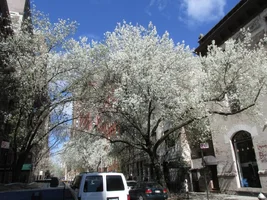
I know this subject is beat to death and no, I'm no advocate for the evil Bradford pear. I just couldn't help thinking about this thread while walking through Greenwich Village and the Lower East Side this week.
 

Attachments

  • Bradford pear 3Apr16r.webp
    Bradford pear 3Apr16r.webp
    240.6 KB · Views: 20
If it weren't for the "escapement" into the wild issue, I'd say the failure comes in most part to the nursery practice that leaves them with the worst structure for longterm integrity.

I've heard the phrase, "No one can kill a tree quite like a nursery can." That sentiment pretty much holds true if plants are bought, installed, and walked away from. Good selection, structural pruning, and continued care could keep any tree healthy!

Yes, they naturally form tighter upright unions, but the nursery is where they get 5 or 6 codoms at waist to chest height. If structural training went on with regular dosage, they could actually form decent crowns...that is, if they didn't all want to escape and take over the world!

So, top them? Assuming the tree is a liability, I'd go with these options in this order:
- Remove & Replace (with something better).
- Pollard.
- Go back in time and nip it at the bud.
 
Bradford pears getting a bad rap I have no problem with them they are planted all over near me and every heavy snow or ice storm they come down like crazy giving me plenty of work.
 

New threads New posts

Back
Top Bottom