My $60 air cannon line launcher....WOW!!

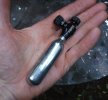
Here is the little tire inflator. It cost about $15. and uses the threaded type cartridges. I get three 60 psi shots from one 16g cartridge. They are a dollar or two apiece, depending on how many you get at once and where. I get them 20 at a time on eBay. I can reinflate my mountain bike tire in seconds. It has a precision on-off valve to control the pressure.
inflator.jpg
 
Here is the little tire inflator. It cost about $15. and uses the threaded type cartridges. I get three 60 psi shots from one 16g cartridge. They are a dollar or two apiece, depending on how many you get at once and where. I get them 20 at a time on eBay. I can reinflate my mountain bike tire in seconds. It has a precision on-off valve to control the pressure.
View attachment 79055

Excellent. Thank you for the write up. The Rainbird valves are available at Amazon and even cheaper off the shelf at Lowes. I've got one of those CO2 inflators in my dirt bike riding vest, so that's next! :-)
 
My old Weaver throw bag started coming unstitched on one seam, so I wrapped some small braided fishing line around it for reinforcement. Now it's easier to load, and it still fits close enough for good range with Notch 2.2mm Acculine.

I'm working on a mount for an old Galaxy Player to use as an aiming device. It's smaller than a typical cellphone, and it's got a front-facing camera that gives a correct image for sighting along the barrel with the air chamber resting on the ground.

The brass street elbow I put between the trigger and the valve is working well, and it eliminated the need for a trigger guard.
 
The Forest products Lab in Madison Wisconsin has one that shoots 2x4s through walls... They use it researching better ways to build walls to withstand extreme winds.
 
holy moly ! I have made in the past an air cannon that used a rubber racket ball as a projectile which was not intended to throw a line. The ball was loaded at the top, and then a cap was screwed down over it, which made a seal, then as the air chamber was charged, as pressure built up, the ball was forced through an aperture until it suddenly popped out to an impressive height. It would often leave the cannon spinning and its trajectory would follow a somewhat unpredictable path, so it was important to aim it straight up if you hoped to recover the ball.

 
UPDATE: No-loss fill adapter now works.

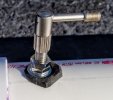
Yesterday I tried using a Topeak Pressure-Rite Schrader Valve Adapter on the cannon. These little inexpensive adapters minimize air loss to a pound or two when you disconnect the pump. This is especially useful with compressors that have long hoses and screw on connectors. You can lose up to 15 psi unscrewing these on some valves/pumps. This is due to the relatively small volume in the air chamber. In a big truck tire, a small amount of air loss doesn't noticeably affect pressure.

Yesterday the adapter wouldn't press in the valve core inside the Schrader valve enough to let air in, so I scrapped the idea. But I knew these things work and use them when filling my dirt bike shocks.

This morning it occurred to me that the cheap Schrader valve I cut off an innertube might not be designed to the exact specs of a $500 motorcycle shock. Pulled out a file and took a little metal off of the Schrader valve threads on my cannon. This moved the little tab on the core that opens the Schrader valve closer to the top. Lossless adapter now works perfectly. I now need to put it on a lanyard attached to the gun because if will likely get broken if I leave it attached all the time. I also swapped out two different brand valve cores and found the height to vary by a few tenths of a millimeter, enough to make a big difference in how well the low loss valved worked.

NOTE: I don't necessarily recommend use with a hand pump with clip on, because the adapter makes it somewhat harder to pump, and a clip on doesn't lose much air. Try it yourself to see if it makes a difference that is worth using it. But with a compressor this thing is money.

fill valve.jpg
 
Last edited:
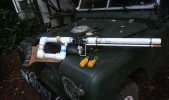
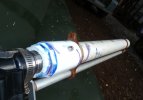
Finished a second version last night for increased range. For hiking with it, I did not want to do anything that involved longer barrels or air reservoir, however, so I doubled the reservoir section into a loop to increase volume. Barrel is just slightly longer than the previous cannon. With the larger reservoir, I only get two 60 psi charges with the CO2 cylinders. Made a shoulder stock with 1/2 inch plywood, Tywraps, some 5-minute epoxy, and soft foam pipe insulation for padding. With it offset below the level of the barrel, I can hold and aim the rig just like a rifle. I made a holder on the barrel for a ramrod, for poking the bag down the barrel, and the fittings for the ramrod holder also are shaped on top like gun sights. Performance was definitely a step up from my first cannon in the previous post, though this setup is not as compact. The barrels on both versions unscrew for easier transport strapped to my backpack. I made the mistake, with this one, of testing it without throw line; and with 60 psi, it tossed the bag so high that it went completely out of sight, well past the 100 foot mark. I thought I had aimed roughly straight up so it should have come down close by, but I never found the bag. The damn bags are not exactly cheap as you guys will know, so I came back inside and tried making some from scratch (in photo). I made them cylindrical for a tight fit in the barrel and being home-made, I can think of them as expendable. I will have to ask all the neighbors about the missing WesSpur bag!
launcher3.jpglauncher4.jpg
 
Finished a second version last night for increased range. For hiking with it, I did not want to do anything that involved longer barrels or air reservoir, however, so I doubled the reservoir section into a loop to increase volume. Barrel is just slightly longer than the previous cannon. With the larger reservoir, I only get two 60 psi charges with the CO2 cylinders. Made a shoulder stock with 1/2 inch plywood, Tywraps, some 5-minute epoxy, and soft foam pipe insulation for padding. With it offset below the level of the barrel, I can hold and aim the rig just like a rifle. I made a holder on the barrel for a ramrod, for poking the bag down the barrel, and the fittings for the ramrod holder also are shaped on top like gun sights. Performance was definitely a step up from my first cannon in the previous post, though this setup is not as compact. The barrels on both versions unscrew for easier transport strapped to my backpack. I made the mistake, with this one, of testing it without throw line; and with 60 psi, it tossed the bag so high that it went completely out of sight, well past the 100 foot mark. I thought I had aimed roughly straight up so it should have come down close by, but I never found the bag. The damn bags are not exactly cheap as you guys will know, so I came back inside and tried making some from scratch (in photo). I made them cylindrical for a tight fit in the barrel and being home-made, I can think of them as expendable. I will have to ask all the neighbors about the missing WesSpur bag!
View attachment 79069View attachment 79070

Now we're getting somewhere! Do you think the geometry has any negative effect on velocity? Amazing how far these beasts will shoot without a string. Shot my 10 oz Wesspur bag without a string at 70 pounds. Easily went 222' (measured), and that was with about a 60 degree angle of the gun.

12 feet inside the fence. 210 feet from the fence to the front of my truck where I fired the cannon.
Cannon Shot Bag 222 Feet.jpg
 
Now we're getting somewhere! Do you think the geometry has any negative effect on velocity?
I would think that shooting straight up is the hardest scenario for velocity and range. This is when the bag would be heaviest against the propelling force in the barrel. Is that what you meant, the geometry of the shot? Shooting on a slant, part of the weight of the bag is taken by the wall of the barrel below the bag as it slides along. There may be a bit of added friction this way, as opposed to the straight up shot, but the inside of this PVC is pretty smooth and should not introduce much friction. Shooting exactly sideways, the entire weight of the bag is sliding along the inside of the barrel and not acting against the propelling pressure at all except with the friction of passing thru the barrel. And if we slant the barrel downwards to shoot at the ground, then the weight of the bag is beginning to be added to the propelling force, etc. And no matter what the shot angle is, gravity itself is always acting on the bag a given amount, so that the more straight up vertical the shot is, and/or closer the target limb, the less gravity will effect aim. Interesting stuff, like calculating artillery trajectories. But I think I am also over-thinking this (I am usually guilty of that, what with being a constant tinkerer). It would be enough to just shoot the thing often enough to get the feel of it and develop a natural grasp of aiming it under various conditions, like we do with hand tossing or the Big Shot.
 
I would think that shooting straight up is the hardest scenario for velocity and range. This is when the bag would be heaviest against the propelling force in the barrel. Is that what you meant, the geometry of the shot? Shooting on a slant, part of the weight of the bag is taken by the wall of the barrel below the bag as it slides along. There may be a bit of added friction this way, as opposed to the straight up shot, but the inside of this PVC is pretty smooth and should not introduce much friction. Shooting exactly sideways, the entire weight of the bag is sliding along the inside of the barrel and not acting against the propelling pressure at all except with the friction of passing thru the barrel. And if we slant the barrel downwards to shoot at the ground, then the weight of the bag is beginning to be added to the propelling force, etc. And no matter what the shot angle is, gravity itself is always acting on the bag a given amount, so that the more straight up vertical the shot is, and/or closer the target limb, the less gravity will effect aim. Interesting stuff, like calculating artillery trajectories. But I think I am also over-thinking this (I am usually guilty of that, what with being a constant tinkerer). It would be enough to just shoot the thing often enough to get the feel of it and develop a natural grasp of aiming it under various conditions, like we do with hand tossing or the Big Shot.

I mean the shape of the reservoir is not straight, which reduces the pressure of the outflow air. Technically this must be true, as you have pressure loss coefficients when air travels through elbows. But PLC is not a huge component in most systems. You'd have to test a straight pipe with the same volume as your system to know, but was wondering if you noticed it at all. My guess is that there isn't much difference between a straight or square reservoir. But like you, I am curious (MSME in college but too lazy to do the calculations right now). :)

Assuming no friction, the farthest range angle will always be 45 degrees. And of course the maximum height angle will be 90 degrees (straight up).
 
You have a good point, that in my loop reservoir there are elbows which the air has to navigate. It might not be such a factor in this case since the exit is restricted down to 1 inch at the valve anyway, and also there are two arms of the loop towards the valve so that total area leading into the region right before the 1 inch restriction is twice what it would be if only a single elbow and a cap somewhere at the other end. I think the main consideration of the whole system, if one is looking at the air flow, is the restriction both at the valve and the valve itself. We compensate for any issue here by an increase in reservoir pressure. The Rainbird does minimize any release problems or delays but it is still only 1 inch ID which I think is the largest affordable one. I did see a larger one in brass on eBay but it was hundreds of dollars! I plan, with next trip to Lowe's, to get stuff to make a series of different lengths of barrel, to see if there is an optimum length at my average pressure of use which I guess would be in the 40 to 60 psi range. This second cannon worked so well in every test that I am more or less completely satisfied with it already, but I can't resist the experimentation to acheive maximum range with the least pressure. If I could get good results with, say 25 to 30 psi, I could have five or six shots from one CO2 cartridge!
 
You have a good point, that in my loop reservoir there are elbows which the air has to navigate. It might not be such a factor in this case since the exit is restricted down to 1 inch at the valve anyway, and also there are two arms of the loop towards the valve so that total area leading into the region right before the 1 inch restriction is twice what it would be if only a single elbow and a cap somewhere at the other end. I think the main consideration of the whole system, if one is looking at the air flow, is the restriction both at the valve and the valve itself. We compensate for any issue here by an increase in reservoir pressure. The Rainbird does minimize any release problems or delays but it is still only 1 inch ID which I think is the largest affordable one. I did see a larger one in brass on eBay but it was hundreds of dollars! I plan, with next trip to Lowe's, to get stuff to make a series of different lengths of barrel, to see if there is an optimum length at my average pressure of use which I guess would be in the 40 to 60 psi range. This second cannon worked so well in every test that I am more or less completely satisfied with it already, but I can't resist the experimentation to acheive maximum range with the least pressure. If I could get good results with, say 25 to 30 psi, I could have five or six shots from one CO2 cartridge!

What is important is the change of direction. Your reservoir has three (total) 90 degree turns that the air must go through. Only one section flows in the direction of the barrel without needing to change direction. The directional change is what is most important. The 1" reduction (nozzle effect) is common to both the straight and square designs, and that small change is not too significant over short distances. Overall I don't think the head loss due to shape is too significant.

The square one you made has a larger air volume (otherwise it would use the same amount of CO2 for identical pressure), so more "fuel" at identical pressure to your smaller original reservoir. I'm thinking that more than overcomes any head loss due to shape.
 
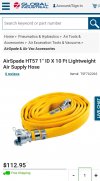
For hiking I wonder if something like this could work for a collapsible air tank? Just need a way to cap off one end. A shorter, larger diameter hose would be preferable.
 

Attachments

  • Screenshot_20211202-180505_Chrome.jpg
    Screenshot_20211202-180505_Chrome.jpg
    165.6 KB · Views: 10
Y'all are beginning to sound like Pumkin Chuckin' wannabes.

What's next? Flinging a throw weight with a trebuchet?

Maybe they need to add a throw weight competition at climbing competitions. Would definitely be entertaining and it's apparent plenty of folks are willing to design, build and test launchers.
 
For hiking I wonder if something like this could work for a collapsible air tank? Just need a way to cap off one end. A shorter, larger diameter hose would be preferable.
A scuba diving neighbor of mine has the cutest little aluminium emergency scuba bail-out bottle, not much bigger than a bicycle water bottle and holding 2000 psi. Could be strapped right to the air launcher!
 
After using the camera on my Galaxy Player as a sighting device, I've decided to set the idea aside. It's not that it doesn't work, but I think it might be dangerous. Looking down at the screen while launching means you won't see where the throw bag goes if it bounces off a solid part of the tree. Having the 12-ounce bag hit the ground just a couple feet away just after I looked up to see where it went was a real surprise, and it would have been really bad if it had hit me.

The air cannon at 60psi launches with a lot more force that the Big Shot ever would, and things happen a lot quicker. I think keeping an eye on the bag is critical for using it safely.
 
Are you guys modifying the sprinkler valve by drilling a hole into the center of it for attaching the blow gun trigger?

Are you tapping the hole toscrew the fitting into?
 

New threads New posts

Back
Top Bottom