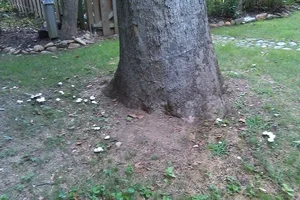
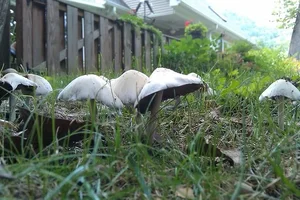
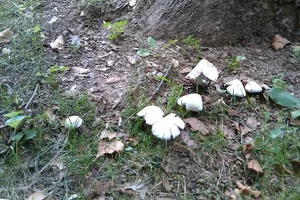
mushrooms on base of large tulip

Very interesting, thank you.

yeah, Daniel be sure to drink a lot of alchohol and then eat those mushrooms please.
devbug.gif


What is Antabuse?
Antabuse (disulfiram) interferes with the metabolism of alcohol resulting in unpleasant effects when alcohol is consumed.

Antabuse is used to treat chronic alcoholism.

Antabuse may also be used for purposes other than those listed in this medication guide.

Important informationknow about Antabuse
Do not drink alcohol while taking Antabuse. Flushing, fast heartbeats, nausea, thirst, chest pain, vertigo, and low blood pressure may occur when alcohol is ingested during Antabuse therapy.
Do not take Antabuse for at least 12 hours after drinking alcohol.

Reactions may occur from drinking alcohol for several weeks after you have stopped taking Antabuse.

Be aware of the alcohol content of other common products such as cough and cold medicines, mouth washes, tonics, sauces, vinegars, and other food products. Alcohol in these products can also cause a reaction.
 
"...The crust fungus that decays the attached branch stub until it snaps off is doing the tree a favor with respect to closure. So is that fungus a beneficial associate of the tree as well as being a decay fungus? Yes!...
**But** pathogen refers to causing a disease that by definition is a disruption in normal functioning. ,,,if a parasitic fungus does not disrupt normal physiology enough to affect or potentially affect crop value, is that parasitic fungus a pathogen? My training is to say no, no disease is involved... I consider the fungus a saprophyte on shed bark *but* as the bark infection can adversely affect the appearance value of the tree (to some folks anyway,) I could consider such infection as a disease. Hence the fungus would be a pathogen! Yet not a parasite!"

Kevin, if a disease disrupts normal functioning, and bark shedding is a normal function, why is Aleurodiscus a disease?
confused.gif
How does aesthetics impact tree function? Considering appearance a normal function seems a bit of a stretch to me...

I think smooth patches on bark are attractive, but that's beside the point...I think...
smirk.gif
 
The disruption in normal bark shedding by Aleurodiscus affects tree appearance. Like it or not, that appearance or overall visual quality is often the crop, or the reason that someone pays for the land on which the tree grows and maybe even pays to maintain it.
Sure, sounds crazy to me, but I think that is the rationale for calling Aleurodiscus a disease. I cultivate all sorts of disease at my place in the Maine woods!
 
What are you guys talking about? There is no such thing as tree decay. Allow me to prove it with these two quotes from respected sources.

"There are four types of protection wood: heartwood and false heartwood, discolored wood and wetwood. Heartwood is genetically age-altered wood that has a greater protection capacity than the sapwood that contains the symplast."
- Shigo's A New Tree Biology

and

"decay is limited to heartwood and inner sapwood because of the presence of high sapwood moisture. The resulting low oxygen and high carbon dioxide levels are thought to prohibit growth of decay fungi in functional sapwood. (Boddy and Rayner 1983)- Luley, Arborist News April 2006

So, clearly, there can be no decay because trees, apparently, are impervious to fungal pathogen.
vroam.gif
 
Re: mushrooms on base of large Sycamore

I came across these mushrooms last summer. I am wondering if anyone has an ID for them. Removal was done because two weeks after the mushrooms showed up, the tree was crispy.
 
Re: mushrooms on base of large Sycamore

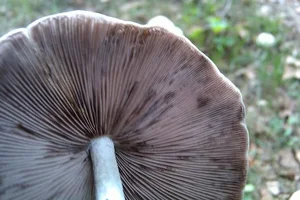
Spore color? Even without a spore print, can sometimes tell from looking at the gills.
The last photo shows two potentially characteristic features. I'd consider the gill spacing to be "crowded". the second characteristic is just out-of-focus enough to be almost of no use, but I'd call the connection of gill to stipe to be "adnexed" or "notched".
Given that, the splits in the caps, and the overall shape...an Inocybe? If so, not a tree pathogen.

Good example of how hard these are to ID from photographs, especially ones with the critical bits out-of-focus.
 

New threads New posts

Back
Top Bottom