Mini vs GRCS

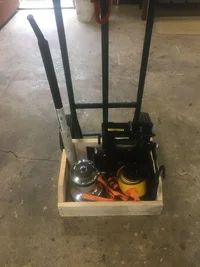
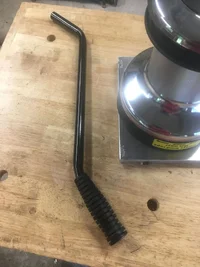
I bit the bullet and bought a GRCS, I guess you can never have too many options at your disposal. It came with the handle Pictured. I watched the videos and didn’t see any application of the handle. Anyone know what it’s used for?
 

Attachments

  • image.webp
    image.webp
    268.5 KB · Views: 42
  • image.webp
    image.webp
    319.3 KB · Views: 39
I bit the bullet and bought a GRCS, I guess you can never have too many options at your disposal. It came with the handle Pictured. I watched the videos and didn’t see any application of the handle. Anyone know what it’s used for?
No idea what that handle is for, it's got the breaker bar to attach it to the tree. As long as you have a hand crank to spin the winch drum you're in business (hiding in the box perhaps?)
 
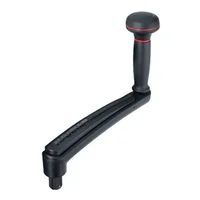
HARB10HOT_540x540.webp
You should have received a handle that looks sort of like this, with a bit on the end of it that fits in the end of the winch bollard. I'm wondering if your seller has all their random black handles on a shelf and chose unwisely...
 
View attachment 52954
You should have received a handle that looks sort of like this, with a bit on the end of it that fits in the end of the winch bollard. I'm wondering if your seller has all their random black handles on a shelf and chose unwisely...


Yep has the winch handle and the bar to tension the attachment strap, and the mystery third handle... Came from Bartlett, you'd think they'd have some idea.
 
I have used a technique that connects a heavy line to the crown of leaning tree, to a ground anchor or stump generally using a tensionless anchor at ground level and winding the line down the trunk and tying near base (to not overload knots). Can add a second line for progress capture.

Then use a floating block connected by rope to a utility/truck/bobcat etc to pull mid-line to lift the tree. Can capture progress with wedges and progress capture line as required, retension the line connected to ground anchor with tensionless anchor and repeat process.

I generally choose a vehicle that won't overload the system with too much pull, as you are pulling using a force multiplier of the mid-line pull. I have pulled reverse leaning 150' trees with a lightweight utility with this system. And with this system you aren't limited by rope diameter like the GRCS.

Must be very careful of danger zones in case something goes wrong, but can lift very heavy trees this way, and not push the limits of very expensive equipment like the GRCS in very heavy pulling situations.

 
I have used a technique that connects a heavy line to the crown of leaning tree, to a ground anchor or stump generally using a tensionless anchor at ground level and winding the line down the trunk and tying near base (to not overload knots). Can add a second line for progress capture.
It’s a pretty bomber piece of gear man!
Then use a floating block connected by rope to a utility/truck/bobcat etc to pull mid-line to lift the tree. Can capture progress with wedges and progress capture line as required, retension the line connected to ground anchor with tensionless anchor and repeat process.

I generally choose a vehicle that won't overload the system with too much pull, as you are pulling using a force multiplier of the mid-line pull. I have pulled reverse leaning 150' trees with a lightweight utility with this system. And with this system you aren't limited by rope diameter like the GRCS.

Must be very careful of danger zones in case something goes wrong, but can lift very heavy trees this way, and not push the limits of very expensive equipment like the GRCS in very heavy pulling situations.
I don’t know what you are lifting that a GRCS is too whimpy for? The system you are describing is at best a 4:1 with a 1000 lb vehicle side pulling? Best I could figure on your description? That would only be 4000 lb max? The GRCS can handle an SUV dropped on 15 feet of slack!
 
I have used a technique that connects a heavy line to the crown of leaning tree, to a ground anchor or stump generally using a tensionless anchor at ground level and winding the line down the trunk and tying near base (to not overload knots). Can add a second line for progress capture.

Then use a floating block connected by rope to a utility/truck/bobcat etc to pull mid-line to lift the tree. Can capture progress with wedges and progress capture line as required, retension the line connected to ground anchor with tensionless anchor and repeat process.

I generally choose a vehicle that won't overload the system with too much pull, as you are pulling using a force multiplier of the mid-line pull. I have pulled reverse leaning 150' trees with a lightweight utility with this system. And with this system you aren't limited by rope diameter like the GRCS.

Must be very careful of danger zones in case something goes wrong, but can lift very heavy trees this way, and not push the limits of very expensive equipment like the GRCS in very heavy pulling situations.
I’m curious about this ( tensionless anchor ) what is that? Can you describe it or better yet photograph it?
 
I’m curious about this ( tensionless anchor ) what is that? Can you describe it or better yet photograph it?
A tensionless anchor comes from the rock climbing world. It's essentially 3 or more turns around a fixed anchor with a stopper know tied around the standing part. The turns of rope have enough friction to them that the knot is just to keep the turns from unraveling, rather than being load bearing. Hence the "tensionless" part of the name.

It also has the advantage of being a 100% rope strength rope anchor without strength loses from knots/splices

A quick Google search returned this https://www.neilhopkins.us/mountaineering-guide/tensionless-anchor.html
 
A tensionless anchor comes from the rock climbing world. It's essentially 3 or more turns around a fixed anchor with a stopper know tied around the standing part. The turns of rope have enough friction to them that the knot is just to keep the turns from unraveling, rather than being load bearing. Hence the "tensionless" part of the name.

It also has the advantage of being a 100% rope strength rope anchor without strength loses from knots/splices

A quick Google search returned this https://www.neilhopkins.us/mountaineering-guide/tensionless-anchor.html
Yeah that I’ve used, I still would use a timber hitch over that.
 
That hitch has been known to slip under extreme loading. But yeah they do work but use up a lot of rope. When I anchor for a hard pull I always use extreme overkill on my system. There is no need for me to worry about cutting a knot because the strength of rope far exceeds the max load I could impose. I never use a hitch that could possibly slip despite it’s no knot cutting thing! However, the fact that it’s backed up by a biner is a bonus. My dead eye slings are not long enough to make multiple trips around a stump. A 20’ dead eye can only do 3 passes on a 2 foot tree. You would need no less than 5 passes? That’s a lot of sling. I can do the same with 1.5 passes with timber hitch.
 
That hitch has been known to slip under extreme loading. But yeah they do work but use up a lot of rope. When I anchor for a hard pull I always use extreme overkill on my system. There is no need for me to worry about cutting a knot because the strength of rope far exceeds the max load I could impose. I never use a hitch that could possibly slip despite it’s no knot cutting thing! However, the fact that it’s backed up by a biner is a bonus. My dead eye slings are not long enough to make multiple trips around a stump. A 20’ dead eye can only do 3 passes on a 2 foot tree. You would need no less than 5 passes? That’s a lot of sling. I can do the same with 1.5 passes with timber hitch.
Your missing that you’re anchoring with the rope directly. It does eat some rope, but works great and is as effective at anchoring on a porty but with less links in the chain.
 
Your missing that you’re anchoring with the rope directly. It does eat some rope, but works great and is as effective at anchoring on a porty but with less links in the chain.
No I get that. But my point is that I don't have confidence in it like a timber hitch. Also it's name is fundamentally wrong, frictionless hitch? it relies purely on friction to work? Not being a troll here... admittedly it does work and I have used it, but I'm no fan of ring around the posey when it comes to rope work!
 
The way I see it, if you are concerned that the rope you are using could get knot cut, perhaps there's not enough rig for the gig? Because a knot usually cuts the rope strength in half right? Do you rig a tree knowingly loading up to 50 percent of breaking strength? You shouldn't even be close to that! What does the manufacturer of the rope say?
 
  • Like
Reactions: evo
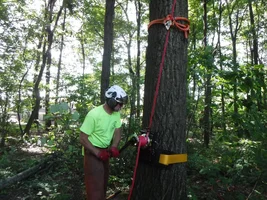
Today I finally got to use the GRCS. Took down 3 woods trees, tall but not very large diameter. One was twisted off at the base and leaning in a large oak, one was standing dead and the last one, which was the biggest one, was leaning over a fence and the inground pool. We also removed a large oak limb over the swimming pool. All I got to say about the GRCS is it is amazing. The way this seamlessly goes from lifting to lowering is sweet. Amazing control and when you lock off the load it stays put, no creep. Glad I made the purchase.
 

Attachments

  • DSCF2329.webp
    DSCF2329.webp
    748.3 KB · Views: 12
Today I finally got to use the GRCS. Took down 3 woods trees, tall but not very large diameter. One was twisted off at the base and leaning in a large oak, one was standing dead and the last one, which was the biggest one, was leaning over a fence and the inground pool. We also removed a large oak limb over the swimming pool. All I got to say about the GRCS is it is amazing. The way this seamlessly goes from lifting to lowering is sweet. Amazing control and when you lock off the load it stays put, no creep. Glad I made the purchase.
And that is what I'm talking about.. Thanks for the input. That type of device has very positive control attributes. It allows control in both directions while being operated by hand from one person. It can be locked off and can withstand some mighty impressive impact! Although the bollard would be better suited for that.
 

New threads New posts

Back
Top Bottom