Mediating the trade-off—how plants decide between growth or defense

TreeCo

Carpal tunnel level member
Interesting stuff.
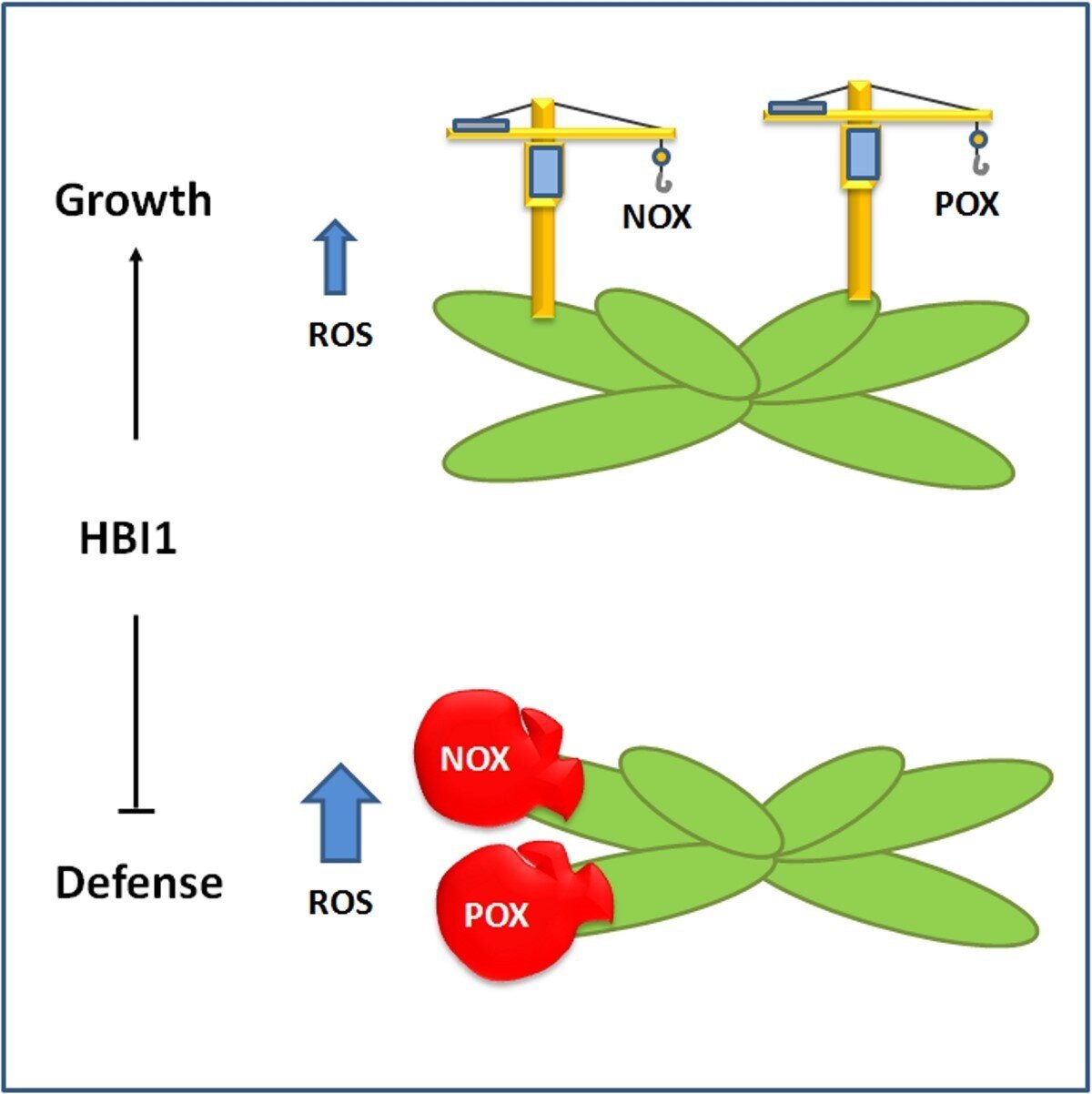
 
That article makes things clear at the cellular level. I wonder if a tree operates like that at the tissue/organ/organism levels, and how far up the hierarchy it goes.

Thanks for posting, @TreeCo
 
That article makes things clear at the cellular level. I wonder if a tree operates like that at the tissue/organ/organism levels, and how far up the hierarchy it goes.

Thanks for posting, @TreeCo

Indeed even at the macroscopic forest level, and supra-macroscopic evolutionary level (epigenenetic) ... fascinating topic
 
Keep in mind that for this study, "growth" means growth of cell size in leaves, not the number of cells or the number of leaves. And "defense" means production of particular classes of enzymes (peroxidases and oxidases). So this is quite different (to me, anyway) from the Dan Herms work that JD mentions above. It's a difference not only of scale but of levels of organization.
Oh, if anyone needs a copy of the full paper referred to in that promotional piece, let me know. It might be open access, anyway, I didn't check. Thanks TreeCo for posting!
 
If you guys n gals haven't read The Hidden Life of Trees by Peter Wohlbien yet, I highly recommend it.


Jemco
 
Keep in mind that for this study, "growth" means growth of cell size in leaves, not the number of cells or the number of leaves. And "defense" means production of particular classes of enzymes (peroxidases and oxidases). So this is quite different (to me, anyway) from the Dan Herms work that JD mentions above. It's a difference not only of scale but of levels of organization.
Oh, if anyone needs a copy of the full paper referred to in that promotional piece, let me know. It might be open access, anyway, I didn't check. Thanks TreeCo for posting!

I'd be interested in reading the full paper if you find it in digital form.

Is Dan Herms work pubic and available?
 
Keep in mind that for this study, "growth" means growth of cell size in leaves, not the number of cells or the number of leaves. And "defense" means production of particular classes of enzymes (peroxidases and oxidases). So this is quite different (to me, anyway) from the Dan Herms work that JD mentions above. It's a difference not only of scale but of levels of organization.
Oh, if anyone needs a copy of the full paper referred to in that promotional piece, let me know. It might be open access, anyway, I didn't check. Thanks TreeCo for posting!

Do you think it's a genuinely constrained contrast set, or part of a larger picture that was constrained by the scope of the method they used?
 
IMHO, the "breakout" paper for Professor Herms was The Dilemma of Plants: To Grow or Defend published in the Quarterly Review of Biology (1992). A lot of work has taken those concepts further and in other directions. Still, this turned a lot of folks on to the concept. Does not seem to be open access. I have a digital copy, but I don't see how to upload it here. PM me and I'll see about getting it to you.
 
Yep, that's the one. Keep in mind that it is more than 25 years old and a lot of newer work has been done, but this is foundational and had a big impact on me when it first came out.
 
Nice, all.
.
i've always taken growth itself
as a defense, of out competing as better food gatherer , linearly in forest allowing wind buffering bretheran to sides
But, wider alone shading out lower competitors in city, thick mulch seeds can't penetrate as well etc.
Thick green grass under tree with volcano mulch is human notion of richness, not Natural idea(l) of messy sense of order, no competitors, and mulch ramped off of trunk flare. The king of the jungle is such, cuz like any other king limits the ravaging of her lands and resources, healthy enough to out run most nasties.
.
Each tho, cover sides eventually to carry water wider to tease roots wider to more food and stability
Tipping down so water runs out farthest and preventing animals coming thru to compress soil.
>>even in death, remaining low tree bones (trunks and branches) tend to restrict and reroute heavy animal traffic away from trampling and compressing oxygen space from the pride's sea of soil.
 
I'm impressed by a tree's situational awareness, and ability to react to adverse situations.

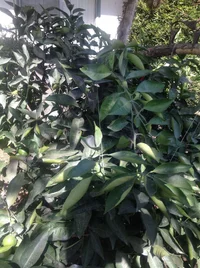
I even performed an admittedly amateurish experiment on a dying navel orange tree as proof.

Sixty year old navel, ravaged by wood borers, nothing left alive but a few sprouts at the trunk base.

So I tied two of these long sprouts together in such a way that both are upside down, leaf tops now facing the ground, not the sky.

But within one week the leaves had twisted around on the petioles to face the sun again.

Defacto situational awareness, right up to the bitter ends.

Jemcoimage.webp
 
Last edited:
Quite right! Charles Darwin, before his publication on evolution and natural selection, studied and published on these "righting" phenomena as well as "nutation", the spiral that a growing shoot describes in its upward or phototropic response. Very neat that you did the demonstration experiment!
 

New threads New posts

Back
Top Bottom