@Shadowscape and
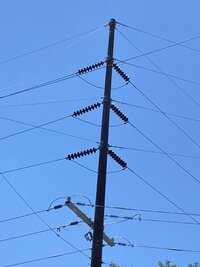
@Reach, thanks for sharing your expertise here. I found it helpful. It confirms (and gives me more confidence in) much of what I have picked up here and there without any formal education. The electrical issue that concerns me the most, however, is dealing with the rare problem of a throwline that gets draped over the primary lines. This happened to me once when my throwbag hit a stem and ricocheted over the nearby primary lines in a residential neighborhood. Nothing happened, but I'm wondering how best to deal with this in the future. I don't know how to judge the voltage of the primary lines, but I look at the insulators on the poles to give me an idea. I am assuming that the shorter they are, the less the voltage, and the length of the insulator generally tells me the maximum arcing distance. Is this roughly correct? Also, how likely is it that the throwline would be unsafe to touch? Assuming basic dyneema, clean and dry, and I'm not standing in a puddle. Would a multimeter tell me if there is any current on the throwline if I set it to the maximum AC voltage, wrapped one probe on the line and stuck the other probe in the ground?
Sorry, I was chuckling there for a moment. Not at your questions, but a picture that formed in my head...
You are correct on the more insulators the high the voltage, usually. I've seen some pretty off the wall insulator jobs however. But the theory is sound.
You have to be careful with throwlines and higher voltage lines. By higher voltage I am talking about 14-40KV (2-3 insulators). You are not likely to be working around
high voltage lines. Throwlines vary in conductivity. A Dyneema line is not very conductive, and any powerline you are likely to have put it over will not fry you if you grab the line. But try not to do that if at all possible. If it scares you, grab the line with your pole saw and pull it back. Forget the multi-meter stunt. I have thrown my DynaGlide throwline over many higher voltage lines than you are likely to run across and have no concern about grabbing it and puling it back. A wet throwline is a different story. Probably not going to kill you but you might get the buzz of your life.
There may be some throwlines out there that this may not be safe doing this with. I ran across a throwline a few years ago that must have been made by some off the wall outfit because it had what looked like an aluminum tracer running through it. It may have just been mylar or some silver plastic, I didn't get a good enough look at it to tell. I am not going to say you can do it with any throwline, and safety is always first. But I would not worry about your Dyneema line and the powerlines you are likely to encounter.
That said, putting your throwline over two different phases of a
high voltage tower at the same time may end up with a flash bang. In that case you don't need to worry about it being hot, you just need to go buy yourself another throwline because that one will be gone, but you shouldn't be working around those in the first place. I don't even work around those. I limit myself to 69KV by personal choice, and there really isn't a need for tree workers on anything higher voltage because they cut the right-of-ways back way beyond having a tree fall on them. There are line clearance workers who keep the trees pruned back on those right of ways, but the dangers they encounter are from the trees, not the power lines.
The high voltage lines don't worry me as much as the low voltage lines. Low voltage being the primary lines you encounter, 7.2-35KV lines. High voltage lines tend to burn you and knock you around, then leave you for dead when you actually are not. The low voltage lines you call primary lines are the ones that will snuff you out. Electricity behaves differently in high voltage (230-800KV). I once watched a fellow try and kill himself on a 300+KV tower. He climbed up there with a household extension cord, out onto an arm, and then whipped the extension cord down onto one of the lines. There was a pop and a flash, and he went sailing off the arm to the ground. Except for a lot of broken bones from the fall, he had no damage from what he had hoped would happen.
Got to remember, it is not the voltage that kills you, it is the amperage. Think of electricity as a water pipe. Water being the amps, and water pressure being the voltage. The volts are the force, the amps are the killer. Higher the voltage the more the amps can overcome insulating factors. That is why you can grab a spark plug, pull the starter rope and get a good buzz. 12,000 volts right up your arm but no damage because the amperage is next to nothing. On the other hand, 120 volts and as little as a 1/2 amp could easily kill you. Service drops and household wiring are generally insulated to protect you from up to 600 volts.
Rule of thumb for primary lines:
1 insulator = 7.2 (7.5) KV
2 insulators = 14.4-23 KV
3 insulators = 34.5 KV
4 insulators = 46 KV
5-6 insulators = 69 KV
You are not likely to be anywhere around more than three insulator lines while working, but there are 24 insulators when you get to the 500KV lines.