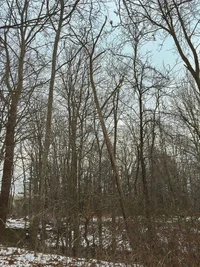
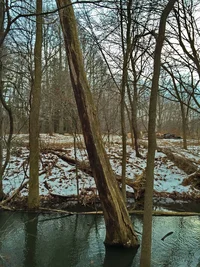
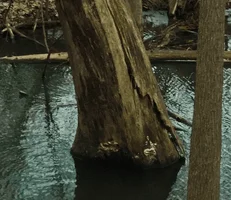
Live structural tree failure study.

how long before this tree fails? Standing no support dec 31 2015

  • B: will fail between 30 to 90 days

    Votes: 0 0.0%

  • Total voters
    10
  • Poll closed .
.... but If this is your perspective when looking at trees, I sincerely hope you are not in the business of looking at trees....

Because my opinion is different than yours, I must be less qualified? You might need to dig a little deeper into your analytical abilities if it is through these that you expect to reach clairvoyance.

" You have been asked by the client to give an estimate of when this tree will fail".

The foundation of your exercise is based on an impossible question. You can identify and measure holding wood, integrity of the remaining support dynamics, wood decay
species and projected advance. You can even guess at future local weather patterns in the hopes of predicting force vectors. But no matter how much you think you "know" about this situation, unless you make the felling cut you cannot "know" when this tree will fall, only that it will.
 
I will also edit the original question to try and open up the thought process rather than get critical feedback on the ethics and possibilities of what is being asked. Hope that helps.
 
Thanks treehumper. Very nice synopsis of the situation. ...My guess says the root zone is in good shape well preserved under water.

Now the game is clear.

In the wild I see trees with tops/trunk looking like this one. Some have shed canopy pieces to decay and wind. When I see them uprooted I NEVER see any root system beyond the zone of rapid taper. Stubs of roots left. The mass of smaller roots that dive a bit deeper and provide friction and support are all long gone. A lot of old dead uprooted trees still have pretty solid trunks.

Compare dead hulks to the trees that are uprooted and swept away in floods. Lots of fibrous root system left but no soil.
 
You can identify and measure holding wood, integrity of the remaining support dynamics, wood decay
species and projected advance. You can even guess at future local weather patterns in the hopes of predicting force vectors.

I like this input. You say all this and then you say Itis impossible too tell when failure will occur. Yet we are asked to give assessments and timeframes and structural analysis etc etc. all the time.

So I am going to suggest that we can indeed give a lot of information about a tree and even timeframes for failure (omg alarm alarm). This ought to get some of you stirring in your seat!!! They include exclusions and liability clauses, but I would not be afraid to give my professional opinion on a trees structural condition, put that into a time frame, include some remedial actions to save the tree if that is an option or say this tree is going to fail within the next 5 days! I have done it in the past. Of course I am not always right, but my (our)information gives people the power to make decisions. Our information often MAKES people decide what to do. That is a very powerful position to be in if one values trees. So back to the excersisize.

What are we missing ??? What do you see??? How much are you willing to study in a tree instead of just putting a cut to the base if you don't have to. That is the information I am interested in. Thanks for your input dsmc. I appreciate it.
 
Good point tom. So why is there a trunk failure and a lean but the tree is still standing? I think you are right about the root zone however I think there
Must be something still holding this up in that root zone. Any guesses. Maybe there was another tree that aught it after the trunk failure but that limb has been lost to wind or decay!! Ah, something else we didn't know. Nice input tom thanks!!! I am about to go for a
Walk. Maybe there has been a change already. Lol.
 
To make it easier on the neck, I rotated and enhanced a couple of the images. Lots of interesting discussion.

I will only add that one reason why dead trees, even leaning ones, stand for quite some time, is that the tree's weight is considerably reduced from when it was alive... and, it has far less wind sail as well.


imageB.webp imageA.webp
 
I like this input. You say all this and then you say Itis impossible too tell when failure will occur. Yet we are asked to give assessments and timeframes and structural analysis etc etc. all the time....

This is, indeed, the problem. We cannot and should not give a time of failure. No matter how much data is collected and analyzed there will always be vast amounts of incalculable variables. On your sample tree it could be something as random as a curious raccoon investigating what remains of the canopy that tips the scales.

I love all things about trees including in-depth studies on seemingly obscure connections but I think it is tremendously inappropriate to succumb to expectations of time frame predictions and even worse to try and validate, through data, that we somehow can.
 
"I think it is tremendously inappropriate to succumb to expectations of time frame predictions"

Yet TRAQ pushes arborists to do just this. I see "Imminent" used way too often, and "Improbable" is rarely used.

"...even worse to try and validate, through data, that we somehow can."

Much worse is when these predictions are based not on data but wild assumptions. Disclosing limitations and focusing on mitigation seems like a more honest approach.
 
Interesting points. I wonder, what does a raccoon weigh? at what point does that become a deciding factor? To what extent has decay broken down fibers where the tipping point is that animal landing on the tree. Maybe it's at what point does the moment force exceed the shear strength as it climbs further upward?

Material strength, wood amongst them is a science and one that is applied daily. We are calculating not just at what point will the material, (species) fail but over how long and under what conditions? Look at destructive testing of products, they are put through cycles of typical use to gain an understanding of what it takes to fail and over what period of time. There is always the caveat that there will be other factors and dynamics that will alter the results and thus the estimates give.

Maybe it's the cost in time (=money) that we feel we can't give clear answers. Is it beyond the scope of work most tree services offer yet, we are asked to give some sort of assessment. Even in saying we don't know there are factors we take into consideration that are part of our collected knowledge that gives us expert insight into tree's structural dynamics. Unlike the layman who says, "I dunno" out of ignorance, we say that but enumerate the reasons the answer can't be definitive.

If you had all the time and resources to come up with some sort of answer, what would you do to determine, to some degree of confidence, with the usual disclaimers and limitations, a range of time or maybe even conditions that will determine the outcome?

I would want to:
  • determine the integrity of the root system and soil structure (think of that video of the forest floor "breathing"). To what degree has the decay diminished the root system. Has the increased water level adversely affected the soil?
  • examine the fungi and the degree of decay at the root plate. Maybe a conversation with a mycologist to gain a better understanding of the impact on the wood by that particular species.
  • identify the tree species and cross reference any information on its strength and typical decline under these conditions.
  • learn what is the usual rate of decomposition in this area for this species? Are there any available studies that could infer such information?
  • review weather conditions historically and forecasted. What over it's life has it been subjected to and consequently reacted to.
  • ascertain when the observed defects occurred and to what degree have they reduced the tree's strength.
What else is there?

And I've still not ventured a guess at how long before it falls.

 
Going strictly by the pics and observations presented I feel it is imminent. Is it just resting there or has it always leaned? To me that is the only real question that would lead me to inquire further
 
I think that this tree may not fall but get hung up in branches and be standing dead wood for years more.

Baumeister, have you read any of the papers by Julian Dunster? He has an article entitled Dealing with Uncertainty that may be of interest and utility with regards to this specific situation and question.
 
Apparently it was not a root zone failure. Sounds like it was a trunk failure at 6" above grade. It failed April 2nd during high winds and some snow we got. No snow load , or very minor if any. We had a hard northwest wind which makes sense. Prior to that storm we had several other high wind events. My guess is it sounds like it broke just above high water mark. Very interesting. I can't wait to take pics. Am on the road pricking up a 2004 f450 to tow my gehl 540. :).
 

New threads New posts

Back
Top Bottom