
Navigation
Install the app
How to install the app on iOS
Follow along with the video below to see how to install our site as a web app on your home screen.
Note: This feature may not be available in some browsers.
More options
You are using an out of date browser. It may not display this or other websites correctly.
You should upgrade or use an alternative browser.
You should upgrade or use an alternative browser.
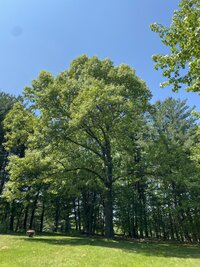
Large Oak Tree
- Thread starter climbingmonkey24
- Start date


Bendroctanus
Carpal tunnel level member
- Location
- Springfield
To that excellent point, we can’t control the trees. As knowledgable and skillful as we may be, trees will still do as they please. We can only steward them. So strive to be an excellent steward. You care a lot and you do well, but to @Tuebor’s point, you don’t need to worry. You’ll go crazy. You’re going above and beyond.

flushcut
Been here much more than a while
- Location
- Delavan, WI
I carry a mallet in each truck. And sound every tree when doing an assessment. If the tree is hollow and has vertical cracks it could be on the verge of collapse. But I’m not trying to be doom and gloom, sounding the trunk is a cheap method for checking for hollows.You guy’s do sound tests regularly or only if you think the situation warrants it?

southsoundtree
Been here much more than a while
- Location
- Olympia, WA
Anything significant that would drop from the tree would most likely be during a wind event. What kind of deadwood are we talking about?They want to reduce the risk of anything dropping, etc. because I guess they’re going to be hosting an event in the backyard at some point down the road.
Do they need to park a bunch of people under the tree?
Looks like a steel cable and brace job.
I'd think to mulch out from the base with any wood chips generated to reduce mower-itis.
Any roots that are getting exposed due to growth and/ or erosion and mowing should get protected with a little bit of soil added, as needed, to prevent damage from mowing and other traffic. Have a smooth-ish transition over the roots to prevent the mower from bottoming out on a high spot.
southsoundtree
Been here much more than a while
- Location
- Olympia, WA
Were you there to bid deadwooding or provide a visual tree assessment or...?You're giving me anxiety, but I know you mean well and yeah I know what you mean. I personally don't "sound" every tree. I think I might've only done it once actually.
I could call the customer and tell them I want to stop by to perform a sound test, that I didn't have the tool with me when I initially looked at the job. Or I could just do the job and be done with it and not think twice about it unless I get a call back sometime down the road.
I don't want the customer to think I don't have my sh"t together either, and ask why didn't you do it when you initially came out and bid the job...

climbingmonkey24
Carpal tunnel level member
- Location
- United States
Anything significant that would drop from the tree would most likely be during a wind event. What kind of deadwood are we talking about?
Do they need to park a bunch of people under the tree?
Looks like a steel cable and brace job.
I'd think to mulch out from the base with any wood chips generated to reduce mower-itis.
Any roots that are getting exposed due to growth and/ or erosion and mowing should get protected with a little bit of soil added, as needed, to prevent damage from mowing and other traffic. Have a smooth-ish transition over the roots to prevent the mower from bottoming out on a high spot.
I didn’t see any significant root exposure that would be cause for concern.
As far as deadwood, from what I could see there’s just a few things here and there. Does it need to come down? Probably not. But this tree is part of a larger project with some other work, so I said we could go through it and take anything out that’s dead if they wanted.
From what I understand there may possibly be a wedding in the backyard next year, which is why they wanted the tree looked at.
climbingmonkey24
Carpal tunnel level member
- Location
- United States
Were you there to bid deadwooding or provide a visual tree assessment or...?
They contacted me because they wanted “dead branches removed” along with some other work.
There’s a few other trees I’m going to prune and also taking down a smaller oak
southsoundtree
Been here much more than a while
- Location
- Olympia, WA
Sounds like you went out to look at a bid, not a consult/ assessment, so not having assessment tools (the mallet you mentioned) would not mean you were unprepared.They contacted me because they wanted “dead branches removed” along with some other work.
There’s a few other trees I’m going to prune and also taking down a smaller oak
Climbing for deadwooding will give you a lot of info.
climbingmonkey24
Carpal tunnel level member
- Location
- United States
If you do detect a hollow in a tree, do you automatically recommend removal or does it depend on other factors like location, how the rest of the tree looks, etc.
I believe I read somewhere that trees can still survive with a certain amount of interior rot…?
I believe I read somewhere that trees can still survive with a certain amount of interior rot…?

Tony
Carpal tunnel level member
- Location
- Lancaster, PA
A hollow or cavity in a tree is certainly not a death sentence. It is another pice of information in the total evaluation of structure, health and vigor.If you do detect a hollow in a tree, do you automatically recommend removal or does it depend on other factors like location, how the rest of the tree looks, etc.
I believe I read somewhere that trees can still survive with a certain amount of interior rot…?
you seem detail oriente. Dig into tree evaluation. I bet you will love it.
Tony
flushcut
Been here much more than a while
- Location
- Delavan, WI
No. Unless it has other signs of failure. Or is really hollow 70% or more near targets. You said the tree has vertical cracks. And they are having a party under it so maybe the tree needs more assessing. Trees can be extremely hollow and have the outward appearance of a healthy tree.If you do detect a hollow in a tree, do you automatically recommend removal or does it depend on other factors like location, how the rest of the tree looks, etc.
I believe I read somewhere that trees can still survive with a certain amount of interior rot…?
I did an assessment a few years ago on a willow mush bag and recommend removal as they were having a graduation party under it. The husband insisted the tree was healthy but clearly wasn’t. Ok no removal, didn’t get the job. The tree failed as they were setting up for the party and was removed by a different company. I come to find out he didn’t want to admit he was wrong and hired somebody else. Shit happens, the more you can inform your custy the better.
southsoundtree
Been here much more than a while
- Location
- Olympia, WA
@climbingmonkey24 Do you have a good Registered Consulting Arborist/ BCMA/ well-experienced TRAQ arborist to hire/ be hired by the Homeowner for a qualified assessment (including resistograph/ tomograph). It would be a great learning experience for you to witness and Q & A.
climbingmonkey24
Carpal tunnel level member
- Location
- United States
Not sure if there’s anyone in the area that consults, but while I was out looking at other trees today I stopped by the property and sounded the trunk in different areas and felt confident with what I heard. The tree is also starting to bloom.

Stumpsprouts
Been here much more than a while
- Location
- Asheville
I totally love this story, thanks for this lil bit of daily affirmation of what we do.I come to find out he didn’t want to admit he was wrong and hired somebody else.
Monkey, I have a rubber mallet for my assessments and it’s invaluable. $7 at Ace, highly recommend. Trees can surprise ya sometimes!
It usually comes down to targets, and then budget. No targets, no problem- leave it or reduce leveraging weight. No budget, move the targets or live with the risk.If you do detect a hollow in a tree, do you automatically recommend removal or does it depend on other factors like location, how the rest of the tree looks, etc.
Different companies have different acceptances for percentage hollow of a trunk. I have climbed and rigged out of trees that were 95% hollow. Eek. More than 50% hollow and with significant targets, I’d usually recommend removal, or at least a tip weight reduction to reduce likelihood of total failure.
climbingmonkey24
Carpal tunnel level member
- Location
- United States
Thank you for all the good advice and opinions!
Tony
Carpal tunnel level member
- Location
- Lancaster, PA
Hollowness is not the real problem. Your home is hollow, yet it stands. You live in it. A cylinder is a strong structure, think pipe, silo, etc. Structural issues came when part of the circumference is compromised, hence the mallet for sounding is two-fold.
It is like the ’ol trick of standing with one foot an empty beer can. Holds you just fine, until you tap in the sides.
There are many ways to quantify and qualify how much is too much, but certainly by 30% of circumference compromised red flags started waiving!
It is also rare that 1 single issue is involved.
Is the tree done yet (old joke)
Tony
It is like the ’ol trick of standing with one foot an empty beer can. Holds you just fine, until you tap in the sides.
There are many ways to quantify and qualify how much is too much, but certainly by 30% of circumference compromised red flags started waiving!
It is also rare that 1 single issue is involved.
Is the tree done yet (old joke)
Tony
climbingmonkey24
Carpal tunnel level member
- Location
- United States
Isn’t she pretty
climbingmonkey24
Carpal tunnel level member
- Location
- United States
Unless a customer states they want every single piece of deadwood removed, to what extent do you guy's chase every little piece all the way out to the tips of branches, etc. on an oak like this espcially when it is in a wide open area?
Bendroctanus
Carpal tunnel level member
- Location
- Springfield
How I was trained is prune to a 1” spec unless the customer wants otherwise. My old boss thought that was the best for getting rid of hazardous stuff and making it look good with out breaking the back. I try to do that to this day. Sometimes customers just want the big stuff and I write it up as a hazard prune. I’ve only done one prune that was to a 1/2” spec.Unless a customer states they want every single piece of deadwood removed, to what extent do you guy's chase every little piece all the way out to the tips of branches, etc. on an oak like this espcially when it is in a wide open area?
New threads New posts
-
test
-
 Alternatives to standard asphalt around roots
- Started by southsoundtree
- Replies: 5
-
-

-

-
 For Sale: 2018 Vermeer BC1000XL Chipper | 918 Run Hours | Deutz Diesel
- Started by Blue Ribbon Tree
- Replies: 2
-

