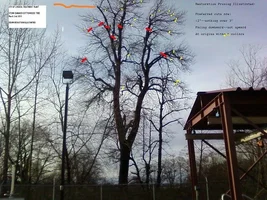
Large Cottonwood reduction

Attached pic is of a 5 ft. dbh Cotttonwood. The red lines represent proposed reduction cuts.
This tree is growing on a dike (next to river) that is about 60 feet from sewage treatment plant. A 4 inch limb tore off and almost hit (expensive) photovotaic equiptment.
All involved agencies (fish, river, wildlife) have approved trimming, no tree removal allowed in sensitive area.
Cut and drop all limbs (into blackberries!). I figure 1 hr. to ascend, 3 hrs. to trim, 1 hr. to pack up and have a cigarette.
Should prove to be a fun climb... will take pics!
 

Attachments

  • 271081-LyndenTreatmentPlantCottonwood.webp
    271081-LyndenTreatmentPlantCottonwood.webp
    225.9 KB · Views: 474
I can see one reduction cut you missed... at the base :P. Maybe put a cable in that bad boy. One of those stems could really do some damage if it cut loose.

I had the pleasure of climbing a few of these mammoths when I was out west, and I did not enjoy them. I don't enjoy any of the poplar species really. Best of luck, post the after picks.
 
Nice to be able to walk away after cutting!

Where i come from,If i was to "reduce" such a tree like what you have marked out on the picture i would not be called an arborist but would be called a lopper......
 
I like those deep bark furrows cottonwoods get. Kinda like rock climbing. Not too impressed by the reduction plan either but it sounds like that's the way she goes. I'd hate to work around blackberries, good excuse for a zip line.
 
I posted the pic hoping for some input. The 'reduction' is more than I like but the client (city!) is pushing for more to be cut. Removal is not an option.
Problematic cottonwood trees are generally removed. I can't think of too many times that I have 'pruned' a cottonwood or alder. Weeds around here...
Note: the sewage treatent plant is new and there is a walking trail under the tree. Everyone is freaking out since the big limb broke... tree phobia for sure.
 
Crown reduction isn't going to make the tree completely safe, remaining branches will still need to be pruned. Where did the branch break off from?
 
Completely unnecessary and will create a greater level of hazard in the future. But, I get where you're coming from. I do some work out here that is similar, removing limbs larger than 1/2 the diameter right back to the trunk so the limbs don't hang over a pathway. Done for a GO as well. It is unfortunate that they can't be convinced to pre-rig or install a dynamic cabling system, thus preserving the structural integrity of the woody cylinder. Or even if a guy was able to convince them to make smaller cuts to reduce the lever arm. Trust me mang, BTDT. Do what you gotta do.

I guess I'm a freak but I like climbing big ol cottonwoods. The one in my avatar is a decent sized one in Calgary. That was where I apprenticed and they were pretty much the only medium to large decurrent trees available.
 
"If the tree is vigorously growing or the total amount of foliage/live wood being removed is at its maximum, avoid compromising on the reduction cut (water sprout) guideline, as the tree is more prone to water sprout growth. With growth, the tree may become more prone to storm damage than before pruning. If the tree will be pruned each year (dealing with the water sprout growth) this becomes less of an issue."
"If tree failure would not cause injury or significant property damage, no pruning may be the better option."


"If tree failure would cause injury or significant property damage, it may be better to accept limited decay and work with resulting structural issues from re-growth than to leave the tree at high risk for storm damage."

Above is info from internet while searching ANSI A300 standards.

"Make that thing into a hat rack..... I mean it is a cottonwood." - I'm with you p/u climber... Steve
 
[ QUOTE ]
Attached pic is of a 5 ft. dbh Cotttonwood. The red lines represent proposed reduction cuts.

[/ QUOTE ]It looks like the 3 main leaders are getting cut back to the same predetermined level. if branches are the concern, why is the top getting cut back so hard? This could be called topping, even if the cuts are made to nodes, because it does not regard structure and health. Quick rot and crazy sprouting would seem inevitable.

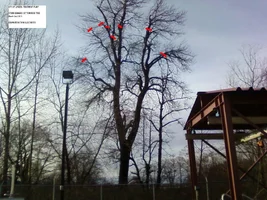
Yellow dots at proposed cuts, 40 or more, <2". Handsaw and pole pruner, i'd take ~2-4 hrs in tree; why rush, when it takes time to read the tree and do it right? Re-prune when sprouting slows down, 5 year cycle?

Orange line point to stub--is this the branch that broke? If so that shows that tip reduction like the yellow locations should be adequate to mitigate that risk to a reasonable level.
 

Attachments

  • 271408-cottonwood110313.webp
    271408-cottonwood110313.webp
    96.2 KB · Views: 175
Guymayor- You are correct, the orange line is where the branch broke and flew into the treatment plant.
I agree with your yellow cuts. Except that it is a Cottonwood tree... and the boys @ Public Works want to see the tree "short". I am in a hard spot. I have heard opinions that say <4 or even <6" is ok on a Cottonwood tree.
Sucks to be the one to have to think about this project. The other funny problem is that I can see the tree from the window at City Hall! I bet the mayor looks at it every morning...

I appreciate all the feedback.
 
u I agree with your yellow cuts. Except that it is a Cottonwood tree.

g the weaker the tree is at compartmentalizing, the smaller the cuts should be, so I don't understand.

u.. and the boys @ Public Works want to see the tree "short".

g and who is the staff biologist at pw that approved this? Tree failed because it was too wide, but they want it shorter, and with weaker branches. O K.... I can agree with shorter--your pic cut off the top (prematurely?)but the cuts could be at or above the yellow dots

u I am in a hard spot.

g if you top it and it rots and then it fails because of the rot...might you be exposed to liability?
ooo.gif
Ask a lawyer!

u I have heard opinions that say <4 or even <6" is ok on a Cottonwood tree.

g are those opinions from the same staff biologists at pw? vitality etc is a big question--root health?--but I wonder what cottonwood experts here (i am not one) think

u Sucks to be the one to have to think about this project.

g yes it must but in time it can turn out well for your future work with them. Or not; this is a defining moment!

u The other funny problem is that I can see the tree from the window at City Hall! I bet the mayor looks at it every morning...

g then maybe she or his agent--does the town have an arborist/uf/la?-- might be interested in the work being done to industry standard and maintaining health and stability, instead of becoming a sick rotting ugly mess.

just one opinion.
smile.gif
 
I agree with Guy's proposed cuts. Is it be possible to make reduction cuts ONLY on limbs or branches growing towards the target?

The reality is 4-6 inch cuts on a poplar are going to introduce and accelerate decay; this tree appears to be mature. Poplars are notoriously weak compartmentalizers. Large cuts like that will initiate sprouting. You'll end up with a similar problem as with topping. Decay accelerating down the woody cylinder and sprouts vigorously growing above old cuts. What kind of maintenance schedule do you think you can sell? It's too bad, it looks like a decent tree and a good climb.

The only other solution I can think of is creating a wildlife snag. That would leave a 12-16 trunk for the bugs, microbes and critters to have at, and would definitely reduce the risk potential. Girdle the heck outta it to prevent sprouting. Its amazing what a cottonwood can take and still keep on pushing sprouts.
 
Guy, I am in agreement. The (smaller sized) City has no Arborist or staff biologist - this is where I come in. They trust in my credentials treatment of their trees. On this tree, they (guys at pw) have asked me to cut it (at red lines) below where it broke. I am obviously conflicted with this and appreciate the conversation.

I might also be exposed to liability if I treat the tree and another limb crashes into their property?

I am the one interested in doing the job to industry standards. That is what I do. They want the tree to not hit the poo factory. I am waiting for that Cottonwood expert to speak up on treebuzz, anyone?

In the end, I may have to explain why I trimmed the tree where I did. Your opinion is good :)


Dylanclimbs - I have thought of the same thing... reduce large limbs over the target. That would help the customer look up and say "that looks good". Then when they ask why I did not top it I will tell them why.

Also, I do have one wildlife snag to do. It is a 18" cottonwood 15 feet from fence. Tops gone, sprouting up all over. When I told public works the plan for that tree, they laugh and ask why I don't just cut it down. Because we can not: County will not allow.

-thanks!
 
U, if you have a copy of the standards you can put them to work by writing yourself proper specs.

Or you can let pw tell you what to do. I'm sure they'll be happy to get your input on how to lay pipe, too...
 
unatool,

I live near you on the coast, across your northern border. Very similar climate.

Am I a Poplar/Cottonwood expert? Hmm. I've built a living green retaining wall out of interlaced poplar limbs in a spot guaranteed to stay wet, ten years later the old limbs are fairly rotted in spots, but it has well rooted, needs pruning for abatement every two years and controls erosion like nothing else.

Dylanclimbs sounds quite expert, and I would agree with him that 4-6" cuts on a cottonwood have little chance of compartmentalization, will rot, and re-sprout. You'd be setting up a spiral of decline and repeat maintenance. Ca-ching$$$.

With Muni budgets being tight, maybe you have to sell end-weight-reduction per guys specs to engineers with the concept of levers and reducing leveraged weight. Maybe you can compare/convert unfamiliar terms like poor compartmentalization to expected loss of structural integrity.

I know, a lot of work for the hated cottonwood. Weeds, right. But if the tree has to stay, it should be done properly, and who has that say if not the Arborist?

Northwind
 
G, copy in each truck...

"I know, a lot of work for the hated cottonwood. Weeds, right. But if the tree has to stay, it should be done properly, and who has that say if not the Arborist?"


- I think this is the best take on situation. The advice is well taken and I shall make it so.
thanks, Steve
 

New threads New posts

Back
Top Bottom