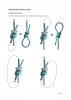
Is there a name for this loop knot? Is it safe for climbing use?

Winchman

Carpal tunnel level member
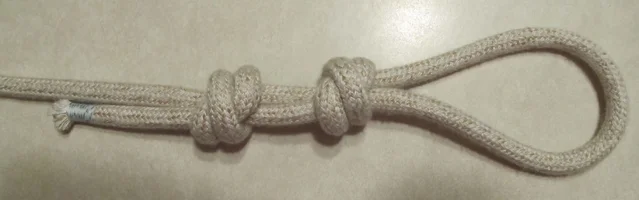
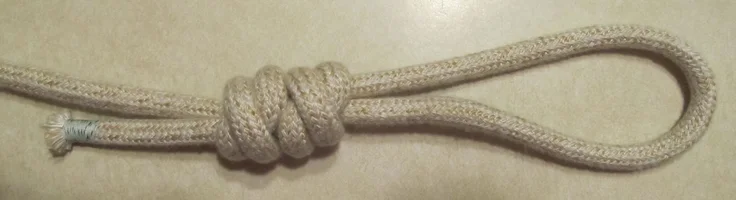
I'd call it a double fisherman's bend on a bight. It's similar to a poacher's knot, but the size of the loop doesn't change when you pull on it. It's easy to tie, and it uses less rope than a double figure eight on a bight. It might be useful for a semi-permanent eye where you want a thimble, and you don't want the thimble to get sucked into the knot. Of course, having it get welded under heavy load is a downside risk.
IMG_3339 (2).webp
IMG_3340 (2).webp
Seeing as it's just two double overhand stoppers, it should be trustworthy. It looks pretty sleek, too.
 
Scaffold knot ("half a double-fisherman's knot) will slip off of a 'keylock' style carabiner easily enough for life-support. Its been my go-to termination knot for over a decade.
That's what I use on the carabiners on my safety lanyard. They stay in place very well, but can be removed easily if necessary.
 
I'd call it a double fisherman's bend on a bight. It's similar to a poacher's knot, but the size of the loop doesn't change when you pull on it. It's easy to tie, and it uses less rope than a double figure eight on a bight. It might be useful for a semi-permanent eye where you want a thimble, and you don't want the thimble to get sucked into the knot. Of course, having it get welded under heavy load is a downside risk.
View attachment 64879
View attachment 64880
Seeing as it's just two double overhand stoppers, it should be trustworthy. It looks pretty sleek, too.
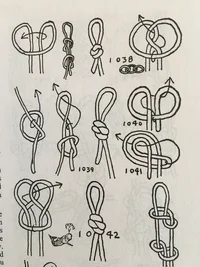
This is one of those cases where knot terminology is a mess. Ashley shows a fixed loop that is tied with two single overhand knots that lock together to form a fixed loop. He gives this knot several names, including the Englishman's loop, Fisherman's loop, Angler's loop, and True Lover's knot (ABOK #1038). All of those knots are tied with two single overhand knots that lock together, whereas the knot you show is tied with two double overhand knots that lock together to form a fixed loop. I refer to the knot you show as the "Locking Double Overhand Loop" as it consists of two double overhand knots that are tied so that one slides down and locks on the other, creating a fixed loop, as opposed to a noose that slides shut and locks on the biner, such as the Scaffold knot or Poacher's Knot.

I am not sure if I would call your knot a bend or a Double Fisherman because it is not a bend and the term "Double Fisherman" is already used incorrectly by arborists for too many knots, and because it creates a single loop as opposed to a double loop. The knot you show is strong and secure and is fine for life support. However, about the only time I ever use it is if I want to make fixed stirrups in the end of a rope. Because once it is loaded it is extremely difficult to get untied.
 
Last edited:
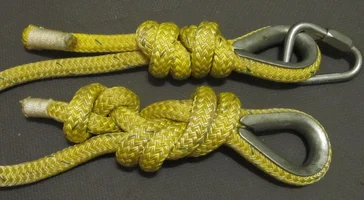
I could use it to secure the stationary end of the rope to the delta link at the upper end of my 3:1 climbing rig. The fixed size of the loop will work well with the thimble, and the knot itself is smaller that a figure eight on a bight with a stopper I've been using. It's lightly loaded, so welding of the knot isn't an issue. I'd only need to untie it when I reverse the rope to even the wear.

I could also use it to hold the thimble at the end of the 5/8" stable braid I use for my basal anchor. That one sees more load, but I probably won't ever need to untie it.

Here's a comparison of the knots.
IMG_3342 (2).webp
 
I could use it to secure the stationary end of the rope to the delta link at the upper end of my 3:1 climbing rig. The fixed size of the loop will work well with the thimble, and the knot itself is smaller that a figure eight on a bight with a stopper I've been using. It's lightly loaded, so welding of the knot isn't an issue. I'd only need to untie it when I reverse the rope to even the wear.

I could also use it to hold the thimble at the end of the 5/8" stable braid I use for my basal anchor. That one sees more load, but I probably won't ever need to untie it.

Here's a comparison of the knots.
View attachment 64895
Looks nice. If you learn to splice you can get rid of the knot entirely and it will be even stronger! ;)
 
X2 on the splice!

A properly tied and dressed figure 8 on a bight (or follow through) does not require a stopper knot and will retain more strength than the fishermans. It's definitely a cool looking knot though.
 
To contribute some more to this, albeit aged thread ...

It's a Grapevine eye knot. A Chouinard catalogue some decades ago showed a similar eye knot, differing in that the SPart was knotted with just an overhand & not a strangle ("STRANGLE", not "half a double..." ! ;) ), supposedly so to have the knot be more easily loosened. Beyond that, though, I've not seen much reference to it.
(The "poacher's / scaffold knots" would be better referred to as "strangle (dble.strangle...) nooses".)

As for strength, um, WHEN has that at all mattered? And when have you got information that really is trustworthy about it. Per the knots cited here, the Dave Richards testing in 3 kernmantle ropes had the grapevine end-2-end knot strongest (but for one wildly high-flying butterfly(!). And who knows WHAT exact knot geometries --well, esp. re the Fig.8 eye knots-- were taking the force in the test : perfect forms, interior- or exterior-strand loaded, or some mix-up as seen in Life_on_a_Line (where the argued for matter for the eye knots seems to have been lost when the end-2-end knot was presented (i.e., different forms).
For the late DRichards's report, cf. https://caves.org/section/vertical/nh/50/knotrope-hold.html
And NB: the data tables are obviously right (well, not confused per rope type) whereas the graphs for the two larger ropes got swapped --the respective forces only make sense for each of the 7-10-12mm ropes, clearly. Also, I recall there being something a bit amiss in a lower graph as well, maybe re one knot.

Looks nice. If you learn to splice you can get rid of the knot entirely and it will be even stronger!
Are you sure?
It came as quite a surprise to me to see info --on maker's site- that in some yachting standard nylon (?) double-braid the eye splice mustered strength only in the 75-85% range. (Clearly not per Cordage Institute guidelines where eye splice IS the rope strength!).
And the strangle noose and some well-made eye knots should approach this, in that rope (and in the brief magazine-reported testing I think one did, even bettered it!). For the Fig.8 EK, e.g., tucking the tail back down through the knot will give the SPart's U-turn a 3dia load of stuff to crunch (and heat sink?) and w/smart dressing AND setting I'll wager makes for an amply strong termination.
Then, again, this will matter ... when?


*kN*

 

Attachments

  • 1596923432570.png
    1596923432570.png
    314.7 KB · Views: 9
Is there a name for this loop knot? Is it safe for climbing use?
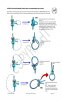
It is a corresponding eye knot from #1415 Double Fishermans bend.
Note that all end-to-end joining knots (ie 'bends') have 4 corresponding eye knots.
Yes - it is 'safe' for climbing. But, it jams - so it is not efficient or of any practical value (in the sense that you would need to use marlin spikes and a hammer to have any chance of loosening and untying the knot.
There are much better fixed eye knots to select from... ones that are either jam proof or jam resistant.

There is a remarkable corresponding eye knot of the Butterfly bend.
It is EEL (either end loadable) and dresses into a very compact uniform state (refer attached image).

Also note that in all cases, the MBS yield point (ie strength) of a knot is irrelevant.
There is no load that a tree climber can personally generate on fall protection PPE that will reach the MBS yield point of a knot. You are more likely to damage your rope via contact with sharp edges (eg a cutting blade) or abrasive tree surfaces.
 

Attachments

  • Double Fishermans bend_corresponding-eyeknots.jpg
    Double Fishermans bend_corresponding-eyeknots.jpg
    241.7 KB · Views: 18
  • Butterfly_Corresponding_Eye-knots.jpg
    Butterfly_Corresponding_Eye-knots.jpg
    323.8 KB · Views: 22
Thanks for looking up and posting that info. I realized a while back that I'd be coming apart before the rope or any part of my climbing rig broke in a fall. I worry more about getting stuck up in a tree that about falling out of one.
 

New threads New posts

Back
Top Bottom