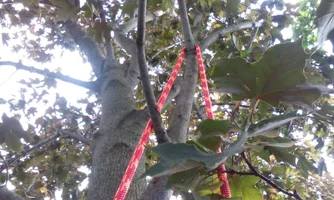
How small of top will you climb into?

i go by forearm, bicep and thigh. if its a good sound tree with good crotch strength i use forearm sized, crap trees like a tulip popular i set on thigh and may move smaller once up there and i can get it around the stem. in between good and crap i use bicep size. thats how i was taught and its stuck with me. works well for a variety of sized climbers too. for production climbing i cant think of when you would need to climb on a crotch less than 3". if you cant fit a top with 3" diameter in the drop zone on a rope your in for a stupid long day anyway.
 
i go by forearm, bicep and thigh. if its a good sound tree with good crotch strength i use forearm sized, crap trees like a tulip popular i set on thigh and may move smaller once up there and i can get it around the stem. in between good and crap i use bicep size. thats how i was taught and its stuck with me. works well for a variety of sized climbers too. for production climbing i cant think of when you would need to climb on a crotch less than 3". if you cant fit a top with 3" diameter in the drop zone on a rope your in for a stupid long day anyway.
Lindens often have smaller tops to get a high angle tie in we have lots of maples etc that are maybe 40' high but 50'-60' wide high angle is key for a less sucky day. I go by my wrist size lots of the times but get up there and see it before anchoring in. Also younger trees to structure prune etc 3" is half way up the tree
 
With smaller crotches or lately ash being extra brittle but still needing height I'll cow hitch a sling or my fs as far down below the crotch as possible and flip the rings or biner up through the smaller crotch so I'm actually girthed to something larger and I've even put back up slings and biners 2 or 3 at 3' increments going down from the top as back ups.

If I'm reading that right - you'd be putting double your weight on that smaller crotch. Or were you using a separate line for the lower "safety" to the one over the upper "maybe" crotch?
 
i go by forearm, bicep and thigh. if its a good sound tree with good crotch strength i use forearm sized, crap trees like a tulip popular i set on thigh and may move smaller once up there and i can get it around the stem. in between good and crap i use bicep size. thats how i was taught and its stuck with me. works well for a variety of sized climbers too. for production climbing i cant think of when you would need to climb on a crotch less than 3". if you cant fit a top with 3" diameter in the drop zone on a rope your in for a stupid long day anyway.
I like that rule of thumb. Can you list some species of trees that fall in each category?
Thanks
 
good - oaks, gum, pine (if you are all the way in the crotch - ive seen good sized limbs pulled off not far off the crotch), hickory. in between are maples, locust, birch. big sized tulip popular, ash(i dont trust ash - havnt since the first one i climbed), paulonia.

these are kind of broad. the best i can say is you are way better off setting lower and having to toss a monkey fist to advance your tip than you are falling trying to get to cute. these are all relative also, just tied to a branch you have to account for attachment angle, how strong the wood is, and prior experience. if you can set a line around the stem supported by a branch then you can go way smaller because the stem is holding the weight. i guess my disclaimer is dont be stupid, and if you are stupid and fall from trying a too small tie in dont come point at me. that and ive only been climbing for 8 years, there are alot of people with a whole lot more experience and smarts than me on this forum.
 
If I'm reading that right - you'd be putting double your weight on that smaller crotch. Or were you using a separate line for the lower "safety" to the one over the upper "maybe" crotch?
You are right. It is extra pressure on the crotch but no more than SRT I believe. But that's why I use a long sling so my tie in is anchored to something bigger just in case
 
good - oaks, gum, pine (if you are all the way in the crotch - ive seen good sized limbs pulled off not far off the crotch), hickory. in between are maples, locust, birch. big sized tulip popular, ash(i dont trust ash - havnt since the first one i climbed), paulonia.

these are kind of broad. the best i can say is you are way better off setting lower and having to toss a monkey fist to advance your tip than you are falling trying to get to cute. these are all relative also, just tied to a branch you have to account for attachment angle, how strong the wood is, and prior experience. if you can set a line around the stem supported by a branch then you can go way smaller because the stem is holding the weight. i guess my disclaimer is dont be stupid, and if you are stupid and fall from trying a too small tie in dont come point at me. that and ive only been climbing for 8 years, there are alot of people with a whole lot more experience and smarts than me on this forum.
As well condition of the tree and season has to be accounted for
 
I like that forearm, bicep, thigh rule. Simple and easy to remember. I mostly climb white oak and ponderosa pine with some other random trees every now and then. So here is another question for you guys. on that cedar I removed how would you go about getting a high TIP on that tree? There really is not a way I could find to get a throwline over something I was comfortable with without just climbing it and setting a TIP. And on removals like that even if your just bombing all the limbs do you climb up and set your TIP and then go back down and start limbing? I ended up just tying in twice to whatever was close and big enough with my flipline and climb line. It worked but seemed very time consuming...
 
Maybe this has already been covered, but it brings up the idea of a fishing pole, where maybe you could use multiple slings and biners along a skinny stem to try to share the load or at least provide multiple, fairly closely spaced backups to the highest suspension point. It might even provide a braking action if the top point were to break out. Just a thought. I always feel like I can use more slings and biners than I already have.

Tim
 
Maybe this has already been covered, but it brings up the idea of a fishing pole, where maybe you could use multiple slings and biners along a skinny stem to try to share the load or at least provide multiple, fairly closely spaced backups to the highest suspension point. It might even provide a braking action if the top point were to break out. Just a thought. I always feel like I can use more slings and biners than I already have.

Tim
Last time I saw that was more srt but good idea all the same
 
When tying in a lot depends on how much horizontal(maybe lateral is a better term) movement you are going to be doing off a tie in point. You can tie in to something pretty small if u are going to be moving straight up or down. Basically how much leverage are you going to be putting on your tie in point. On small tops in larger trees u can usually tie in high just to get the tops, then move your tie in point down when u will be working horizontaly off it. In most cases if you feel the need to back up your tie in point you are in the wrong place. Lots of variables, play it safe and as you get more experience it will all make more sense. ;)
 
........ In most cases if you feel the need to back up your tie in point you are in the wrong place....
I understand your comment but I feel it is a little like saying, "don't go out on a limb".
I often back up my TIP, even when choosing what kind of anchor I'm going to set to access the tree and how I deal with the tree structure when I move around and get where I want to be.
 
I understand your comment but I feel it is a little like saying, "don't go out on a limb".
I often back up my TIP, even when choosing what kind of anchor I'm going to set to access the tree and how I deal with the tree structure when I move around and get where I want to be.

Nothing wrong with backing up your TIP by using the structure of the tree while ascending. This comes into play much more with single line and a base anchor. If you have a shitty TIP even with a larger branch underneath to "back it up" it can go bad. If the shitty TIP breaks the rope might only drop a foot into the larger crotch beneath it. That foot would be more than enough on a limb walk to send you flying. Or if you are making a chainsaw cut. Even when bucked in and and the TIP only dropping a foot it would be super easy to put that chainsaw somewhere you don't want it. A shitty TIP(backed up) for ascending is one thing, a shitty TIP for working the tree is something completely different. Just my opinion, I am sure we have all worked off some less than optimal TIPs.
 

New threads New posts

Back
Top Bottom