
- Location
- Poland, OH
"O" rig... Yes?

Follow along with the video below to see how to install our site as a web app on your home screen.
Note: This feature may not be available in some browsers.


I recently ordered a hitch climber setup (have been climbing on a taughtline hitch forever) and I am curious about termination knot possibilities. My climbing line does not have a spliced eye, nor do I really feel like spending the money to get one at this juncture, but I am aware of the potential problems with the termination knot affecting the friction hitch. Is there an alternative termination knot that can be used that will not affect the friction hitch?
Is there any problem with using the spliced end of the climb line on the termination end? I thought I heard once that it's not good for the splice but I can't really see why.
Is there any problem with using the spliced end of the climb line on the termination end? I thought I heard once that it's not good for the splice but I can't really see why. In the O-rig that is...
If you position the hitch climber close to you then the splice will be bent in your biner / ring / pulley whatever you have connected the "O" to. This bending of the splice should be avoided.
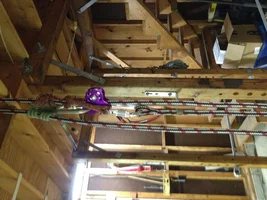
View attachment 33504
"O" rig... Yes?
Yes best avoided, you could ruin your splice, the nice part of the system is the adjustment and being able to move it as close to you when needed.
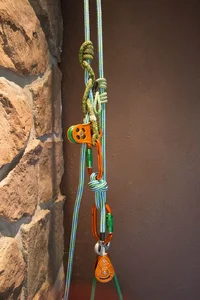
View attachment 33506

Here's a Red Wings commercial featuring fellow buzzer Raven. You'll see the O Rig in action when he's on his initial ascent. If I climbed DdRT regularly anymore, I'd still use this very helpful tool. IMO, it's most helpful on long ascents and limb walk returns. Unfortunately, compared to SRT ropewalking, the O Rig's got nothing in comparison on long ascents. But it's leaps and bounds better than body thrusting, and manually tending your hitch. In a nutshell, the O Rig moves your climbing hitch almost out of reach, so that you can body thrust without even thinking about your hitch, and it sucks up the slack with every pull of the fall line. In addition, it's adjustable, like a pulley on a prusik in a typical mechanical advantage setup. So you can move the system away from you when beneficial, but close to you again when it's a better fit for the station you're in.I tried to find something on the web about the "O" system, with little success. There's one short video I found on YouTube, but for me it produced no sound, so I could not hear the climber's explanation of how it all worked.
I was kinda hoping for others to weigh in as well. Im kinda new at forums and threads so I'm wondering if this topic should be in a different place.
Here's a Red Wings commercial featuring fellow buzzer Raven. You'll see the O Rig in action when he's on his initial ascent. If I climbed DdRT regularly anymore, I'd still use this very helpful tool. IMO, it's most helpful on long ascents and limb walk returns. Unfortunately, compared to SRT ropewalking, the O Rig's got nothing in comparison on long ascents. But it's leaps and bounds better than body thrusting, and manually tending your hitch. In a nutshell, the O Rig moves your climbing hitch almost out of reach, so that you can body thrust without even thinking about your hitch, and it sucks up the slack with every pull of the fall line. In addition, it's adjustable, like a pulley on a prusik in a typical mechanical advantage setup. So you can move the system away from you when beneficial, but close to you again when it's a better fit for the station you're in.
BTW, this is a pretty cool video...one of my faves. You'll notice some good quadcopter footage and crane work.

I usually take them off before I go to bed at night.
The same pair???? Pewwwwwwww....Just for the record, before anyone jumps on it, when I say I've been wearing Redwing boots for 25 years, I don't mean without a break.


