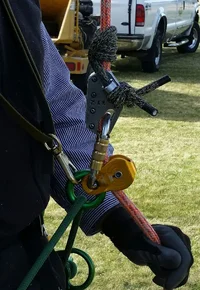
HH2 Hitch Length

My preferred hitch is technically a 4/1 VT. It is just one wrap away from the Ropetek recommended hitch and with a little monkeying around will turn itself into a 3/2 VT. It works great, smooth as silk with the ropes and hitch cord that I use.

Climbers need to understand though, that a configuration that works spectacularly on one set of ropes, hitches, and situations is not enough to say it will work well for you. Climbers that use hitches really do need to understand how they work. Just copying someone else's setup may not give you what you were hoping for and without a good working knowledge, you will not know why.

20150409_100225-1.webp
 
My preferred hitch is technically a 4/1 VT. It is just one wrap away from the Ropetek recommended hitch and with a little monkeying around will turn itself into a 3/2 VT.

View attachment 60992

You find that the pulley really helps tending with the HH?

I have a 4-hole rigging plate on my bridge right now since I often will use MRS for short jaunts during a climb, and enjoy having multiple places to hook secondary and tertiary connections to my bridge (keeps it from getting too crowded with multiple tie-ins). BUT, if I could add a pulley to help tending and be able to use one with a rated becket for a secondary attachment point, I might try going back to just a ring on the bridge to try and compact things around that area slightly.
 
My preferred hitch is technically a 4/1 VT. It is just one wrap away from the Ropetek recommended hitch and with a little monkeying around will turn itself into a 3/2 VT. It works great, smooth as silk with the ropes and hitch cord that I use.

Climbers need to understand though, that a configuration that works spectacularly on one set of ropes, hitches, and situations is not enough to say it will work well for you. Climbers that use hitches really do need to understand how they work. Just copying someone else's setup may not give you what you were hoping for and without a good working knowledge, you will not know why.

View attachment 60992
What hitch cord is that DSMc?
 
You find that the pulley really helps tending with the HH?

It just makes the already smooth tending, smoother. But it does three other things as well. It keeps the carabiner in line with the HH when you pull up on the tail facilitating advancing. It makes a haul-back setup much smoother. Lastly, when I tighten my chest harness, the pulley comes up and closer to my chest making things real easy with little need to use my arms. Not as good, but similar to a chest roller.
 
My preferred hitch is technically a 4/1 VT. It is just one wrap away from the Ropetek recommended hitch and with a little monkeying around will turn itself into a 3/2 VT. It works great, smooth as silk with the ropes and hitch cord that I use.

Climbers need to understand though, that a configuration that works spectacularly on one set of ropes, hitches, and situations is not enough to say it will work well for you. Climbers that use hitches really do need to understand how they work. Just copying someone else's setup may not give you what you were hoping for and without a good working knowledge, you will not know why.

View attachment 60992
Great point DSMc. What works great for others might not work so well for you,. There are just too many variables for a one size fits all answer. Rope and prusik used. Work environment/type of work, weight of climber, etc.
 
Last edited:
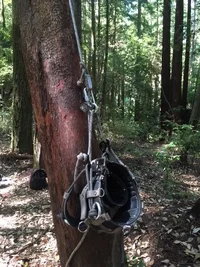
The HH2 setup has the dog bone and the carabiner providing friction as well.
You wouldn't drop very fast if your hitch collapsed.
Using a good hitch cord and rope combo makes all the difference.
1/2" Vortex and 9mm RIT make a great combination.
 
The HH2 setup has the dog bone and the carabiner providing friction as well.
You wouldn't drop very fast if your hitch collapsed.
Using a good hitch cord and rope combo makes all the difference.
1/2" Vortex and 9mm RIT make a great combination.
I don't own a HH, or ever used one, but if the hitch collapsed I don't believe the dogbone would provide any friction, the carabiner won't provide much either.
 
The HH2 setup has the dog bone and the carabiner providing friction as well.
You wouldn't drop very fast if your hitch collapsed.
Using a good hitch cord and rope combo makes all the difference.
1/2" Vortex and 9mm RIT make a great combination.

If the hitch fails, there is nothing remaining to pull the body of the hitch hiker up into the rope and, thus, to press the carabiner into the rope towards the spine.

In other words, there has to be something to cause the HH's body to resist being pulled downwards for the carabiner and dog bone to constrict the rope.
 
Last edited:
Also, I switched to some fatter hitch cord from the RIT - Sterling Flex 10mm - and, at least for my weight (~220lbs-ish loaded), the hitch I use, how I tie it (tight as I can humanly get it before leaving the ground), etc., etc., I greatly prefer it to the RIT. Also tried some 9.3 epiCORD and that worked really well too. Just seems to release a little easier than the smaller diameter 9mm RIT.

I'm tying the hitch described in the Hitchhiker instructions (Valdotain sans tresses), and sometimes play around with one less wrap (helps tending, i.e., tending without causing my neck lanyard to rip a mole off, or cut into my neck meat).

*I know crap about any of this and am a total newb.
 
Gave the HH a good run yesterday in some Madrone's using the recommended HH Hitch, but with only 3 wraps and a pulley underneath it. Man was it smooth, fast, and effortless. I know the HH with the HTP/HRC combo has the potential for magic and this was just about there. One of the most enjoyable climbs I have had in a long time.

IMG_1601.webp
 
Last edited:
That an MCRS, @rico?

Switched back to the HH2 yesterday for a few partial ascents, and tried the recommended hitch, but with 4 wraps instead of 5 like usual (that's what I'd always run). Did the little 'setting' procedure that someone recommended on the ground (weight, slack, take up slack, repeat, etc., etc.), and ended up with <2" between bottom of hitch and top of HH body, as also recommended (that thing is tight if it fulfills the 2" criterion after being weighted). It tended dramatically easier as the result of having fewer wraps (at least, there is a correlation). Made me want to incorporate climbing on the HH2 much more regularly than I currently do.

I'd gone to the Rope Runner last month or a little more (from the HH2), and have at least enough climbs on it with Vortex to wear some of the friction plate's anodizing off. Probably the most apparent advantage of it to me, if you aren't familiar with my other posts, is the ease of tending, at least with respect to the HH2.
 
Yea that's the MCRS. Tell me about the Rope Runner. I have been drooling over one for awhile but am a little gun-shy when it comes to mechanicals.
 

New threads New posts

Back
Top Bottom