Awesome! I tuned out from that thread, couldn't keep up!

Navigation
Install the app
How to install the app on iOS
Follow along with the video below to see how to install our site as a web app on your home screen.
Note: This feature may not be available in some browsers.
More options
You are using an out of date browser. It may not display this or other websites correctly.
You should upgrade or use an alternative browser.
You should upgrade or use an alternative browser.
HH2 for twin rope
- Thread starter SoftBankHawks
- Start date

SoftBankHawks
Branched out member
- Location
- Japan
Hi Tim,I'm pretty certain that I do not understand all of the subtleties that SoftBankHawks is trying to convey about how he deploys his Twin Rope Technique system. I'll need to read it through a few times to see if that helps.
What I will say about JohnnyPro's method of deployment that is a weakness of the system (in my humble opinion) compared to using two separate ropes with two separate SRT systems, is that you lose the safety factor of having two systems. JohnnyPro's setup effectively creates one large, highly adjustable system, but a failure of the system anywhere along either rope is a failure of both ropes.
I have not yet attempted to use JohnnyPro's Twin Rope Technique, as I do not own the equipment it takes to do it. I also have probably not had a circumstance yet that would play to its strengths, even if I did have the gear.
I tend to be a cautious climber, so I like having the redundancy that DSRT offers, and this is how I climb most often. Not saying that I won't ever try JohnnyPro's technique, if the opportunity presents itself.
Tim
It's best to think of it as 1 system but distinct because you can do different things with it. So I use it for DSRT, the other rope ar the moment being a normal 11.7mm db with RR or RW. TRT by itself has nothing to do with DSRT.

TylerHoffman
Participating member
where did you buy the 8mm sirius and that hitch cord???It's 8mm marine sirius, very round cross-section, unlike the arb version that flattens out, very static too. Maybe the zk1 is OK, I set up the zk2 and it sat uncomfortably, just not enough space.
TylerHoffman
Participating member
It would, but id rather carry a bag of sand. hahaI wonder if Gordon could design a "plus" size bulldog that would accept two larger ropes? That would be interesting.
TimBr
Official Well Known Greeter
- Location
- Northern Virginia
SoftBankHawks said: "Hi Tim,
It's best to think of it as 1 system but distinct because you can do different things with it. So I use it for DSRT, the other rope ar the moment being a normal 11.7mm db with RR or RW. TRT by itself has nothing to do with DSRT."
--------------------------------------------------------------------------------------------------------------------
My response:
So, if I'm reading you right, you actually have three ropes in one tree? Two for the Twin Rope Technique, and one additional for SRT? Combine both systems and you have DSRT, correct?
It just occurred to me that if they made a suitable rope, one that is thin enough, strong enough, and capable of being spliced at both ends, you could use one long rope in a giant loop for the Twin Rope Technique. The bight of the rope would sit at the bottom of the tree, hopefully with a bit extra for safety.
So in this way, you'd only need two ropes to do the Twin Rope Technique/DSRT combo. I think I like this idea. Now we just have to find a rope that fills the bill. For all I know, JohnnyPro's rope would work. Just need to check to see if it's able to be spliced at both ends or not.
Tim
It's best to think of it as 1 system but distinct because you can do different things with it. So I use it for DSRT, the other rope ar the moment being a normal 11.7mm db with RR or RW. TRT by itself has nothing to do with DSRT."
--------------------------------------------------------------------------------------------------------------------
My response:
So, if I'm reading you right, you actually have three ropes in one tree? Two for the Twin Rope Technique, and one additional for SRT? Combine both systems and you have DSRT, correct?
It just occurred to me that if they made a suitable rope, one that is thin enough, strong enough, and capable of being spliced at both ends, you could use one long rope in a giant loop for the Twin Rope Technique. The bight of the rope would sit at the bottom of the tree, hopefully with a bit extra for safety.
So in this way, you'd only need two ropes to do the Twin Rope Technique/DSRT combo. I think I like this idea. Now we just have to find a rope that fills the bill. For all I know, JohnnyPro's rope would work. Just need to check to see if it's able to be spliced at both ends or not.
Tim

NE Tree
Branched out member
- Location
- fremont, Ne
Dsrt is just 2 separate srt lines with different tie -ins and separate srt devices hooked to one climber. Trt is two lines hooked together to form one big loop and the working ends run through the same deviceSoftBankHawks said: "Hi Tim,
It's best to think of it as 1 system but distinct because you can do different things with it. So I use it for DSRT, the other rope ar the moment being a normal 11.7mm db with RR or RW. TRT by itself has nothing to do with DSRT."
--------------------------------------------------------------------------------------------------------------------
My response:
So, if I'm reading you right, you actually have three ropes in one tree? Two for the Twin Rope Technique, and one additional for SRT? Combine both systems and you have DSRT, correct?
It just occurred to me that if they made a suitable rope, one that is thin enough, strong enough, and capable of being spliced at both ends, you could use one long rope in a giant loop for the Twin Rope Technique. The bight of the rope would sit at the bottom of the tree, hopefully with a bit extra for safety.
So in this way, you'd only need two ropes to do the Twin Rope Technique/DSRT combo. I think I like this idea. Now we just have to find a rope that fills the bill. For all I know, JohnnyPro's rope would work. Just need to check to see if it's able to be spliced at both ends or not.
Tim
NE Tree
Branched out member
- Location
- fremont, Ne
The way johnnypro uses Trt is brilliant. He certainly is a climbing genius different in his own ways.
SoftBankHawks
Branched out member
- Location
- Japan
Sure, you could do it with a loop, but, having 2 ropes that can be SEPARATED is crucial for me. A separation in front of you with a connector and 2 tails. Hauling 8mm rope is very lightweight, when you are drawing equipment in or throwing a traverse hook, a very noticeable different in fatigue.SoftBankHawks said: "Hi Tim,
It's best to think of it as 1 system but distinct because you can do different things with it. So I use it for DSRT, the other rope ar the moment being a normal 11.7mm db with RR or RW. TRT by itself has nothing to do with DSRT."
--------------------------------------------------------------------------------------------------------------------
My response:
So, if I'm reading you right, you actually have three ropes in one tree? Two for the Twin Rope Technique, and one additional for SRT? Combine both systems and you have DSRT, correct?
It just occurred to me that if they made a suitable rope, one that is thin enough, strong enough, and capable of being spliced at both ends, you could use one long rope in a giant loop for the Twin Rope Technique. The bight of the rope would sit at the bottom of the tree, hopefully with a bit extra for safety.
So in this way, you'd only need two ropes to do the Twin Rope Technique/DSRT combo. I think I like this idea. Now we just have to find a rope that fills the bill. For all I know, JohnnyPro's rope would work. Just need to check to see if it's able to be spliced at both ends or not.
Tim
SoftBankHawks
Branched out member
- Location
- Japan
I'll talk about my anchor set-up later, the picture shows the set-up to be able to pull a second line to you from a distance. The floating connector is returned to the anchor, DSRT system is set and climbed on and then the same set-up can retrieve to put the line back to waiting mode or redirected at another point.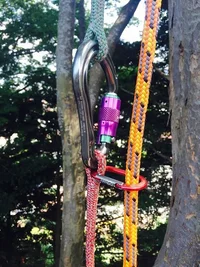
TimBr
Official Well Known Greeter
- Location
- Northern Virginia
Dsrt is just 2 separate srt lines with different tie -ins and separate srt devices hooked to one climber. Trt is two lines hooked together to form one big loop and the working ends run through the same device
Right. All of that I understood. What I thought SoftBankHawks might be trying to say was that he combined both of those systems together in order to create a hybrid system. It's brilliant, really, if that is what he was trying to say. I'm not sure if he answered my question or not yet, so I'm not sure. The idea of the hybrid system would be to get around the weakness of Twin Rope Technique, which is the loss of redundancy of climbing lines or systems.
By using one system that is a standard SRT setup, plus a second setup that is utilizing Twin Rope Technique, (which would use two separate ropes, per SoftBankHawks) you would have the advantage of the floating false crotch combined with with the backup afforded by having a second system.
If you offset the SRT system laterally so that it formed a "T" shape, you would be able to easily access almost any point in the crown of the tree.
To take this to an even more ridiculous extreme, you could utilize two separate Twin Rope Technique systems in order to create a square or diamond shape of tie-in points at the top of the crown. This might provide an almost perfect coverage of most of the crown of a tree. The limitation is the sag in the systems that JohnnyPro warns about in his video about the technique. So the highest parts of the tree might still take some work to get to.
Please forgive my rambling brainstorming session.
Tim
P.S. On second thought, I think SoftBankHawks did answer my question to some degree, because the photograph he posted shows three separate ropes; two hooked together on a biner in Twin Rope Technique configuration, plus another rope that is presumably used for his SRT system.
SoftBankHawks
Branched out member
- Location
- Japan
Here is a recent article of mine about SRT anchoring, check the Pulley Saver 2 System Loop anchor, it is as clear an explanation as I can make without showing video. It has been 2 months or so since I wrote it, the system continues to present ideas and I am trying to refine it.
http://www.works-odsk.jp/original68.html?mode=pc
http://www.works-odsk.jp/original68.html?mode=pc


Hard to say, really. I think it was diving right into DSRT with two Bull Dog Bones, though I did play with it for a while. Perhaps the need to isolate again, which I swayed away from for years with base anchoring. That, and also the ability to leapfrog the lines in DSRT, a distinct advantage that so much of my work can benefit from.Hi Eric, what stopped your exploration with tandem hitches?
I've had it in my head that TRT means constant symmetrical redirecting the fall of both lines, and not being able to hang on one side alone. Also, with hitches, performing a remote redirect by forwarding the falls and retrieving to reset onto can feel convoluted, and makes for potential of the rope to rope connector getting jammed in a redirect when pulling out the entire system following the end of a climb.
Every system has its limitations, though I'd like to see more of your TRT method. It seems very interesting!
TimBr
Official Well Known Greeter
- Location
- Northern Virginia
Here is a recent article of mine about SRT anchoring, check the Pulley Saver 2 System Loop anchor, it is as clear an explanation as I can make without showing video. It has been 2 months or so since I wrote it, the system continues to present ideas and I am trying to refine it.
http://www.works-odsk.jp/original68.html?mode=pc
SoftBankHawks! Thanks for the link to your article! Again, I have a lot of studying to do before I'll achieve a glimmer of understanding. Just outstanding quality and quantity of photographs in that article. It looks like you put in a ton of work on it. Thanks so much for making it easily and freely available to anyone who wishes to learn.
Sincerely,
Tim
TylerHoffman
Participating member
Please tell where you can purchase the 8mm sirius Paul!Here is a recent article of mine about SRT anchoring, check the Pulley Saver 2 System Loop anchor, it is as clear an explanation as I can make without showing video. It has been 2 months or so since I wrote it, the system continues to present ideas and I am trying to refine it.
http://www.works-odsk.jp/original68.html?mode=pc
SoftBankHawks
Branched out member
- Location
- Japan
I buy in Japan , google 'FSE Robline Sirius 500'.
SoftBankHawks
Branched out member
- Location
- Japan
Anchoring and Re-directing is either 'in-front of' or 'behind'. I tend to use the former.Hard to say, really. I think it was diving right into DSRT with two Bull Dog Bones, though I did play with it for a while. Perhaps the need to isolate again, which I swayed away from for years with base anchoring. That, and also the ability to leapfrog the lines in DSRT, a distinct advantage that so much of my work can benefit from.
I've had it in my head that TRT means constant symmetrical redirecting the fall of both lines, and not being able to hang on one side alone. Also, with hitches, performing a remote redirect by forwarding the falls and retrieving to reset onto can feel convoluted, and makes for potential of the rope to rope connector getting jammed in a redirect when pulling out the entire system following the end of a climb.
Every system has its limitations, though I'd like to see more of your TRT method. It seems very interesting!
On a slightly different note Working Line can be 'actively managed' or 'actively avoided'. I feel very strongly about anchor legs and want to see safety factors of distance built into the setting of them. With TRT, like Ddrt, the climber can Actively Manage the climb line as it has potential for dynamic movement, at any time and from anywhere.
SoftBankHawks
Branched out member
- Location
- Japan
It's a pleasure to give something back, kind Treebuzzers helped me so much when I began tree work. I hope that I can share something useful! For me it is a technical search for a system that makes me fluidly connect to the tree. Maybe you guys didn't hear but Oceans will come to Japan in November to teach about DSRT ideas, another arborist, an englishman called Robert Knott will teach Body Feeling, ideas taken from a martial discipline and translated to the tree climbers environment. Sharing and Connecting.SoftBankHawks! Thanks for the link to your article! Again, I have a lot of studying to do before I'll achieve a glimmer of understanding. Just outstanding quality and quantity of photographs in that article. It looks like you put in a ton of work on it. Thanks so much for making it easily and freely available to anyone who wishes to learn.
Sincerely,
Tim
http://thewoodenhand.com/workshop.html
Last edited:

Howie65
Participating member
- Location
- Aschaffenburg, Germany
I buy in Japan , google 'FSE Robline Sirius 500'.
Here is a link to Teufelberger with the Technical Data for the interested people.
http://www.teufelberger.com/en/products/marine/fse-robliner/cruising/sirius-500.html#
The MBS for the 8 mm version is stated there with 18 kN.
Because there is no information about any certification why the Pros have no concerns to use it for life support? In comparison the rope of JohnnyPro (Mammut Serenity 8.7) is certified as sinlge rope for rock climbing.
Howie65
Participating member
- Location
- Aschaffenburg, Germany
There is the New England KM III in an 8 mm version that might be interesting for TRT:
http://www.teufelberger.com/en/products/climbing-recreation/static-ropes/kmiii.html#
MBS is 21 kN and it has been certified by EN 1891 (B) and NFPA "Escape Rope".
What the Pros think about this rope?
http://www.teufelberger.com/en/products/climbing-recreation/static-ropes/kmiii.html#
MBS is 21 kN and it has been certified by EN 1891 (B) and NFPA "Escape Rope".
What the Pros think about this rope?
New threads New posts
-
test
-
-

-
-

-
First time rope and harness tree climber shows the best attitude
- Started by moss
- Replies: 7
-


