HH2 for twin rope

8mm kmiii , good find, although not being able to splice it is a shame, my anchor rings are 28mm and I'm not sure that it would be compatible. Good find though I'm gonna try some.
Sirius 500 is a polyester/polyester double braid, I bet it breaks at lower than 18kn with a knot and certainly the system needs to address issues of Safety Factor. Taking the example of a 100kg climber that is tied into a Ddrt system a 22kn rope (11-11.7mm) means a huge SF of 44:1, we can easily work in rescue and put another climber into that line and maintain a 22:1 SF. Same climber using the rope SRT has a 22:1 SF, with rescue that decreases to 10:1. 10:1 is the base for rigging items but, from memory, most industrial rope disciplines require between 14-20:1. So the climber that hooks into an 18kn or more specifically a 36kn TRT system has a SF of 36:1, this is only thinking of static force, moving on to dynamic forces I wonder how the Sirius 500 would bear but we must consider the belay, a hitch will slip at around 5kn, I'm sure the Rope Runner would be less, 2.5-3.5kn would be my guess. All of these things must be tested, I will scratch away when time permits.
 
You mean if a rope is used DdRT then the MBS doubles? Why? I would agree if you tie both ends of the rope to two separate anchors. If I pull on both sides of the rope with force F then at the highest point the rope sees 2F . So now difference between SRT and DdRT in my opinion.

With TRT you have the 2 independent anchors but in a system like JohnnyPro there is also to consider the angle of forces, right? If the angle is e.g. 45° then a anchor needs to carry 1/cos(45) of the half climber weight what is factor 1,414. If the angle is 60° then it is already 2 times the half climber weight what means the full climber weight is at every anchor again.
 
I put the Enforcer into different parts of the floating highline and was surprised at how low the forces were, friction reduces it a lot.
About the doubling of strength, of course bend radius from rope to rope is different but to think about it another way think about an eye2eye hitch cord compared to a single leg hitch cord. The belay point on the ddrt point is like this. Perhaps not doubled exactly but certainly a massive change in strength and stretch characteristic.
 
I put the Enforcer into different parts of the floating highline and was surprised at how low the forces were, friction reduces it a lot.
About the doubling of strength, of course bend radius from rope to rope is different but to think about it another way think about an eye2eye hitch cord compared to a single leg hitch cord. The belay point on the ddrt point is like this. Perhaps not doubled exactly but certainly a massive change in strength and stretch characteristic.
Was the Highline anchored directly to each support point, or was it redirected through each and tied off elsewhere?

Force on the rope itself will be one thing, but forces at the anchor points or redirects will be entirely different (moment vs. compression). I'm sure that you understand all this, SBH, though just was thinking of clarifying for myself and anyone else reading this.
 
Eric,
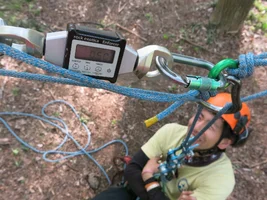
I put the load cell inside and outside the floating TRT highline, which I decided to call 2 Lovers because the top points will roll UPWARDS if set in certain ways, the ends want to come together like 2 lovers. This is scary because as you mentioned a highline set to create unnecessary leverage is un-wanted, dangerous even if it has the potential to move upwards. IMG_0715.webpIMG_0748.webp
 
Excellent photos, Paul. So in the first, we get the total load applied to the Enforcer (or one of the 2 anchor points), and in the second, we get...let's see...1/2 the load of each anchor point?
 
I dug the figures out, here ya go.

Climber weighed 68kg, all forces are in kg.

Force at the anchor (load cell outside the rope)
Centred floating anchor - 106

Non-centred floating anchor
far from load cell - 76
close to load cell - 94.

As I have been using knots I checked the forces out there too (load cell inside the rope).
Floating point - 50
Knot at ring - 32.

Ddrt double anchor was 114. SRT top anchor even higher.
 
I dug the figures out, here ya go.

Climber weighed 68kg, all forces are in kg.

Force at the anchor (load cell outside the rope)
Centred floating anchor - 106

Non-centred floating anchor
far from load cell - 76
close to load cell - 94.

As I have been using knots I checked the forces out there too (load cell inside the rope).
Floating point - 50
Knot at ring - 32.

Ddrt double anchor was 114. SRT top anchor even higher.
Ok, so the load I would be concerned about is with the Enforcer "inside" the rope, since that can really only account for 1/2, which correlates well with the Enforcer "outside" the rope, minus a bit of friction here and there.

So, the total comes out to just over 3x the climber's weight, being dispersed out to two anchor points when the "floating redirect" is centered. However, the loads are actually reduced when off center. Very nice to know.

The question I have is what interior angle does the floating anchor stop at when the lines are loaded...and the concern I have is whether or not it can creep on its own beyond the critical 120 degree interior angle. This is where the forces can really begin to multiply.
 
My concern was the same before I did this little test, seems that to get the interior angle beyond 120 degrees is really difficult and it won't slip because of the friction at 4 points, 2 at the tree and 2 at the floating point, combined with the huge amount of energy dissipation through 6 legs of rope....I hesitate to say it but...."No worries". It can't be set up to retrieve in a beautiful way though, I don't go in for draped retrieval lines, you have to re-position the floating section to one side or the other, climb up and dismantle it all and after getting into DSRT there are many more options available than the 2 Lovers can give.
I must say that Johnny Pro's amazing energy and thought pattern has brought something very unique for us. Thanks Johnny P !!
 
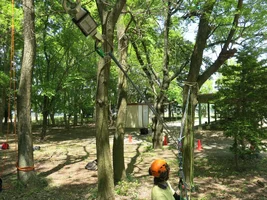
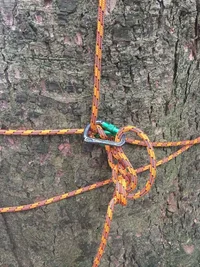
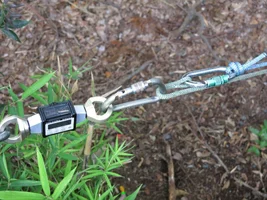
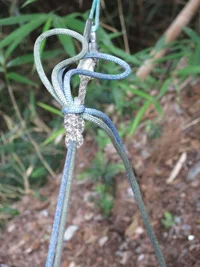
Today I worked on a rigging job, removing a large Douglas Fir, we call it a Momi here. The guys had done some rigging already and there was a throwline set at 25M. I brought 1x 40M double braid (11.7mm) and 1 x 30M TRT, both too short by themselves. I could've joined them together and later asked my ground worker to untie the whole caboodle but because of the TRT system decided on something different.

I pulled over the two standing ends of the TRT system
Unclipped the TRT connector and fed it through the anchor ring.
Continued pulling the throwline until the standing end was at ground level.
Finished tieing the trunk anchor.

The anchor ring ended way up at about 18M, but whatever the distance from the climber the TRT system can be quickly retrieved to set a crown anchor.
 

Attachments

  • IMG_6901.webp
    IMG_6901.webp
    722.2 KB · Views: 85
  • IMG_6902.webp
    IMG_6902.webp
    292.9 KB · Views: 82
  • IMG_6904.webp
    IMG_6904.webp
    995.6 KB · Views: 81
  • IMG_6905.webp
    IMG_6905.webp
    1 MB · Views: 80
Last edited:
Today I worked on a rigging job, removing a large Douglas Fir, we call it a Momi here. The guys had done some rigging already and there was a throwline set at 25M. I brought 1x 40M double braid (11.7mm) and 1 x 30M TRT, both too short by themselves. I could've joined them together and later asked my ground worker to untie the whole caboodle but because of the TRT system decided on something different.

I pulled over the two standing ends of the TRT system
Unclipped the TRT connector and fed it through the anchor ring.
Continued pulling the throw-in until the standing end was at ground level.
Finished tieing the trunk anchor.

The anchor ring ended way up at about 18M, but whatever the distance from the climber the TRT system can be quickly retrieved to set a crown anchor.
I love it. Very nice way to work with the scenario and adjust to suit your needs.

How are finding dual tail management through the HH? Any more or less an issue than the RR?
 
You mean as it runs? Hockles and stuff? I can say for sure that downward movement produces less than the RR.
Throwing 25M of rope tails around to grab winch lines and stuff is so dreamy with 8mm.

I've got a question. A rope, any rope, lets say Tachyon for want of a better one, I had always assumed that when hung in a single line would stretch more than when hung doubled? But looking at my enforcer results for the highline shows that more legs in means more shock-absorbtion...but less stretch? I'm confused !
 
You mean as it runs? Hockles and stuff? I can say for sure that downward movement produces less than the RR.
Throwing 25M of rope tails around to grab winch lines and stuff is so dreamy with 8mm.

I've got a question. A rope, any rope, lets say Tachyon for want of a better one, I had always assumed that when hung in a single line would stretch more than when hung doubled? But looking at my enforcer results for the highline shows that more legs in means more shock-absorbtion...but less stretch? I'm confused !
Interesting. Could have much to do with tree movement absorbing forces. Significant moment in the Highline config. Dunno.
 
My last post was a little misleading, apologies, the angle the climber attained by the different systems led to different outcomes.
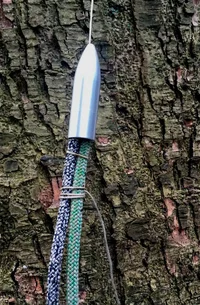
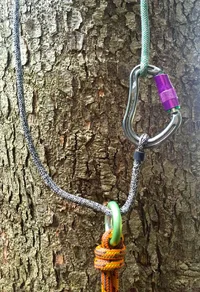
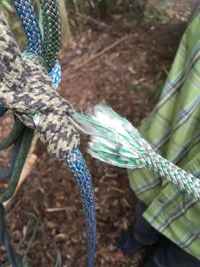
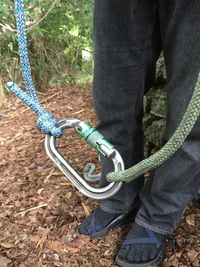
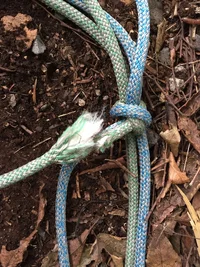
I static pulled to breaking point the 8mm sirius today. I wanted to check bend radius, bad loading with the neck of the splice around the anchor and knot strength. I pulled until something broke, surprisingly, and the first time for me to see, rope snap at the hitch. Technora is amazing....and unforgiving ! 14.5knIMG_1347.webpIMG_1349.webpIMG_6940.webp IMG_6942.webpIMG_6943.webp IMG_6945.webp
 
Interesting stuff, those enforcers are great. Keep in mind incase you missed it in the instructions....the digital force scale/meter will break long before the aluminum body (I think it is about 4000lbs). Just don't want you to break it by mistake.
 
Thanks for posting that, SBH. How was the rope connected to whatever applied the load?

It's interesting that one leg broke. Perhaps it was slightly unbalanced tension between the two legs.
 
Check the photos again, it was the leg that the technora prussik bit first into. There is a sweet set-up for breaking at ODSK. The Smartwinch is at shop level, strapped to a Zelkova, the rope goes up into the Zelkova and then much further down to the break area, about 6M. We double-whip a piggybacked 5 fold (!!) WHAT. The rigging rope is formed into a 2:1 and we pull a block and tackle. We can easily pull over 20kn but usually stop at 19.
 
Digging up an old thread. Anyone been playing around with TRT at all? Been thinking about giving this a go.
The sirius 500 isn't terribly expensive. I am wondering if this is the way to go.
 

New threads New posts

Back
Top Bottom