helmet cam, climbing a big dead tree FUN FUN FUN

Re: An appolory to the board.

[ QUOTE ]
It seems kinda cumbersome working with two ropes in that manner. Using a highline would allow you to use only one climbing rope.

[/ QUOTE ]

Absolutely, Butch. I was simply throwing out another possibility. I once worked off a tightline for a small dead maple. I posted the pics years ago on AS. I fixed a double pulley in the middle of the tight line, and used one sheave for life support and the other for lowering the tip tied tops of a small dead maple. I would have used separate tightlines, but the loads were quite small, and the anchor trees were bombproof. (Mike..take note.) And, when I got down lower, and took maybe a couple 200 pound loads, if the rigging had failed (highly unlikely), the risk to me would have been minimal,as I was lanyarded in to larger wood by then and only a few feet above the carport roof.

Mike, I've guyed trees back when sideloading on occasion...rarely has it been necessary, however. Small loads, no shock loading. Or, bombproof tree, bigger loads.
 
Re: An appolory to the board.

Another option to minimize the side pull on the support trees when using a highline is to tie the ground end of the line to an anchor away from the base of the support tree. The effect is that much of the force is redirected into compression down the stem. Mike in that picture you posted of me I could have done that but was 100% confident with the support trees.

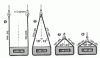
Illustrating the forces created by a highline in kind of a backwards way:
74873-slingstress.gif
 

Attachments

  • 74873-slingstress.gif
    74873-slingstress.gif
    15.2 KB · Views: 62
Re: An appolory to the board.

Gord, your illustration shows the load on the rope at different angles. It shows how loads increase exponentially as the angle gets smaller. Most of us have seen this to death.
But, and this is a big but (giggling to self about big but jokes), it does not take into account the leverage calculations on the spar.
A speed line set at 100 feet will put a much greater load on a tree than one set at 50 feet.
 
Re: An appolory to the board.

[ QUOTE ]
Another option to minimize the side pull on the support trees when using a highline is to tie the ground end of the line to an anchor away from the base of the support tree. The effect is that much of the force is redirected into compression down the stem. Mike in that picture you posted of me I could have done that but was 100% confident with the support trees.

Illustrating the forces created by a highline in kind of a backwards way:
74873-slingstress.gif


[/ QUOTE ]

See, Mike, I told ya Gord was safe...

But, a few points. Gord, the method you described here is fine as a backup. But, it would be easy to tie a mid line knot around the treetop, which would then make the ground tie be a fully effective guy anchor. Of course, then the tree would have to be reclimbed to dissmantle the rigging...unless both lines were made retreivable, which is easy, given enough rop length. note I said both lines, as in order to make them retreivable, you'd need a separate guy line...
 
Re: An appolory to the board.

RB, what he's saying is to simply attach the ends of the high line out at an angle, no special installation or removal problems.

The same thing can be set up for speedlines. It's just as easy tying the speedline end to another tree base as it is to trace it down the host tree, but much safer because it reduces side loading the host tree.
And when you go to tension the speed line, the host tree doesn't bend forward allowing for less sag in the speedline.

Drawing of high line attached earlier in thread.
 
Re: shredded strap and break away lanyard

[ QUOTE ]
I have seen A LOT of comments on the cuts in my strap.

So I am honestly curious.

has anyone ever heard of a story of someone cutting through a steel core flip line?

Also there was mention of a breakaway lanyard earlier.

I am really interested in that.


[/ QUOTE ]

Thought I posted this already:

a few years back, while working, we heard sirens. Next day, when we returned, the customer told us what had happened. An out of work logger was removing a few firs on his own property (or for a friend), cut through his steelcore flip line, and fell about 40 feet, landing on the edge of a roof, and was killed.

Steel core can be cut through in a fraction of a second.

25-30 years ago, I nicked the core of mine, (never since) by not checking the backside of the tree. A stub had caught the line and kept it high. My current flip line is about 3 years old, and it may have one tiny nick in the rope, from a careless moment--too much follow through after cutting a branch. I've improved a lot in that regard over the years. While I still work very fast and one hand all the time in conifers, I've nicked flip lines less and less.

Regardless, all need to follow the law (ANSI) and be tied in twice when working aloft with a saw. T.I.T.S. = tie in twice, stupid

re breakaway devices, I already posted about that...
 
Re: An appolory to the board.

I understand the concept, Mike. But there will still be movement with that nice, simple and quick to set up method. So, with a critical situation, say, when a real high tie is needed, the guy line should be tied off.
 
[ QUOTE ]
Once you have the high line set, you know if the tree falls, you don't want to be attached to it, so you design a lanyard that breaks away before your high line, but still allows it to be used for work positioning.

This presents a possible conflict with ANSI standards that require you tie in twice.

[/ QUOTE ]


That would not be a conflict with ANSI. The climber would have two points of attachment, although one of the attachments would be a breakaway.

Also ASNSI does allow for one point of attachment in certain situations (6.3.8).
 
Re: An appolory to the board.

[ QUOTE ]
I understand the concept, Mike. But there will still be movement with that nice, simple and quick to set up method. So, with a critical situation, say, when a real high tie is needed, the guy line should be tied off.

[/ QUOTE ]
Are you talking about whether the the speedline has to be secured to the tree or if the rope can just go through a crotch and back down to the ground?
You live in one of the few spots in the world where there might be 150' trees on each side of the dead tree to tie in to! (see Gord's picture)

Everyone else in the "normal sized tree world" is always going as high as possible in the host tree. The discision as to how high, is always based on how strong the tie in point is.
In some cases, yes, you need to climb the tree and tie the speedline to the spar and then run the guy back to the ground. Then the tree will not move (anymore than the rope stretches) when it's loaded.
 
[ QUOTE ]
[ QUOTE ]
Once you have the high line set, you know if the tree falls, you don't want to be attached to it, so you design a lanyard that breaks away before your high line, but still allows it to be used for work positioning.

This presents a possible conflict with ANSI standards that require you tie in twice.

[/ QUOTE ]


That would not be a conflict with ANSI. The climber would have two points of attachment, although one of the attachments would be a breakaway.

Also ASNSI does allow for one point of attachment in certain situations (6.3.8).

[/ QUOTE ]
Do you interpret "employer can demonstrate" as: Disregard this standard?
grin.gif
I think a lot of people do.
The use of this term should be dropped from use in the standards, or at least from the individual standards and put at the beginning as a fuse for all the individual standards. After all, no matter what safety standard we're talking about, if it's safer not to follow it, we shouldn't follow it.

Another problem with this particular standard is point of attachment is not defined. An example is given, but it's not defined. It could be your hand holding a branch, a shirtsleeve snagged on a stub, or a low-test breakaway lanyard. I think the spirit of the phrase was a connection rated the same as the climbing system, but they don't say.

Hence I said "possible" conflict.
 
Mike,

Good points about the wording of the Z standard. I would suggest that you go to the ISA site and find the comment form that will make it's way to the Z Committee. We have a meeting in April to start the next round of revisions. The longer we have to work on changes the easier, and better, the results will be.
 
I could nit pick my way through the standards, but I worry that I tend to pick too many nits. Those who don't skip over my posts know that. There are many places I'd think changes would help, too many to list, but some I think are quite important.

I have made comments through my chapter liaison (is that the right word) in the past, and when I did he responded and seemed appreciative, but I don't want to be a pain in the proverbial arse.
 

New threads New posts

Back
Top Bottom