Girdling roots is it worth it for this tree?

I don't doubt that it was a beautiful living tree , and yes it can thrive. Especially since you opened up some of the choke point.

But that root system is not a stable platform, so keep the crown not as heavy and maybe it won't tip over too soon
 
If trees pop out like a molar out of a donut without root pruning, how can root pruning increase liability?

And how does one judge that a tree is 'structurally sound' or not, without a lot of undefendable assumptions?
It stood up to the last storm, didn't that prove something?

Having been involved in several litigation cases re failed trees, these liability fears sound way overblown. Is there a factual basis for them, or is it all just imagining? The big question is, did climbhigh get paid for the 3 hours?
 
The tree was not in horrible conditions, as far as canopy wise, I have seen worse. The client said every year, for the past few, the top has been slowly getting thinner. It didn't appear to me that the tree has ever been professional thinned or structure prune...or ever done by anyone. So there are some concerns and problems there. I didn't offer to do that, for 2 reason. One I prefer to leave what live limbs on a tree like this as possible, till after the stressor is fixed. Two, they are kinda outside my service area.


The client had seen how bad the roots were, and what I had did to them. He realized it may not work, but that it was better then nothing...and it wasn't causing more harm. He was mostly trying to prolong this tree, and another one, life for 2-3 more years because they want to downsize their house.

Which unfortunately means I probably won't be able to followup on this tree much, or do future work on the roots etc.
 
Not worried about getting paid. I told them up front to expect 3 hours of work. Once I seen how bad it was, I said I could blow out a bunch more soil and see what is going on (get under all the girlded roots). But he didn't seem to want to get that extensive or $, so I did what I could.
 
Root pruning is interesting to me and I believe I can learn some useful facts about it that I can then apply in real life.
Litigation is useful in my mind to consider as a possibility, after that each must choose their own. No facts need to bear against you for it to hurt. Just having to defend against an aligation is enough. At $250 to $300 an hour how much Lawyer time would I want to spend on 3 hours of income.

Just read about one person being brought into a lawsuit for having installed a tree swing years earlier. It is acknowledged that the complaintant used it improperly - still he is in court. Another situation a friend was accused of wrong doing in a laughable way when you hear the facts. Just getting to an actual court day that wasn't wrangled/manuvered and canceled cost him six days of work. Just things to concider.
 
Lawyer not needed to defend against frivolous lawsuits.
I've seen dozens of tree-damage litigation cases; none adjudicated against a contractor.
Last week a lawyer dropped a claim against tree owner/pruner after getting my report on the facts of the case. This happens in about 1/4 of the cases I'm in. Very rare for even a tree owner to be judged negligent; the bar for proof is very high.

But of course it's all a matter of company policy/owner risk tolerance, which goes up with experience. Good sleep comes with confidence in defendability of work. Just things to consider.
 
Im glad to hear that the litigation case you've seen havent been against the contractor. Ive never experience this issue , but ever since 'tree cabling' , I've been concerned about liability and what I tell people and what could happen later.

I didnt say root pruning would increase liability. I implied that stating the tree can stay, and if it tips over unexpected, than that could create liability. This trunk looks so choked out that root pruning may not help, if there arent any structural tracer roots present.

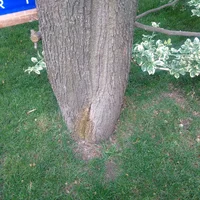
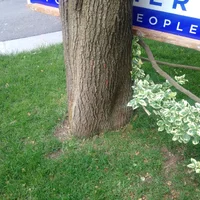
There are lots of ways to determine if a tree is 'structurally sound' . From a photo , one can only go from experience. My experience tells me: donut tree would push over easier in its current state, than if it had a more developed root system. How easy it would tip over can be guessed by the lack of any main structural root present in the photo.

Yes it has survived all sorts of storms, but the tree is growing larger still. Will this be more of an issue later? I would guess yes.

I will try to preserve a tree wherever possible, I did mention reducing the crown weight could help.
 
Lawyer not needed to defend against frivolous lawsuits.
I've seen dozens of tree-damage litigation cases; none adjudicated against a contractor.
Last week a lawyer dropped a claim against tree owner/pruner after getting my report on the facts of the case. This happens in about 1/4 of the cases I'm in. Very rare for even a tree owner to be judged negligent; the bar for proof is very high.

But of course it's all a matter of company policy/owner risk tolerance, which goes up with experience. Good sleep comes with confidence in defendability of work. Just things to consider.

R u able to disclose any details about this case?
 
so another factor to consider would be potential damage should the tree fail...
That tree didn't look big enough to hurt much... and the only time you're gettign hauled into court is gonna be for major $$$, which would usually pertain to an injured person, not the patio furniture....
 
Yes I doubt anyone would file even an insurance claim , let alone a lawsuit, over some mere items.

I think the liability worry is more if the tree is by a patio with people around.

Recently I bid on a tree that fell and landed on the patio. There was food on the grill , and other personable items under the smashed limbs.
 
"Recently I bid on a tree that fell and landed on the patio. There was food on the grill , and other personable items under the smashed limbs."

I'll bet they lost their appetites in a hurry! I once assessed a tulip poplar that cleaved a trampoline with 3 kids bouncing on it...nary a scratch!

"stating the tree can stay, and if it tips over unexpected, than that could create liability." Well yeah but the question is, why would a a contractor be "stating the tree can stay?" Unless you own it, or are being paid for a consultation, why would anyone want to say that? If we make it the owner's decision, and don't put anything dumb in writing, i don't see the liability.
Gorman, one expert said anyone could see the rot and the tree should've been removed long before, the other showed that comparable conditions were common, and cited several other factors involved in the failure.
I can tell you more in 350 days or so. :sleep:

Removing a branch or a tree ALWAYS increases the risk that adjacent trees and branches might fail. So are you open to liability if you say that your removal work made the person or the yard or the street any safer, and then another tree bonks em????
 
" I'll bet they lost their appetites in a hurry! I once assessed a tulip poplar that cleaved a trampoline with 3 kids bouncing on it...nary a scratch!"

I'd be willing to bet that Tulip Poplar had codominant stems that started at about 12' to 20' above ground and one of the stems split and fell. I may be wrong but I can almost picture it :) They're notorious for codoms.
 
Nope no codoms; rotted at a wound. What's notorious in one region may be rare in another (seldom seen in NC), hence the cautions about overgeneralisation, and assuming/betting....
The 3 kids got a look later at the strength in trees. We don't need any more arborphobia in this world. Speaking of which...

Removing a branch or a tree ALWAYS increases the risk that adjacent trees and branches might fail. So you ARE open to liability if you say that your removal work made the person or the yard or the street any safer, and then another tree bonks em.
 
Last edited:
Oh well you win some lose some. In my area the majority of tulipfera are single trunked and turn codom at about 15'. My area is really my only concern as an arborist but thanks for the lesson.

RE: liability - Have you ever had or seen a case where someone was being sued for causing adjacent tree issues due to removing a tree or limb? I think the average person would have to be heavily encouraged to pursue that one.
 
It seems like the next money spent at that project would be for a replacement tree. Get the next generation going since this one looks like it'll be a removal soon enough.

I wonder what good could be done with an unlimited budget for the tree. Do a full-on RCX and decide how much of the girdling roots you'd remove.

I haven't done a lot of RCX work but when I have there have always been several layers and concentric rings of bad root structure.

Without a long term commitment and money to match it seems like these jobs are nothing more than 'painting over rust'.
 
I haven't done a lot of RCX work but when I have there have always been several layers and concentric rings of bad root structure.

This is what I believe the photo shows, without more excavation needed.

Guy you sound like a great court defender, no wonder why you matched up with that sort of work. If we ever have a litigation, i'll make sure to consult with you!:buitre::hueco:

My only suspicion is that when we 'support' and perform what a client wants to pay for, without showing them the possible negative outcomes, we could be held responsible for not rejecting their idea.

I read we can be held accountable for trees on their property that they did not mention even. If we go there and see a hazard and don't mention it. I recall the arborist study manual , but ill check...
 
TL that's really weird with the codom tulips--were they all broken over at some point? Or just bad genes? I'll be passing by Cton this month--can you point me to some?

Tom yes on these maples there are often many layers, and poor odds of a successful outcome. pics later today re that.
family, that work matched up with me; I don't advertise to do it. re hazards outside our scope, lots of previous discussion on that in review 8 years ago;
consensus was we could be held responsible in extraordinarily obvious cases, but the odds are astronomical, so that's no reason to start condemning every tree in sight (which one guy advocated in an Expo talk a few years ago)

http://www.historictreecare.com/wp-...A-CEU-Basic-Tree-Risk-Assessment-complete.pdf
"People may unreasonably expect that all arborists are
experienced and knowledgeable enough to be experts in tree
risk assessment, even if they are not. Knowledge gained from
experience and from books will build your abilities, but that
knowledge is a double-edged sword. As professionals we
are expected to act reasonably and in the public interest if
we see a very high-risk, life-threatening condition.
Despite
our disclaimers, and even if we were hired for other reasons
and they are not part of our assignment, we may still be wrongly
considered responsible for nearby trees. In extreme cases,
it may be a good idea to document critical conditions with
words and pictures, deliver that information to the property
owners, and make copies for your files. Once you have
lowered your personal and professional liability to a level
that is acceptable to you, you are ready to assess tree risk. "

Possible negative outcomes should be disclosed if they are likely and significant--and so should possible positive outcomes! The error comes in on both sides when we speculate beyond our actual (as opposed to imagined) knowledge. We DON'T KNOW a lot more than we do know about tree biomechanics.
.

 
TL that's really weird with the codom tulips--were they all broken over at some point? Or just bad genes? I'll be passing by Cton this month--can you point me to some.
Sure Guy. Wanna stop in for a few, have a beer and I'll show you some of the showcase trees around here? I'd be glad to. Or if you don't have much time I'll try to remember where some good Liriodendrons are. It may be cause we're in hurricane country and they get their tops snapped and regrow. Definitely a common theme around here.
 
Last edited:
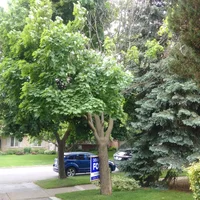
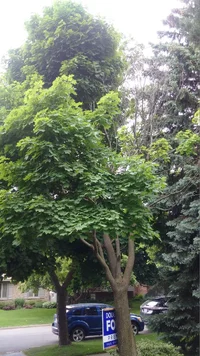
I ran into this posting as I was trying to figure out if the tree in front of our house is worth saving.

It's a Norway Maple, lost about 40% of leafs. However one of the dead parts sprouted this summer, a few branches.

I have a tree company that said they would come and for $300 dig around and cut some of the roots to give it breathing space and get nourishment back in. Not with an air spade, they plan on doing it with a shovel. Either way... We would love to save the tree but are hesitant.

Is it worth it?
Is it too far gone to try and bring it back?
Is it worth trying?

Will it fall over if we try?

Thoughts????
 

Attachments

  • IMG_20180605_182847.webp
    IMG_20180605_182847.webp
    1,004 KB · Views: 49
  • IMG_20180605_182904.webp
    IMG_20180605_182904.webp
    576.8 KB · Views: 51
  • IMG_20180606_114930.webp
    IMG_20180606_114930.webp
    1.4 MB · Views: 54
  • IMG_20180606_114935.webp
    IMG_20180606_114935.webp
    1.1 MB · Views: 50

New threads New posts

Kask Stihl NORTHEASTERN Arborists Wesspur TreeStuff.com Teufelberger Westminster X-Rigging Teufelberger
Back
Top Bottom