

*useless info*
Participating member
- Location
- usa
I think in terms of single input/open vs. dual input/closed versions of same visual architecture
>>tho forcewise, ushering forces thru differently extrudes different effects
especially in tension ratio of how hitch grabs host life line.
>>single input/open friction hitch brings full force to grip matching leg of tension.
>>dual input/closed friction hitch brings 2 softer tensioned legs to grab single harder tensioned host.
So, I think smaller 50-75% perhaps stiffer 'chord' helps make up the math to give more firmer control thru smaller footprint of even stiffer material making playing field to grab harder tensioned host with softer tensioned line more even game. You can use these hitches to grab a stiffer wooden column, but not the whole slide effect we need to fine tune/tame.
...IN ROUND CHORD
.
Once again finding in some ways flat rope (webbing) geometry opposite strategies of round rope geometry as a flexible/non rigid support device choice. Such as:
>>round gives equivalent leverage geometries on bend,
flat gives different leveraged weakness across major vs. minor axises
>>round stacks high on tight bight leveraging load to fewer fibers
flat very good choice on non moving tight bight, presenting minimal distortion on deformed bent axis; by only bending web's minimal axis profile that gives no height/leverage on the bend.
>>round in Whatnot is very good, but shifts too easily , so much so is actually a magic trick
(in round with ends seized up to mains whatnot is reeving knot for feeding bent ropes thru ship side port so is a good knot, just shifts)
flat rope tho, Whatnot is Grass Knot and doesn't shift, very easy untie(also found fair for chain to web etc.)
>>round rope most efficiency loss in Overhand Knot alone in single line
flat rope tho, Overhand becomes favorable as the Water Knot.
Etc. , all cuzz of flat vs. round profile geometry and thus the different dispositions on same topics.
In the end, rope only round as easier to work, drag around self, doesn't seat whole footprint to tear up on wood like in lowering, deforms predictable losses cuz same size from any angle across, just handles and stores easier etc.
.
So found interesting grip characteristics in way 3/8" Tenex grabbed host line for this. Seen Tenex flatten on curve around self and other lines. But as maid Scaffold Hitch eyes seen the outer flat on curve around itself, but then the favorable round properties on the innie part of Scaffold as the rope seemed to know what to do to maximize(to best/least loading profile)!
>>then too as flattened out in hitch around host lifeline a different grip of not a single line of contact footprint from round cord pressed to service, to this flatter sleeve gripping footprint .

.
Another counter-intuitive mixture rode for quite a while is 3strand as hitch for Blake's and Tautline single input styles. Safety Blue long wearing as iron for this, and gives split tail for dodging around obstacles etc. instead of using tail of lifeline with DBY tail extended to be friction hitch back to rope in DdRT. TreePro Red is very good olds-cool 12strand line, lil'slick fer some. i think the knubbier texture of 12strand is easier grab than smoother/rounder 16 strand. 24 plait even rounder, smoother surface to grab by hitch.
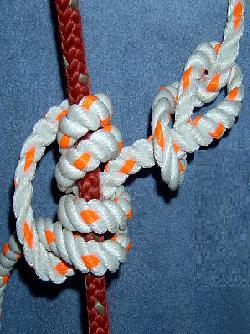
stiff 3strand curious type of footprint grab, and seems vented friction hitch as worked with.
.
>>tho forcewise, ushering forces thru differently extrudes different effects
especially in tension ratio of how hitch grabs host life line.
>>single input/open friction hitch brings full force to grip matching leg of tension.
>>dual input/closed friction hitch brings 2 softer tensioned legs to grab single harder tensioned host.
So, I think smaller 50-75% perhaps stiffer 'chord' helps make up the math to give more firmer control thru smaller footprint of even stiffer material making playing field to grab harder tensioned host with softer tensioned line more even game. You can use these hitches to grab a stiffer wooden column, but not the whole slide effect we need to fine tune/tame.
...IN ROUND CHORD
.
Once again finding in some ways flat rope (webbing) geometry opposite strategies of round rope geometry as a flexible/non rigid support device choice. Such as:
>>round gives equivalent leverage geometries on bend,
flat gives different leveraged weakness across major vs. minor axises
>>round stacks high on tight bight leveraging load to fewer fibers
flat very good choice on non moving tight bight, presenting minimal distortion on deformed bent axis; by only bending web's minimal axis profile that gives no height/leverage on the bend.
>>round in Whatnot is very good, but shifts too easily , so much so is actually a magic trick
(in round with ends seized up to mains whatnot is reeving knot for feeding bent ropes thru ship side port so is a good knot, just shifts)
flat rope tho, Whatnot is Grass Knot and doesn't shift, very easy untie(also found fair for chain to web etc.)
>>round rope most efficiency loss in Overhand Knot alone in single line
flat rope tho, Overhand becomes favorable as the Water Knot.
Etc. , all cuzz of flat vs. round profile geometry and thus the different dispositions on same topics.
In the end, rope only round as easier to work, drag around self, doesn't seat whole footprint to tear up on wood like in lowering, deforms predictable losses cuz same size from any angle across, just handles and stores easier etc.
.
So found interesting grip characteristics in way 3/8" Tenex grabbed host line for this. Seen Tenex flatten on curve around self and other lines. But as maid Scaffold Hitch eyes seen the outer flat on curve around itself, but then the favorable round properties on the innie part of Scaffold as the rope seemed to know what to do to maximize(to best/least loading profile)!
>>then too as flattened out in hitch around host lifeline a different grip of not a single line of contact footprint from round cord pressed to service, to this flatter sleeve gripping footprint .
.
Another counter-intuitive mixture rode for quite a while is 3strand as hitch for Blake's and Tautline single input styles. Safety Blue long wearing as iron for this, and gives split tail for dodging around obstacles etc. instead of using tail of lifeline with DBY tail extended to be friction hitch back to rope in DdRT. TreePro Red is very good olds-cool 12strand line, lil'slick fer some. i think the knubbier texture of 12strand is easier grab than smoother/rounder 16 strand. 24 plait even rounder, smoother surface to grab by hitch.
stiff 3strand curious type of footprint grab, and seems vented friction hitch as worked with.
.
Last edited:


