Friction hitches

[ QUOTE ]

Isn't that 3/8" Tenex??

[/ QUOTE ]

Yep, now that I look at it, I think it is. The tail is buried all the way through the end and fattens it up... to exactly 1/2". Thanks, this give me some options now.
 
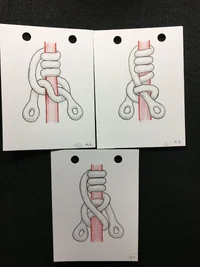
I tried the icicle hitch but it locked up too much so I have been using the schwabish. Nice, with almost no slack. Have been trying only 4 wrap schwabish on my safety and works Very smooth. Anybody use 4 wrap schwabish on climbline?
 
Wow Chip is who last posted in Gord's thread in 2007.....two topdogs....sorry @Dave tettleton but I use a 3 wrap michoacan with wrench SRT on yale 11.7 or vega presently using 10mm AP mostly. Someone else may be able to help you.....
 
Hi Dave, nice thread to resurrect. I’ve used the Swabish when I first saw it in the Sherrill catalog, can’t remember how many wraps I used. It was shown first in On Rope under the name of the Asymmetrical Prusik. What hitch cord and climb line are you using, also stationary or moving rope system, these factors, and climbers weight seem to determine how a hitch will work?
 
So I guess the Schwabisch / Asymmetrical Prusik doesn't lock up as bad as a regular prusik?

(I was thinking I might use it instead with my prusik loops, but I guess you can't tie it with a loop.)
 
It can be tied with a loop, that is how I first used it. It doesn’t bind as much as the Prusik, but there are many better performing hitches.
 
Interesting. I see how to do a Schwabisch with a split-tail but not with a loop, but I can be dense. I'll have to mess with it some more. When doing it with a loop, do you start out as if tying a Klemheist?
 
Hi Dave, nice thread to resurrect. I’ve used the Swabish when I first saw it in the Sherrill catalog, can’t remember how many wraps I used. It was shown first in On Rope under the name of the Asymmetrical Prusik. What hitch cord and climb line are you using, also stationary or moving rope system, these factors, and climbers weight seem to determine how a hitch will work?
I'm using 13mm vortex and 10 mm beeline. My safety is 9/16 tho. I don't want to be going fully experimental really using just 4 but inadvertently did it as my prusiks arrived inches shorter than I ordered. And DoD not realize I had used only 4 on my safety. This is all double moving system.
 
The number of wraps can be varied, there is no set amount that has to be used. If one less wrap works, adding one more might create more friction that isn’t needed. Low and slow testing is mandatory until it’s dialed in and works reliably.
 
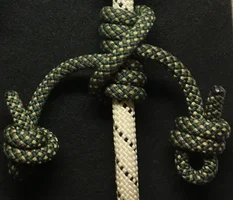
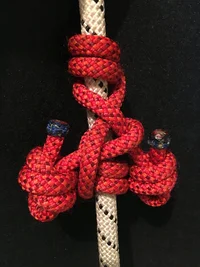
The Michoacán is a popular hitch, along with the Knut, and Matt Cornell, shown below.
528D7C57-B280-4F93-95A2-6390A44818FF.jpeg
Edit: forgot to mention to add or subtract wraps for your personal needs. Slight slipping can be corrected by twisting the eyes before clipping to carabiner.
 
Last edited:
i think we look at friction hitch in face, with own life on it in more of a microscope of focus than other knots. Also, the totally specialized movements we target different than other rope functions, and we hold them to higher precision also. Compared to other working knot HOLDS of load, we are using the achilles heel of the slide past HOLD (of basic all other knot functions) to our own uses, and not just in the adjust tent stake tension and leave type usage mostly seen outside of our folk!
.
There is a common shared mechanic of Half Hitch preceding to convert from right angle of pull (Killick style) or VT braids from either side style as procedures partially to and preceding mains of att_frict.pdf numbers. Inverting the force reductions (necessary equal/opposite yin/yang) of the capstain effect of Porty, now used for grip to effect balance against capstain math to balance equation...
.
So, i find these as the most personally tunable to lacing style, materials/devices, loading etc. with widest variance of confidence etc. Simply, your mileage might vary.
.
A lot to be read into these not friction machines, focus given aimed at other knots can give similar lessons.
.
Friction Hitches are in class of knots of 'lengthwise pull' (not correct right angle) as most errant angle of pull on a gripped host. Who's special properties should be studied as a set, separte from the rest of the pack somewhat. Chapter_22 specifically for 'lengthwise pulls' leads off with Killick of Half Hitch kinda in and out to adjust for the errant angle to Trusty Timber and warns not to expect too much. This includes thus friction hitches with the leading geometries of VT style braid angle lines to center or Half preceding converter killick style. Chapter_27 Occasional knots takes this further ABoK shows knots for tapered spar at this angle, sometimes rubbed with ashes and wrapped in slit open innertube to then lay rope even taping or tacking down final Bitt and lacing half etc from there. Later the Icicle Hitch (not quite like ours) joins this elite pack of grip at worst angle with taper. ALL show best to apply weight slowly to these as best. Many lessons in this thin range of twilight in candle flicker between can and can't; and what makes the wind blow the correct way positively on the flicker!
.
At work, will finish later, jest had to jump in and capture most immediate, raw reaction in this jar..
 
Last edited:
I just tied up the Michiocan last night. I'm liking the look of it, and can relate to some of the turns from the Blake's. Will try in tree soon. It does seem true that the sliding then holding , constantly is specialized. I was thinking of some stopper knots to take tension on an already loaded line, it's temporary but no sliding effect, which is so important. Thanks for the drawings!
 
Anyone tested/used the "symmetrical Distel" that I saw somewhere here on TreeBuzz once?

Modified Distel Hitch - TEST THIS FIRST.webp

I liked its symmetry and thought it might work better than a vanilla prusik for a 2-in-1 lanyard adjuster, but it still seemed to jam/lock up some if I recall right...
 

New threads New posts

Back
Top Bottom