
Navigation
Install the app
How to install the app on iOS
Follow along with the video below to see how to install our site as a web app on your home screen.
Note: This feature may not be available in some browsers.
More options
You are using an out of date browser. It may not display this or other websites correctly.
You should upgrade or use an alternative browser.
You should upgrade or use an alternative browser.
Eagles
- Thread starter Steve Connally
- Start date

Steve Connally
Been here much more than a while
- Location
- Suffolk, Virginia
Steve Connally
Been here much more than a while
- Location
- Suffolk, Virginia
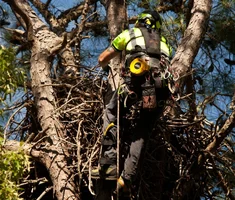
I'd love to share. So basically I try to get above the nest with a good TIP but sometimes I end up below because I can't risk blasting a nestling with the throw bag or dragging my line across one of them. It's challenging because you are under the bowl of the nest and have to work yourself up and over the outside. Lots of sticks to poke you. I'm all cut up.
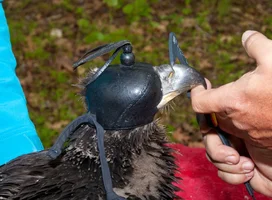
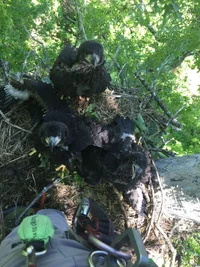
So I get to the nest and let the crew know how many nestlings are there, what the feathers look like and how big and mean they think they are. Once I carefully get into the nest without making eye contact I get comfortable and they send up the bag, line, and a small pulley with webbing. I find a clear lowering area if possible. In the forest the sub canopy is generally thick and inconvenient. I set up the system and then slowly and gently place the bag in the nest and open it. Some are chill, others spread their wings and hiss or grunt at me. A few have tried to bite me but once I figured out it doesn't hurt, it changed my approach. Bag open and I try to grab them in axis with their body by folding the wings in like normal and holding them between both hands and my pinky and ring fingers lifting the legs. Sometimes they grab nest material. You have to manually free the talons because they are still delicate at this stage and very vascular. You can dislocate a talon if you are not gentle. Some go rite in the bag and some fight you a lot. Even if I get them near the bag I'll cover their head with the bag material. Once a raptor goes blind they totally chill out. That's why falcons have those cool hoods to keep them mellow. I then make sure all their parts are in before I zip up the bag and lower it to the ground. Then I repeat for the number of the brood. Then my job is done for 30 to 40 minutes. I find a comfortable spot and chill. Some nests are big enough for me to stretch out and still be inside the nest. I'm talking 6' across, 6' deep and 1000lbs. Basically I did facebook live a bunch of times and just took it all in. Looked at all the bones and shells and carnage in the nest. Sorta stinks like old fish but it was cool anyway. Fairly clean. Evidently there a certain lizard and beetle that are part of the ecology of the nest. They clean up all the scraps. According to the biologist, there's nothing up there to infest me or bite me so I could lie down and nap if I wanted to.
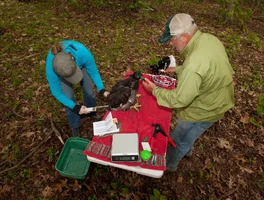
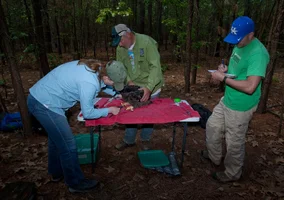
On the ground they band the birds with state and federal bands. Take a feather sample for DNA testing, 3 viles of blood for heavy metal testing and DDT poisoning type chemicals. Weight, Beak and talon measurements, sex identification and a picture. They then send them back up to me one at a time and I reverse the bagging process making sure they don't hurt their talons grabbing the bag material. I then send the bag and rigging down, Snap one last picture and say my goodbye's. They are totally calm after coming out of the bag. I can actually pet their not so little heads.
Some nests have one, 2 or 3 nestlings. Depends on the energy stores of the mother how many eggs she has. It's very interesting. The better hunters have more eggs. It's also interesting the variation of size in the chicks. Some have been very small and those are usually males. Some huge ones. The bigger ones seem to be in bigger nests so I assume a more mature pair of parents and with maturity comes better foraging skills. Probably also has some to do with the hunting grounds. The Chesapeake bay area has the largest breeding population of native and migrating bald eagles in north America. A very productive watershed.
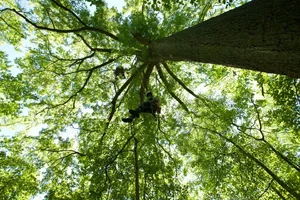
Other questions people have asked are about the parents. The closest they get to me while I'm in the nest is about 100 to 150 yards. I can hear them chattering but they keep their distance. It's really a nonissue. Those nests are solid as hell!! Some of the climbs have been a real challenge like the oak I'm coming out of above. Yesterday the wind was awful. I was on the east side of the Potomac in a wind out of the east. The Mason Neck Refuge sits on a bluff so the wind comes across the Potomac and picks up speed then hits the bluff and tumbles over the tops of the trees. I actually got a little seasick in the top of a skinny Virginia Pine. There was another one we were gonna do but the nest was every bit of 120' in a 150' or so Oak. The nest was also about 40' out on a large lead. Could done it but It would have been a long climb and they didn't feel like it was worth the effort. I was sorta glad. I love a challenge and all but.......Meh! We ended up in another tall oak with worse wind. I had to use the bigshot for the first time only because of the wind. I had the elevation but not the accuracy. I physically hit the nest 3 times hand throwing. 90' or so. One shot I untied one end of the throwbag and the biologist untied the other and let go. My throwline blew into the top of the canopy and it was a bit of work to get it back. Oh well, lesson learned.
So hopefully that answers your questions. It's a National Park Service Eagle Contamination Project. The other area for it is in the great lakes region. I am working for The Center for Conservation Biology. They are cosponsored by William & Mary and Virginia Commonwealth University. They work all over the world. www.ccbirds.org The project is several decades old I believe and information and research can be found via google. Please ask anything you want. If I don't know i'll find out. This is the most rewarding tree related thing I have ever done. Truly a high point of my career.
Thanks for reading and excuse the typo's
So I get to the nest and let the crew know how many nestlings are there, what the feathers look like and how big and mean they think they are. Once I carefully get into the nest without making eye contact I get comfortable and they send up the bag, line, and a small pulley with webbing. I find a clear lowering area if possible. In the forest the sub canopy is generally thick and inconvenient. I set up the system and then slowly and gently place the bag in the nest and open it. Some are chill, others spread their wings and hiss or grunt at me. A few have tried to bite me but once I figured out it doesn't hurt, it changed my approach. Bag open and I try to grab them in axis with their body by folding the wings in like normal and holding them between both hands and my pinky and ring fingers lifting the legs. Sometimes they grab nest material. You have to manually free the talons because they are still delicate at this stage and very vascular. You can dislocate a talon if you are not gentle. Some go rite in the bag and some fight you a lot. Even if I get them near the bag I'll cover their head with the bag material. Once a raptor goes blind they totally chill out. That's why falcons have those cool hoods to keep them mellow. I then make sure all their parts are in before I zip up the bag and lower it to the ground. Then I repeat for the number of the brood. Then my job is done for 30 to 40 minutes. I find a comfortable spot and chill. Some nests are big enough for me to stretch out and still be inside the nest. I'm talking 6' across, 6' deep and 1000lbs. Basically I did facebook live a bunch of times and just took it all in. Looked at all the bones and shells and carnage in the nest. Sorta stinks like old fish but it was cool anyway. Fairly clean. Evidently there a certain lizard and beetle that are part of the ecology of the nest. They clean up all the scraps. According to the biologist, there's nothing up there to infest me or bite me so I could lie down and nap if I wanted to.
On the ground they band the birds with state and federal bands. Take a feather sample for DNA testing, 3 viles of blood for heavy metal testing and DDT poisoning type chemicals. Weight, Beak and talon measurements, sex identification and a picture. They then send them back up to me one at a time and I reverse the bagging process making sure they don't hurt their talons grabbing the bag material. I then send the bag and rigging down, Snap one last picture and say my goodbye's. They are totally calm after coming out of the bag. I can actually pet their not so little heads.
Some nests have one, 2 or 3 nestlings. Depends on the energy stores of the mother how many eggs she has. It's very interesting. The better hunters have more eggs. It's also interesting the variation of size in the chicks. Some have been very small and those are usually males. Some huge ones. The bigger ones seem to be in bigger nests so I assume a more mature pair of parents and with maturity comes better foraging skills. Probably also has some to do with the hunting grounds. The Chesapeake bay area has the largest breeding population of native and migrating bald eagles in north America. A very productive watershed.
Other questions people have asked are about the parents. The closest they get to me while I'm in the nest is about 100 to 150 yards. I can hear them chattering but they keep their distance. It's really a nonissue. Those nests are solid as hell!! Some of the climbs have been a real challenge like the oak I'm coming out of above. Yesterday the wind was awful. I was on the east side of the Potomac in a wind out of the east. The Mason Neck Refuge sits on a bluff so the wind comes across the Potomac and picks up speed then hits the bluff and tumbles over the tops of the trees. I actually got a little seasick in the top of a skinny Virginia Pine. There was another one we were gonna do but the nest was every bit of 120' in a 150' or so Oak. The nest was also about 40' out on a large lead. Could done it but It would have been a long climb and they didn't feel like it was worth the effort. I was sorta glad. I love a challenge and all but.......Meh! We ended up in another tall oak with worse wind. I had to use the bigshot for the first time only because of the wind. I had the elevation but not the accuracy. I physically hit the nest 3 times hand throwing. 90' or so. One shot I untied one end of the throwbag and the biologist untied the other and let go. My throwline blew into the top of the canopy and it was a bit of work to get it back. Oh well, lesson learned.
So hopefully that answers your questions. It's a National Park Service Eagle Contamination Project. The other area for it is in the great lakes region. I am working for The Center for Conservation Biology. They are cosponsored by William & Mary and Virginia Commonwealth University. They work all over the world. www.ccbirds.org The project is several decades old I believe and information and research can be found via google. Please ask anything you want. If I don't know i'll find out. This is the most rewarding tree related thing I have ever done. Truly a high point of my career.
Thanks for reading and excuse the typo's

Cool Steve.
I grew up near Lake Erie in Cleveland that also has a fair amount of large glacial lakes and whatnot for their hunting grounds. It was said the populations were always growing up there back then near lakes with forests near them. Things were kept fairly quiet. about their locations as the concern was that some bumpkin would shoot them to get stuffed and put over the fireplace. Apparently this has happened before.
Fast forward to today and now Columbus also has a growing population. Saw an adult today on the side of a freeway on-ramp with a kill just today. Big SOBs they are.
I grew up near Lake Erie in Cleveland that also has a fair amount of large glacial lakes and whatnot for their hunting grounds. It was said the populations were always growing up there back then near lakes with forests near them. Things were kept fairly quiet. about their locations as the concern was that some bumpkin would shoot them to get stuffed and put over the fireplace. Apparently this has happened before.
Fast forward to today and now Columbus also has a growing population. Saw an adult today on the side of a freeway on-ramp with a kill just today. Big SOBs they are.
Steve Connally
Been here much more than a while
- Location
- Suffolk, Virginia
So the point on Mason Neck was a location hunters used to travel to in the early 1900's to hunt them. Kinda crazy. There was an outfitter near where I used to guide in Wyoming that shot some golden eagles feeding on his trout pond. He went to the bar and bragged about it and was later prosecuted.


Steve Connally
Been here much more than a while
- Location
- Suffolk, Virginia
I was able to set a tip from the side of nest. I could though
Steve Connally
Been here much more than a while
- Location
- Suffolk, Virginia
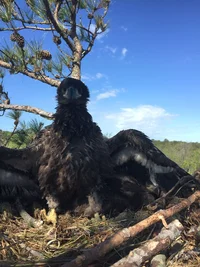

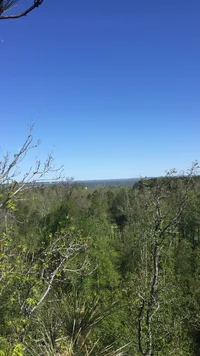
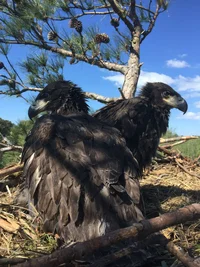
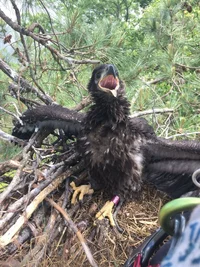
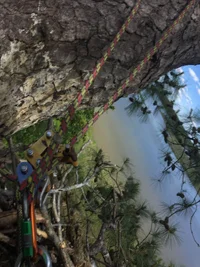 Day 4. 3rd nest was empty after slogging through the swamp.
Steve Connally
Been here much more than a while
- Location
- Suffolk, Virginia
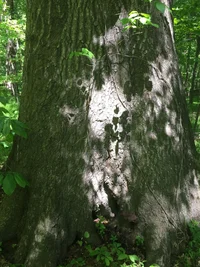
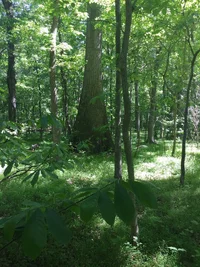
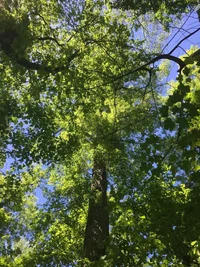
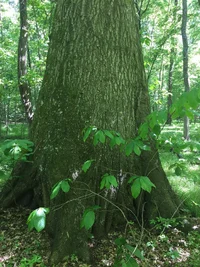
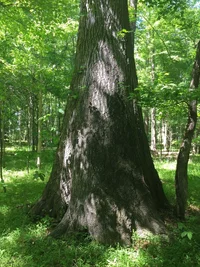
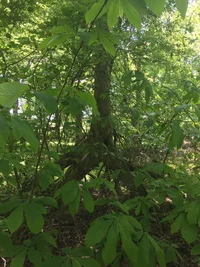

 Day 5. Last day. The woods claimed a throwline and bag today. Looking across the river at Mt Vernon. A grove of the tallest oaks I've ever seen in my life. Look at the base of the pin oak.
Muggs
Been here much more than a while
- Location
- Canuckistan
What a fantastic gig Steve, and amazing pics. Seems like it was highly rewarding. I'm amazed that the adult birds leave you alone in those nests. Too cool. I live straight across Lake Erie from Cleveland, outside of a little place called Eagle, Ontario. Good population of bald eagles. Never jumped into one of their nests though...
Steve Connally
Been here much more than a while
- Location
- Suffolk, Virginia
Yeah. It was great but I'm glad I'm done. 2000 miles on my truck in 2 weeks very tired.
Steve Connally
Been here much more than a while
- Location
- Suffolk, Virginia
I'd look from a close tree. They are at the age they get a little nasty and soon they'll be testing wings. I'm told when that happens, if they're scared in the nest, they'll jump.
I'd look from a close tree. They are at the age they get a little nasty and soon they'll be testing wings. I'm told when that happens, if they're scared in the nest, they'll jump.
Also good to know. That would suck.
New threads New posts
-
test
-

-
-

-
 Alternatives to standard asphalt around roots
- Started by southsoundtree
- Replies: 21
-
-
