Treetopflyer
Been here much more than a while
- Location
- Coastal N.J
At the 120 degree critical which is more realistic . each would feel the full wieght of climber on each, so not too crazy .Good thought.

Follow along with the video below to see how to install our site as a web app on your home screen.
Note: This feature may not be available in some browsers.
Ninety pounds would be achieved through a 45 angle . Ideal!Right, it would sag for sure. I was thinking each rope transmits 90 lbs to each limb, but it's like they are basal anchored, and would have 180 lbs force applied to each.
With this system as is what johhny pro has presented they aren't basal anchored upon reaching canopy t.I.p. but a basal anchor would not be a 180 over the limb if it was on one or the other anchor at any given time. But better to adjust for more force as climber bounces around. Typical basal anchors from ground do exert double forces on t.I.pRight, it would sag for sure. I was thinking each rope transmits 90 lbs to each limb, but it's like they are basal anchored, and would have 180 lbs force applied to each.

Ropebook.com is legit.Ok, back to the books.
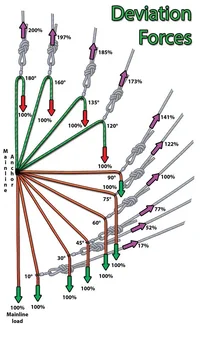
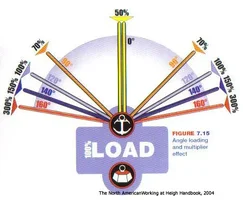
in a single line stationary configuration anchored in canopy the load is all on the one. This system with floating anchor the intricacies of move it about change the load significantly just based on angles which we've established and it should be brought up that if ONE ANCHOR DID FAIL THE OTHER WILL NOT HOLD YOU.I didn't want to post until I found the chart to attach, but what I do know is after 120 degrees (the image shows 180 degrees) the loads begin to spike dramatically.
Our "Critical Angles" are 20 degrees and 120 degrees. If the biner were pulled down to a point at which the interior angle of the lines leading up to the TIP's was 20 degrees, each TIP will see 1/2 the climber's weight. If the biner was allowed to move upward and stop at an interior angle of 120 degrees, each TIP will see the climber's full weight.
Again, beyond 120, and the loads quickly increase.
I realized who I replayed to and isn't wasn't for you oceans cause you already know DAT shit.!in a single line stationary configuration anchored in canopy the load is all on the one. This system with floating anchor the intricacies of move it about change the load significantly just based on angles which we've established and it should be brought up that if ONE ANCHOR DID FAIL THE OTHER WILL NOT HOLD YOU.

and here

That's a good question. Equally important may be...if it tightens beyond 120 degrees, will it slack out back to that 120?Does a floating anchor always sink to the point where the force vectors equalize at 120°?


Don't forget that each side of the line is acting with mechanical advantage through the carabiner. The forces are quite high in that system...once it's opened up and anchored to two TIPS. Going around 1 TIP will equal 1x climber load on the union. Going around two TIPS and redirected to the RR through the carabiner means the carabiner will act as a force multiplier, so the math is now beyond the charts we've applied here.This diagram might be better:
You and I are standing on the roofs of two buildings, opposite side of the street. A climber stands in the middle of the street, tied into two ropes: one up through a carabiner and over to me, the other up through the same carabiner then to you. We all weigh 180 lbs. We both pull, trying to lift him off the ground. The best we could do (I think), is pull him up to the point that the ropes split at a 120° angle. At that point you're pulling 180 lbs and I'm pulling 180 lbs.
Now instead, we stand in a bucket suspended above the climber. The ropes run up from the climber's harness, through the carabiner, through a ring (or rigging plate) mounted on each rooftop, and back to us in the center. We start to pull until the climber is lifted to the point the ropes are at 120° angle. Are we still each pulling 180 lbs, and the rings (branch limbs) are feeling 360 lbs? Just trying to wrap my head around it.