DRT

I'm really impressed with that carabiner set up to anchor the lines. But I suspect that it wouldn't work if the ropes were on two separate climbing systems, like if you just try to climb only one, it would shimmy your anchor point away from where you want it to be.
Great, I've just spent all my time and money getting setup for twin wrench systems, now I think I need a rope runner and a couple 200' lengths of 9mm line! Ill be broker'n hell.
I'm very comfortable climbing single line, but I love the peace of mind and work positioning potential of DRT. Lots of kinks to work out, just becoming efficient at managing so much rope, but it's definitely worth the time, that much is clear.
Great stuff Johnnypro, there's a lot of cool technique in this video.
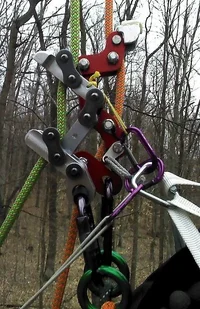
 
After several attempts to get a throwline where I wanted it in a tulip poplar, the closest I came was farther out on the limb than I felt comfortable with. My solution was to place a second rope on a lower branch and climb DSRT for the first time. Nice!

I started off with a foot ascender on each rope but found each step unweighted the opposite rope requiring every step to take up the stretch. This would probably work on more static ropes. I quickly changed to using a knee ascender.

Looks like a mess, but it worked really well.

IMG_20150131_164658_569 crop (Small).webp
 
After several attempts to get a throwline where I wanted it in a tulip poplar, the closest I came was farther out on the limb than I felt comfortable with. My solution was to place a second rope on a lower branch and climb DSRT for the first time. Nice!

I started off with a foot ascender on each rope but found each step unweighted the opposite rope requiring every step to take up the stretch. This would probably work on more static ropes. I quickly changed to using a knee ascender.

Looks like a mess, but it worked really well.

View attachment 30192
Reminds me of one of my first real attempts at DSRT climbing. I tied in two bridges and had two RR's. It was super fun.

How did you find it to operate those with opposing directions of the upper arms? Is one handed operation of both possible?
 
I used both hands for today. It was getting late or I might have set it up with swivels. I need to get my 2nd BDB put back together for the next time. One of the rope bridges is adjustable so it would have been easy enough equalize the height of the two devices.

The setup certainly resolved my safety concerns about the original TIP.
 
I actually liked having my two devices oriented opposite. (Runner and runner with modded body). It allowed me to operate them with my finger in the middle. But it took a minute to get used to.
 
Of course anything can be made to work but a HH configured like that would have some serious slack tending issues to overcome. Having two HHs though would work a treat for those times when dsrt seems like a good idea. I actually think there would be far more versatility in having two independent systems then one combined unit.
 
Also 2 independent units only have 1 set of stresses to worry about. Once you start tieing them together and the add some bad rope angles (you know we all do it sometimes), you are creating a hugh amount of vector forces trying to rip stuff apart.
 
That was my concern watching that Doughnuts video. It was cool that two lines can go into the Runner but once those lines go two different directions it can be hairy.
Better watch it again Fairfield. The lines don't ever get pulled away to different anchors . The biner in the middle connects the lines and goes around oppisng anchors . while keeping the lines parallel guiding into device . You better watch pizza and beer for a better view.:birra:
 
In theory something like a quick link riding over the bird would allow one to spread the ropes without stressing the runner. How would it work in reality , I don't know . Don't have a RR or twin lines to use this way to find out...
 
i just spent an hour reading this thread from page 1 while i convalesce with the flu. interesting discussion. seems to have gotten off to a rocky start, but i like where it is going. i think working with two independent ropes has a lot of potential as a valuable addition to every climbers mental tool kit. that said, you are only as safe as the weakest link in your system, and no mater how many redundant systems you set up a moment of carelessness or poor judgement will still get you into trouble. if you set 1 or 5 at in the tree it will make no difference if your tie-in breaks or your anchor fails/is compromised, or you slip while setting your next redirect and take a nasty swing. work safe and work smart.

not to stir anything up, but a couple of things from back near page 10 bothered me a bit. Kevin, you insisted on referring to old school doubled line techniques as srt. i understand your point, it is a single rope and you will fall if either leg of the line is severed, but it is a very different animal compared to static single line. i cant speak for the manufacturers, but i would guess that the spiderjack, zigzag, etc are approved for doubled single line without backup because that is what they were designed and tested for. a doubled line requires the device to manage only half of the climbers weight, and as such is not subject to the same forces as a single static line device. would they fail on static line? probably not right away, but they certainly wouldnt function in a safe manner. now, if you are using say the zigzag, in the manner it is approved, and you cut a leg of your line and fall to your death, is that the fault of the device? i think not. nothing is fool proof, every device and every system can be made to fail. now, it is up to us as climbers to decide what risks we are willing to take day by day. i applaud you for starting this discussion knowing, im sure, what kind of opposition you would face. as a technique for day to day work positioning, im not quite convinced. keep at it. cheers
 
Better watch it again Fairfield. The lines don't ever get pulled away to different anchors . The biner in the middle connects the lines and goes around oppisng anchors . while keeping the lines parallel guiding into device . You better watch pizza and beer for a better view.:birra:
My mistake, I had misrecalled the video. The linl or small biener above may a good solution though.
 
The real issue with that system is the critical angle created when the ropes run trough the same biner and out to multiple TIP's. It will find its own happy angle, which may not be so happy for the tree.
 
The real issue with that system is the critical angle created when the ropes run trough the same biner and out to multiple TIP's. It will find its own happy angle, which may not be so happy for the tree.
Careful choice of tip most definitely nothing too thin for sure . Much care in this setup is needed no doubt.
 
Allowing the an angle to be less critical by using it simialarly to an andvanced m method almost . like keep the biner closer to climber allowing angle to become less critical. More vertical. At least in 45 thereabouts. I'm just unsure without trying first hand about sliding anchor closer to one or the other . Its almost like going back to ddrt with dual static lines that are stationary while you move along them but move them around while you are stationary. Haha . what!
 
Last edited:
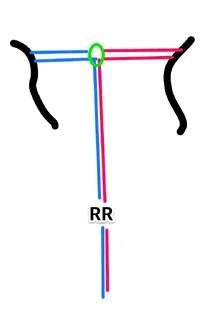
If a 180 lb climber were on the RR, what force are the limbs feeling? Forgive my primitive drawing.
 

Attachments

  • uploadfromtaptalk1422919161392.webp
    uploadfromtaptalk1422919161392.webp
    13.9 KB · Views: 48
I'm gonna pretend here that actually what you've drawn is possible even though it is not achievable. Angle 180 that is . It would be in excess of 500% increase on anchor points. Thanks to studying rope book.com
As well as a few other literatures that I cant think of at the moment.
 
Right, it would sag for sure. I was thinking each rope transmits 90 lbs to each limb, but it's like they are basal anchored, and would have 180 lbs force applied to each.
 

New threads New posts

Back
Top Bottom