drt and srt hybrid system

you guys are off topic here im not rigging im climbing and i dont use a f8 for my srt lock i use a portawrap backed up with a hitch but i do understand the forces you put on a TIP and you cant use this system for smaller or hazardous trees..ill just take my own pictures and put together my own little package of info for this system for my manager thanks guys.
cheers!
 
Hey Tom how did you get to 4:1 load increase on the tip, Im not quite sure I understand.

If you use a closed system (dDrt) you're putting one times your weight on the tip (in this case, a FFC). The FFC is attached to a rope that goes over the tip and is attached to the ground. Wouldn't that only make 2:1 or am I missing something?

If you had a FFC and were working SRT off that (rope through pulley hen attached back at the tree), I could see that being 4:1.

Am I way off???

Thanks,

Matt
 
I like your idea MikeyO, simple= good...Nick I were talking about it.

The advantage the the SW is that you retrieve it with a retriever-ball and have it slide down the line to you, in case you have to re-rig in another spot.
 
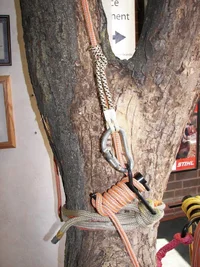
Mikey - The "hybrid" I have been using and like a lot is set up like this - SRT rope set in tree, run through an ID at the base of the tree so I can be lowered from the ground if needed. On the SRT line I wrap a prusik with a cocoon pulley attatched. My Ddrt system is run through the cocoon pulley acting like a false crotch. Under the prusik is my hand ascender, which advances my prusik and Ddrt system up the rope. You can advance up SRT how you prefer, I use a frogwalker setup. When I get to a point where i want to use the Ddrt, Marlinspike the SRT line and switch over to Ddrt (which you can be attached to during ascent) Don't know if this makes sense, or is what you are looking for? Hope it helps!
 
Here is a pic of the secret weapons I use now.
Just got word from Samson Rope about using the 'Liquid Tape' product on rope fibers. They said it's OK to use it in the application I'm using it.
I hitch the weapon on using a 'VT'. It retrieves very nicely. Always tie an alpine butterfly beneath as a 'stopper'.
 

Attachments

  • 262796-101_0188.webp
    262796-101_0188.webp
    54.5 KB · Views: 198
tom has been argueing the opposite side for a year about ground anchors and srt he claimed you can work a higher tip be cause you can back the system up by double crotching and the friction at the tip reduces the MA on the tip. i could be wrong about some of that. when i get back from the geezers i will pull up the discussion out of the rigging section
 
this is what i put together for my manager

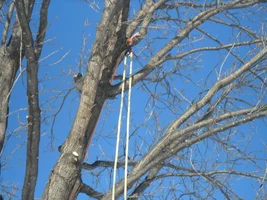
So this is called a HYBRID climbing system, its a hybrid between a DYNAMIC climbing system and a STATIC climbing system. A dynamic climbing system is one in which both parts of the rope are moving when in use. Although this system will work with the rope simply running over the bark of the tree in an appropriate crotch or branch attachment point, it will be much more efficient with greatly reduced friction if a device such as a friction saver or pulley is used. These devices reduce friction at the tie-in point to varying degrees, saving wear on the rope, wear on the tissue of the tree, and wear on the user. This means the climber is able to move more quickly, efficiently, and longer while using one of these devices, simply by reducing the effect of friction on the system. The use of a dynamic system means that the climber’s body weight will be roughly divided between the two parts of rope. Forces at the tie-in point of dynamic climbing systems will typically only be the weight of the climber themselves. A static climbing system is one in which no part of the rope is moving when in use. Static climbing systems may be used on both parts of rope or on a single leg of the climbing line, typically called single rope technique (SRT). SRT involves using only one part of the climbing line to ascend or work; the other part is tied off or otherwise secured to an appropriate anchor (portawrap), usually at ground level. The use of a long enough climbing line and lowering device as an anchor with this technique can allow for the lowering of an incapacitated climber from the ground. An additional refinement is a hybrid system, in which a dynamic climbing system is piggybacked onto a static climbing system. Each of these systems will generate a variety of forces and all need to be evaluated for the appropriateness of their use in any given situation. With the single rope technique, all of the climber’s body weight is on one part of the line, which then goes up and over a tie-in point, returns to the ground and is secured in some manner, thus the tie-in point experiences twice the climber’s body weight and must be evaluated and chosen accordingly. Hybrid systems in which a dynamic climbing system operates off of, or in conjunction with, a static climbing system will generate approximately the same forces as when operated individually. However, prior to using a static system as a floating anchor or tie-in point, the climber must back up the static system with an appropriate knot or hitch properly secured (attatched to the portawrap). Once again, just as in SRT, a dynamic system piggybacked onto a single part of a climbing line passing over a branch then back to the ground will generate twice the weight of the climber at the branch and is not to be used with every tree. Climbers should, when making these choices and decisions, be fully aware of not only what forces individual climbing systems generate on their tie-in points, but also what forces they, as users, must generate within systems to move around. Knowledge of these forces will not only help them climb and work more efficiently, but also more safely.

Pros- quick to set up
- dont need to mess with throwball to isolate a limb (which saves alot of time)
- reduces friction from pulley also saves wear on the rope, wear on the tissue of the tree, and wear on the user.
- most important able to rescue the climber from the ground

Cons- a bit more gear
- twice the climbers weight at your tie in point
- having to work around the static line running down the stem of the tree (after practicing you get used to it)
- cant use it for every tree

 
[ QUOTE ]
If you use a closed system (dDrt) you're putting one times your weight on the tip (in this case, a FFC). The FFC is attached to a rope that goes over the tip and is attached to the ground. Wouldn't that only make 2:1 or am I missing something?

If you had a FFC and were working SRT off that (rope through pulley hen attached back at the tree), I could see that being 4:1.


[/ QUOTE ]

Climbing DdRT off a single line only applies twice the load on the TIP. This is the same if you're using a secret weapon or a floating pulley suspended from a single line.

On the other hand, if you are hanging a rigging block suspended by a single line, that would in fact quadruple the load at the apical point (the top TIP).
 
If you want a true hybrid system check the attachment. I posted this before and it handles the TIP load issues well and allows SLT and DbL in the same package. Also works well for rigging in certain situations.

It can use a lot of rope, but of all the tools I own rope is the least expensive for the use it gets.

BTW: This system is excessive, but fun to fool around with and was developed to crush the competition at a Master's challenge!!!!


Tony
 

Attachments


New threads New posts

Back
Top Bottom