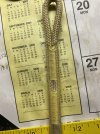
Documenting my hand-sewn eye process

i always thought soft, everlasting, non-corrosive adhesive between legs to eye, then hand sewn would be answer.
Where the adhesive kept it in place and the stitchings would just assure the positioning of the adhesive and mated parts w/thread as a 2nd stringer, not main force incurred.
As like cotter key to hitch pin, cotter key as keeper, not primary.
Or back to model of bolt applies pressure to washers, that apply to work.
>>when tight load is more on the washers and mated parts as primaries, not the bolt hole; unless lose primary hold of washer sandwich spread frictions to hold larger area, and then starts wearing hole as now hangs from it alone, in a more focused foot print.
 
i always thought soft, everlasting, non-corrosive adhesive between legs to eye, then hand sewn would be answer.
Where the adhesive kept it in place and the stitchings would just assure the positioning of the adhesive and mated parts w/thread as a 2nd stringer, not main force incurred.
There was a discussion of glued splices on Buzz a while back.
I've taken to still soaking the stitching of my hand sewn splice jobs in Freesole (polyurethane boot sole repair goo) and then putting heat shrink tubing over this. CE lanyard used to have sewn eyes with quite hard stitching they presumably put some coating on. For me, hand sewn eye - Freesole - heat shrink tubing is like a rock. Never have had any movement, first used on tree cabling for storm disasters now I have a couple of chewed upon lanyards with new hand sewn eyes that I have no qualms about climbing on. They've been bomber. The Freesole does soak into the rope cover fibres a little before it sets.
 
Last edited:
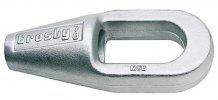
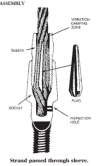
I wonder if it's practical to develop a spelter socket for climbing ropes.
Screenshot_20220212-141031_Google.jpg
With wire rope, the strands are fully separated, pulled back into the conical hole, then it's filled with molten zinc or epoxy. For polyester or nylon rope, a non-damaging filler compound would be needed. Fiber ropes might require a little broader cone shape as well. In some applications, the metal attachment point might be better than attaching to (and causing wear on) an eye in the rope itself.
 
As I recall, the final step of making a splice in double braided rope is to put several stiches through the splice to prevent the buried part from slipping during repeated light loads. This stitching works well, but it's difficult to remove (for adjusting the size of the eye) without damaging the rope. The barbed insert in this patent eliminates the need for the stitching, thus making it feasible to make minor adjustments rather easily while still ensuring that the splice will not slip.

I don't think such splices will ever be approved for life support applications.

I like the socket terminations that use a plug insert, but anything like this is going to be way too costly for short-lived life-support applications. You simply cannot beat the $15 certified sewn eye for what we do with ropes.
1644734370189.png
 
Last edited:
Or something that would jam with a stopper knot?
A stopper knot would definitely be the quickest possible way. However, a thingamajig that can jam a stopper knot would be bulky. If the bulk isn't an issue, I'd just tie an eye. (And I think the spelter is potentially stronger since the fibers aren't bent through a knot.) I'm trying to envision an alternative to sewing or splicing that can be done at home or shop, quickly without special tools or talents which provides a nice compact eye. I've hand sewn a few rope eyes and it takes me a long time. As thrifty as I am, I might shell out a few bucks for something that would save a whole bunch of my labor.

The plug socket @Winchman showed above is interesting, but I'm skeptical of how much strength it could have with fiber rope without being excessively large. I don't think wedge sockets (like for crane cables) are as promising as the spelter socket either; too bulky by nature.
 
An easier and seemly stronger method of hand sewing is the Round Perimeter method, not as nice looking but stays more flexible, which might help with more strength retention.
 
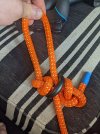
If you want quick and easy with know, something like this with a ring is possible... But a regular knot is probably more practical
 

Attachments

  • PXL_20220213_141045485.jpg
    PXL_20220213_141045485.jpg
    591.3 KB · Views: 34
All/ AJ I'd be interested on everyone's thoughts on this:
Another take on hand sewn splices
I must admit there were a couple of things about using the speedy stitcher like using another needle for the lock stitch I hadn't thought of.
Cheers all
I like the initial setup to fix and align the eye etc. I “build” my eye around a carabiner and then “fix” it so I get exactly the fit I want on a biner.

It appears he’s using the leather cutting chisel-edge needles that come with the Speedy Stitcher. Not a good idea because it is cutting fibers in the cordage every time the needle is pushed through.

Should not be, and does not need to “hammer” the needle through, needles will be broken frequently this way. There are some other subtleties involved getting the needle through but gentle twisting with moderate force will get it done. I’m no genius but I’ve broken two needles in 10 plus years of doing many hand-sewn eyes.

For that diameter cordage I use a stronger thread than what comes stock with the SS.

I trim the sewn cordage after the eye is sewn, just a preference.

He is amazingly innovative with the gear mods and builds he does. His sewn eye demo gives me ideas to further improve my work!
-AJ
 
Thanks for the note - in the interest of completeness I cross posted a link to this thread you started, in the YouTube comments. As for Daigentanoen's other content he is an amazingly inventive guy to me. Some of the lanyards/ cinches I wouldn't use but to each his own. Wish I could think stuff up at the rate he does (still trying to work thru a design for a throwbag upright spar flipper for trunk cinching spruces). I' ve learned so much from this thread, in fact, from everyone here at Buzz. Cheers
 
Thanks for the note - in the interest of completeness I cross posted a link to this thread you started, in the YouTube comments. As for Daigentanoen's other content he is an amazingly inventive guy to me. Some of the lanyards/ cinches I wouldn't use but to each his own. Wish I could think stuff up at the rate he does (still trying to work thru a design for a throwbag upright spar flipper for trunk cinching spruces). I' ve learned so much from this thread, in fact, from everyone here at Buzz. Cheers
Ooooh! “Throwbag spar flipper for trunk cinching spruce”! We’ve been needing a new Holy Grail, this should keep the knights who say “Ni!” busy!
-AJ
 
Here you go...
Scroll down about one third the page, and look for this:
1650827594909.png
It goes on for quite a bit after that. Unfortunately there are no pictures or diagrams.

Again unfortunately, they used terminology only known to those who already know how to do the task at hand. The rest of of us are left to guess at what they mean.
 
Last edited:
OK Brocky. I give up searching. What is a "Round Perimeter" method?
I’m such a neatnick, I like the lock-stitched firm sewn area ;-) Next one will incorporate a space between two shorter stitched areas so it will wrap nicely for smaller diameter branch cinches (for positioning only my friends!) but highly life-support quality when a lanyard or rope end is implemented for “best practices” life support quality
-AJ
 
"Again unfortunately, they used terminology only known to those who already know how to do the task at hand. The rest of of us are left to guess at what they mean."
Yup. Kinda anecdotal at best. Writing like this reminds me of reviewing journal articles where the authors come out with something like "It has llong been known that . . " (loosely translated - I couldn't be bothered to look up the original references and cite them for you here . . . ). And so it goes. Even tried Google on some of the terms but only came up with fancy crochet moves . . . but thanks for the link W-man.
 
B8A98ED3-4111-44F1-B1B5-44D9E1AC9C85.jpeg
This is how Sterling sewed their 6mm XTEC, break strength of 4,721 lbs. The sewn eye is rated at 3147 lbs. Covered with shrink tube so doesn’t flex much.
 
View attachment 81571
This is how Sterling sewed their 6mm XTEC, break strength of 4,721 lbs. The sewn eye is rated at 3147 lbs. Covered with shrink tube so doesn’t flex much.

Fire escape line? I'll stop guessing, what is the intended use of the sewn eye and cordage from the manufacturer's perspective?

Aha, just looked it up, heat and abrasion resistant, high-strength (of course) What are you using it for Brocky?
-AJ
 
Last edited:
[ QUOTE ]
You should also go through the sides to compress the rope, adds a great deal of strength.

[/ QUOTE ]

Yep, that has occurred to me. At this point the finished "splice" is hard as a rock, I did three passes total and the last pass was tough to get the needle through. Pre-compressing with the C clamps made a big difference.

But you are right, I could do the initial basting stitch through the sides, potential is there for an insanely strong sewn eye.

Here's just after I finished the basting pass you can see how much of the compression is retained from the clamping
8523122572_b8bfd54ef5_c.jpg


And then finished after the third pass, muy fuerte, I believe a fair amount stronger than my previous attempts.
8523123132_3bf6bc2da6_c.jpg


I was going fast to make a flight out of town with my rope, could be a little neater but I think the quality is good.
-AJ
Super nice stitching !! I'm just getting into it with simple stuff like a saw lanyard and hitchcords.
That job looks really good , can't wait to see the test results..
 

New threads New posts

Kask Stihl NORTHEASTERN Arborists Wesspur TreeStuff.com Teufelberger Westminster X-Rigging Teufelberger
Back
Top Bottom