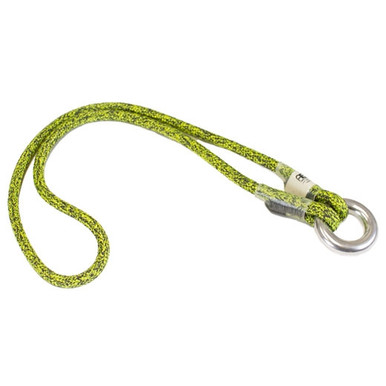
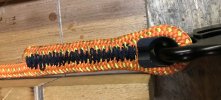
Documenting my hand-sewn eye process

AJ thanks - I wondered about going over centerline - and I notice you're using doubled thread above? Is that right?
However, I stayed inside the midline a bit (as in Brocky's pic at #759 above in this thread) except for the ends where I did a short fourth pass (by now things were getting like concrete). Next one will do as you suggest.
Any recommendations on thread - I just used the Treestuff whipping twine?
I was able to have an easier time clamping by putting the doubled over rope into a wooden miter box with clamps on a hardwood stick to compress the rope legs prior to taping as shown in your pictures - worked like a charm.
This splice is 3 3/4" inches long and is now hard as rock, even before the shrink tube - it'll be what I call a "sap" lanyard - I make a bunch of 'em for when I get tired of cleanup in the middle of things.
Stitching eyes is a great way to spend some bench time on our long cold cold winter nights up here. Cheers mate.
 
AJ thanks - I wondered about going over centerline - and I notice you're using doubled thread above? Is that right?
However, I stayed inside the midline a bit (as in Brocky's pic at #759 above in this thread) except for the ends where I did a short fourth pass (by now things were getting like concrete). Next one will do as you suggest.
Any recommendations on thread - I just used the Treestuff whipping twine?
I was able to have an easier time clamping by putting the doubled over rope into a wooden miter box with clamps on a hardwood stick to compress the rope legs prior to taping as shown in your pictures - worked like a charm.
This splice is 3 3/4" inches long and is now hard as rock, even before the shrink tube - it'll be what I call a "sap" lanyard - I make a bunch of 'em for when I get tired of cleanup in the middle of things.
Stitching eyes is a great way to spend some bench time on our long cold cold winter nights up here. Cheers mate.

Yep, the stitching compresseses the cordage in so I keep moving out per pass. No doubled thread, you're seeing the tight final pass stitching pattern.

I like the mitre box pre-compression technique, excellent.

Here's the thread spec I use, Brocky and others have posted some quality thread specs as well:
50671181863_0c7e8b34b6_c.jpg


C-Lon Tex 400, .9mm, 75 lb. breaking strength

I wax it w/bees wax, improves handling during sewing, increases strength and UV resistance. I've never had this thread visually degrade over the working life of the sewn eye, cordage wears out sooner.
-AJ
 
Last edited:
I used this pre-waxed polyester thread that comes with the Speedy Stitcher to sew a bridge on to my Tree Motion w/Globe 3000 then later with a custom replacement bridge cordage. It's difficult to stuff the .9mm thread into the smaller static bridge cordage especially on the third pass. The Globe 3000 bridge broke at 9500 lbs at the center of the bridge after 4-5 years of use. I think the thread is spec'd in the 40 lbs ABS range.

50672107306_a96d8c50f9_c.jpg


49265400858_ccac330ef3_c.jpg


-AJ
 
Your artistry could look a little more “professional“ if you cut the rope end square, rather than angled!
 
Moss, thanks again for your help. I didn't go to a forth pass over half the cordage as the rope was getting uncomfortably tight. I will say also for those posting above, when I've played with this sewing in the past using the stock Speedy Stitcher needle you could hear tearing fibers as you went through fabric sometimes, the last pass especially. Not so with the needles in the link above, not even on the last passes. So not sure if the Organ size 24 needles referred to above are "round point" but they do behave differently and go through the rope fabric really slick.
On durability, I've had some of my earlier sewn stuff on bracing for trees we were trying to straighten/ train after snow damage and even after a couple of years through winters and summer thunderstorm seasons they looked fine when we finlally removed the cabling - rope was a little faded sometimes, but the sewn splices hadn't moved a bit. Unscientific I know, but no way I would abuse climbing equipment like that. Cheers


"Your artistry could look a little more “professional“ if you cut the rope end square, rather than angled!"
I always do that too but I think in my case it's the years and years of single malt . . . . .
 
Moss, thanks again for your help. I didn't go to a forth pass over half the cordage as the rope was getting uncomfortably tight. I will say also for those posting above, when I've played with this sewing in the past using the stock Speedy Stitcher needle you could hear tearing fibers as you went through fabric sometimes, the last pass especially. Not so with the needles in the link above, not even on the last passes. So not sure if the Organ size 24 needles referred to above are "round point" but they do behave differently and go through the rope fabric really slick.
On durability, I've had some of my earlier sewn stuff on bracing for trees we were trying to straighten/ train after snow damage and even after a couple of years through winters and summer thunderstorm seasons they looked fine when we finlally removed the cabling - rope was a little faded sometimes, but the sewn splices hadn't moved a bit. Unscientific I know, but no way I would abuse climbing equipment like that. Cheers


"Your artistry could look a little more “professional“ if you cut the rope end square, rather than angled!"
I always do that too but I think in my case it's the years and years of single malt . . . . .
I do 3 passes, it creates sufficient stitch density in a 1.75” run of stitching to more than meet life support break strength. Yep, it would be very difficult to do a 4th pass. Good thing about moving the needle insertion point out a little per pass is the cordage is a hair softer/less compressed.

Can’t be said enough, don’t use leather cutting needles to sew textile fibers!
-AJ
 
There's nothing in that listing about them being ball point. How do you know that's what they are?

Has anyone dissected a sewn splice to show how many rope fibers are cut or damaged by the process? It would be interesting to see pictures.

The ball point needles are sharp but they don't have a cutting edge. A needle tip can be examined to verify it is not a cutting needle, it's obvious, looks like a knife edge. When you push a cutting needle through cordage you can hear the fibers being ripped, with a fabric/textile needle you don't.

The textile needles are designed to push fibers aside not cut them. In pull tests on my eyes there is no evidence that the cordage fibers have been cut, the rope always breaks before the sewn cordage area does. The sewn eyes are meeting all the criteria for life support use. Nothing against taking one apart to see if fibers are damaged, it's not a question I need answered.
-AJ
 
Hand-sewn eye for a 15' lanyard, cordage is Sterling Tendril 11.1mm. Turned out that it firmed up sooner than usual, after the second pass the cordage was turning into stone. The last pass was really tough, plenty of opportunities to break the needle but I dodged that bullet. I think it's because of the Tendril's construction, a very firm line out of the box. If I ever sew it again I may not pre-compress it. I would still tape it though before sewing, part of what pre-compression does is allow me to line up the two legs of the join as well as possible, they tend to squirm around otherwise while you're sewing ;-)

50691414932_cdcdf3d966_c.jpg


50691325081_185a56dba3_c.jpg

Two passess complete, third/final pass underway from left to right


50691415042_673317dc70_c.jpg

Finished lanyard

-AJ
 
@moss Interesting product that I just found on treestuff, hand-sewn products. I'm not sure how long they have made this particular item or if there are any other hand sewn eyes on the site. But given the initial reaction to your sewing, I thought it was interesting.


@moss Interesting product that I just found on treestuff, hand-sewn products. I'm not sure how long they have made this particular item or if there are any other hand sewn eyes on the site. But given the initial reaction to your sewing, I thought it was interesting.


It also says "spliced by the experts at rope logic." There's no desire for precision in that description.
It is funny though.
 
It also says "spliced by the experts at rope logic." There's no desire for precision in that description.
It is funny though.

Despite this thread being in the 'Buzz Splicing category sewing as the primary join really isn't splicing in a real world rope use sense. I think when SherrillTree first introduced (at least to the tree industry) machine-made sewn eyes they called it a "splice" to ease the worries of climbers who didn't want to trust the idea. I think it was more of a gentle marketing strategy than factual representation of the construction. This terminology use has continued.
-AJ
 
Yesterday's Tachyon effort - 3 passes/ 175 stitches (which at 75 lb break strength thread is way over 5K lbs) - with a "longer" sewn pattern splice maybe made it a little easier to pack in the thread? Hard as rock now, even before shrink tube.

Thanks again all for all the tips and help . . . .
 

Attachments

  • TachyonSewnSplice.jpg
    TachyonSewnSplice.jpg
    74.7 KB · Views: 41
Last edited:
I'm documenting the sewing process for an eye I'm working on. Sewing the eye on NE Ropes Tachyon. For this eye I'm pre-tensioning the join with clamps to increase the friction on the finished eye.

Sewn eye documentation

I'll add more photos to the set as the eye is finished.

Materials...

Thread
C-Lon Tex 400 Double bonded nylon, .9mm, 75 lb. dry strength.
Hand-waxed with bees wax, improves handling for hand sewing and increase tensile strength.

Needle
7x3 (ball tip) 180 industrial machine needle (ground down the needle shaft to fit the sewing awl chuck)

Speedy Stitcher sewing awl

Clamping to increase pre-sewing compression
8518712177_b6ab925422_c.jpg


Clamps off, tape retains the compression, basting stitch to capture the tension with thread. White tape is removed as the stitching progresses.
8519825348_25ee6a7d6c_c.jpg


-AJ
[ QUOTE ]
You should also go through the sides to compress the rope, adds a great deal of strength.

[/ QUOTE ]

Yep, that has occurred to me. At this point the finished "splice" is hard as a rock, I did three passes total and the last pass was tough to get the needle through. Pre-compressing with the C clamps made a big difference.

But you are right, I could do the initial basting stitch through the sides, potential is there for an insanely strong sewn eye.

Here's just after I finished the basting pass you can see how much of the compression is retained from the clamping
8523122572_b8bfd54ef5_c.jpg


And then finished after the third pass, muy fuerte, I believe a fair amount stronger than my previous attempts.
8523123132_3bf6bc2da6_c.jpg


I was going fast to make a flight out of town with my rope, could be a little neater but I think the quality is good.
-AJ
Holy shit looks amazing...im just starting reading threw. But cant wait how is all this going for you now? Are you still doing it? And have you tried this on your hitch cord? Thats what i want to do. Thats what brought me to your thread.
 
Cool.. haha didnt let anything stop ya. Or anyone. ;-]. But shit this was an interesting thread. After first 20. I just skimmed the rest. But after reading this i may try my hand in splicing.
 

New threads New posts

Kask Stihl NORTHEASTERN Arborists Wesspur TreeStuff.com Teufelberger Westminster X-Rigging Teufelberger
Back
Top Bottom