Documenting my hand-sewn eye process

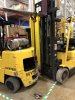
Testing the larger thread/fewer stitches: This eye had 17 stitches/pass/side for a total of 102 stitches with 70lb actual strength thread. That's a theoretical strength of 7140 lbs and the jacket of this rope has less edit: more friction than the last test piece. I only have cranes at work up to 4000 lbs so I had to get creative. I used a forklift to pick up the back end (counterweight end) of a 10,000 lb rated forklift (8990 lbs on the rear axle per manufacturer data sheet) Let's see how we do:
IMG-7400.jpg

I had to stop because I heard the fibers in the rope breaking at the knot and didn't want to add another satellite to space. I wish I knew the actual pull amount but we can get in the ballpark. The truck doing the lifting is rated to 5000 lbs but they can pick up more if the load center is closer to the front tires like it is above. The rear tires on the test dummy were able to be moved by hand so they were significantly unweighted. Let's call this a (very) conservative 6000 lbs. Here's another pic of it under load:
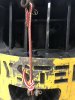
IMG-7404.jpg

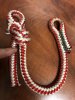
And here's what the test piece looked like afterwards:
IMG-7406.jpg

Note the fibers at the knot beginning to break and the stitching that has gone a little diagonal. Again, seems to be a good indicator of overloading. I'd say we achieved our goal of having the stitching be stronger than the knot. Also, side note, look how the knot rolled under load!

I'd rather have hard data vs. the close estimates I have now. I'm in the process of welding up a break test stand and will report back when it's done. So far I have the I-beam, cylinder and power unit but still need a load cell and a readout and they're pricey. I'll let you guys know when it's done and then do some more break testing.

Takeaway: @moss 's technique is one I'll continue using for myself. Nice job, Andrew!

I'm curious to hear what you guys think so bring it on.
 
Last edited:
Testing the larger thread/fewer stitches: This eye had 17 stitches/pass/side for a total of 102 stitches with 70lb actual strength thread. That's a theoretical strength of 7140 lbs and the jacket of this rope has less friction than the last test piece. I only have cranes at work up to 4000 lbs so I had to get creative. I used a forklift to pick up the back end (counterweight end) of a 10,000 lb rated forklift (8990 lbs on the rear axle per manufacturer data sheet) Let's see how we do:

View attachment 67531

I had to stop because I heard the fibers in the rope breaking at the knot and didn't want to add another satellite to space. I wish I knew the actual pull amount but we can get in the ballpark. The truck doing the lifting is rated to 5000 lbs but they can pick up more if the load center is closer to the front tires like it is above. The rear tires on the test dummy were able to be moved by hand so they were significantly unweighted. Let's call this a (very) conservative 6000 lbs. Here's another pic of it under load:

View attachment 67532

And here's what the test piece looked like afterwards:

View attachment 67533

Note the fibers at the knot beginning to break and the stitching that has gone a little diagonal. Again, seems to be a good indicator of overloading. I'd say we achieved our goal of having the stitching be stronger than the knot. Also, side note, look how the knot rolled under load!

I'd rather have hard data vs. the close estimates I have now. I'm in the process of welding up a break test stand and will report back when it's done. So far I have the I-beam, cylinder and power unit but still need a load cell and a readout and they're pricey. I'll let you guys know when it's done and then do some more break testing.

Takeaway: @moss 's technique is one I'll continue using for myself. Nice job, Andrew!

I'm curious to hear what you guys think so bring it on.
The only thing that I have to say is that engineers are the only guys as cool as tree climbers.
 
Only if they are not the ones designing modern trucks or machinery.


I'd like to see actual break test data. But good test nonetheless.
 
I'm curious. How exactly are you sewing?

Traditional sewing uses two threads. One is carried through the material by the needle, and a loop is formed on the far side. A second thread from a bobbin is passed through the loop, and it's pulled into the material as the needle goes pack up. The interlocked loops will hold the stitching in place if the thread breaks. A short back stitch will lock the treads in place at the end so a knot isn't needed.

You can also use the needle to push the thread through the material, then grab the thread and pull all of it through. That process is then used from the other side, and repeated over and over until all the thread is used up. The thread needs to be secured with a knot at the end. This method results in more wear on the thread from being pulled through the material over and over.

I expect the special sewing machine used to make professional eye splices is using the traditional method with two threads.

From the picture of the failure of the sewn eye in the black rope in post 746, it looks like friction is doing a pretty good job of holding the threads in place.

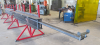
It's good to see there's another engineer on the forum, and one who is also a welder/fabricator. This is one of my more challenging projects after retiring from engineering to take up a hobby of welding, fabricating, and machining. It's a saw table for the local steel supply company, complete with rollers on the bed and a roll-out support extension. I also built the table behind the welder in the background.
2020-04-23_cutting_table.png
 
I'm curious. How exactly are you sewing?

Traditional sewing uses two threads. One is carried through the material by the needle, and a loop is formed on the far side. A second thread from a bobbin is passed through the loop, and it's pulled into the material as the needle goes pack up. The interlocked loops will hold the stitching in place if the thread breaks. A short back stitch will lock the treads in place at the end so a knot isn't needed.

You can also use the needle to push the thread through the material, then grab the thread and pull all of it through. That process is then used from the other side, and repeated over and over until all the thread is used up. The thread needs to be secured with a knot at the end. This method results in more wear on the thread from being pulled through the material over and over.

I expect the special sewing machine used to make professional eye splices is using the traditional method with two threads.

From the picture of the failure of the sewn eye in the black rope in post 746, it looks like friction is doing a pretty good job of holding the threads in place.

It's good to see there's another engineer on the forum, and one who is also a welder/fabricator. This is one of my more challenging projects after retiring from engineering to take up a hobby of welding, fabricating, and machining. It's a saw table for the local steel supply company, complete with rollers on the bed and a roll-out support extension. I also built the table behind the welder in the background.
View attachment 67554
Everything about that picture is beautiful.
 
I'm curious. How exactly are you sewing?
Ductaper is using the technique I've detailed in the beginning of this thread and have also updated in the thread as I learned more and refined my technique. It's a long thread ;-)

Interesting to see the two legs of the sewn eye shift during the break test. Typically when my sewn eyes have been pull tested there is no movement in the sewn area or of the two legs of the eye. Since I moved to what I call my "second generation" technique (thorough pre-compression of the two legs before sewing) no one has been able to break any stitching or cause it to shift. The rope always fails first and away from the stitched area.

Here's my most current technique, always use ball-tipped industrial needles intended for textiles, do not use leather cutting chisel needles that come with many sewing awls:
https://flickr.com/photos/naturejournal/albums/72157712585698993

I use a lock-stitching technique, you can see it in any "Speedy Stitcher' sewing awl tutorial video. It is effectively like a manual sewing machine stitch. Instead of a bobbin with a second thread spool on the bottom side, to start the sewer takes a single length of thread and pulls it through the cordage join to the halfway point of the thread length. The length of the thread on the "bottom" side functions essentially the same as a separate bobbin thread. Others have gotten good break results using a "baseball stitch", basically a continuous wrapping stitch through the cordage with no locks. I like lock stitching because it greatly reduces or eliminates a zipper failure effect on extreme loading or say when a few stitches are abraded or broken from contact with tree parts or hand saw. With the lock stitches any thread failures are isolated. Even so on inspection time to retire "the eye" but no one will get dropped out of a tree from a few stitches being broken. This is the same as machine eye stitching. My 3-pass stitching pattern is derived from machine stitching which I studied by dissecting them and by looking at videos of cordage sewing machines operating.
-AJ
 
Oh, yeah, standard disclaimer, it takes a long time, is nowhere near as fast as traditional splicing. I got into hand-stitching before custom machine stitching was widely available. Nowadays you can have your cordage stitched to your specifications for a very reasonable cost. I use hand stitching primarily for prototyping these days and special cases like for example sewing a rope bridge to my harness anchors.

Like so:
49265400858_ccac330ef3_b.jpg


-AJ
 
Interesting to see the two legs of the sewn eye shift during the break test. Typically when my sewn eyes have been pull tested there is no movement in the sewn area or of the two legs of the eye. Since I moved to what I call my "second generation" technique (thorough pre-compression of the two legs before sewing) no one has been able to break any stitching or cause it to shift. The rope always fails first and away from the stitched area.
Totally agree. I was doing this test to find what would be better than a knot vs. trying to make the joint as strong as possible. Your stitch density seems higher than what I used in the red rope. I was coming at it from a different angle: if all I can use in this rope is a knot, what would be better than it?
 
Your stitch density seems higher than what I used in the red rope.

You probably noticed that as you stitch the stitches tend to "roll" towards the center of the join as the cordage compresses for each pass I move the needle entry point further away from the center, this keeps the stitching engaged with more of the cordage fibers and allows me to fit the stitcches more densely, especially th e last pass which has the most stitch density.
-AJ
 
@moss or anyone that knows. Got a link to a source for some ball point needles compatible with a Speedy Stitcher, that can accommodate fat thread? I think the thread was called Tec400 or something like that. Also think it said .9mm but that sounds massive, Idk.
I lost mine... I’ll check the haystack but I’m not hopeful.
I had found a link to get them before on this thread but can’t find it now.
 
@moss or anyone that knows. Got a link to a source for some ball point needles compatible with a Speedy Stitcher, that can accommodate fat thread? I think the thread was called Tec400 or something like that. Also think it said .9mm but that sounds massive, Idk.
I lost mine... I’ll check the haystack but I’m not hopeful.
I had found a link to get them before on this thread but can’t find it now.
Here’s the one I used for my big thread, size 25/200: https://www.ebay.com/itm/261513034459
It fit the SS with no modification.
 
72142A97-9F19-4F70-BD43-854FCB102F0E.png
This is the next type of stitching I’m going to try next, it just takes a lot more thread and cord, and time!
There are a few different methods that I know of, the above type, the multiply passes rock hard kind, the single pass flexible slides some with use known as the Petzl splice mostly, and the Round Perimeter stitching that moss described above.
 
Somebody recommended these ball point 135x17 needles in one of the previous posts. They work well with no mods on SpeedyStitcher. I've done 8mm cord using .61mm thread. I also used them with .71mm thread repairing some throwline cubes. I don't think the eye with accommodate any larger thread without some patience.
 
Somebody recommended these ball point 135x17 needles in one of the previous posts. They work well with no mods on SpeedyStitcher. I've done 8mm cord using .61mm thread. I also used them with .71mm thread repairing some throwline cubes. I don't think the eye with accommodate any larger thread without some patience.

There's nothing in that listing about them being ball point. How do you know that's what they are?

Has anyone dissected a sewn splice to show how many rope fibers are cut or damaged by the process? It would be interesting to see pictures.
 
There's nothing in that listing about them being ball point. How do you know that's what they are?
Well, it's Amazon so you never know until you get it, lol. BTW, I pulled this from my order history, but the pic and numbers on package still match what I received. The ones we got were ball point. I seem to remember that Organ was putting some extra letters or code after the "DPx17" if it had a special point like cutting or sharp. Ours were the standard needle which comes with a round point. I would certainly double check with the seller though. I can tell you that I've lightly bumped myself numerous times with these things and have never broken skin. I have also never heard any signs of fabric ripping.
 
View attachment 67573
This is the next type of stitching I’m going to try next, it just takes a lot more thread and cord, and time!
There are a few different methods that I know of, the above type, the multiply passes rock hard kind, the single pass flexible slides some with use known as the Petzl splice mostly, and the Round Perimeter stitching that moss described above.

Is that a single pass lock stitch?
-AJ
 
Moss, Brocky, Birdyman88 and many others on this thread - wanted to say BIG thanks for documenting your sewn eye process and for the link to the needles for the Speedy Stitcher - these needles (Organ 135X17 Walking Foot Industrial Sewing Needle Size 24) worked great (and thanks for the other link). Can anyone recommend a link to the thread(s) they are reliably using please (sorry if I missed this).
Below is yesterday's effort - triple pass buried lock stitching (comments pls?) - it has a coat of Flexsole on the stitching and is ready for shrinktube (crosspost to Tom glued splices thread - https://www.treebuzz.com/forum/threads/glued-splices.42686/page-2#post-666085 ). Rock solid. Thanks everyone.
 

Attachments

  • sewnsplice.jpg
    sewnsplice.jpg
    91.3 KB · Views: 37
Moss, Brocky, Birdyman88 and many others on this thread - wanted to say BIG thanks for documenting your sewn eye process and for the link to the needles for the Speedy Stitcher - these needles (Organ 135X17 Walking Foot Industrial Sewing Needle Size 24) worked great (and thanks for the other link). Can anyone recommend a link to the thread(s) they are reliably using please (sorry if I missed this).
Below is yesterday's effort - triple pass buried lock stitching (comments pls?) - it has a coat of Flexsole on the stitching and is ready for shrinktube (crosspost to Tom glued splices thread - https://www.treebuzz.com/forum/threads/glued-splices.42686/page-2#post-666085 ). Rock solid. Thanks everyone.

Looks good! I like to have the stitched area wider so it bites into more of the cordage. Each pass rolls in a little as it compresses the cordage fibers. For the next pass I put the needle in at the halfway point of the cordage width and the third pass slightly outside half the cordage width so it looks more like this:

This is in 10mm EZ Bend static line
28235828339_eb9a2f642f_b.jpg


-AJ
 

New threads New posts

Kask Stihl NORTHEASTERN Arborists Wesspur TreeStuff.com Teufelberger Westminster X-Rigging Teufelberger
Back
Top Bottom