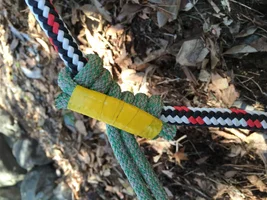
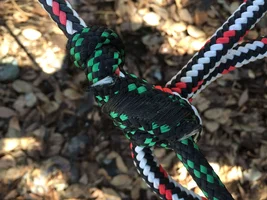
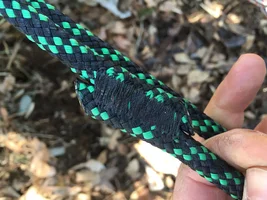
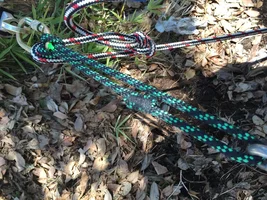
Documenting my hand-sewn eye process

If you SRT and don't have a spliced eye termination to make everything so much easier than you're missing out.
Examples (remember the spliced eye is not bulky but streamlined )-
-forwarding your tail with a quickly attached throw ball
-joining lines quickly and safely without bulk (an oval quick link will pass through crotches easier than a knot)
-tail retrievable redirects
-DdRT on tail
-Choking a spar with a steel biner or quick link
And so many more!
[emoji2] [emoji38]

Reed Wortley
CTSP #01739
ISA CA #SO-6953A

I do know what you mean, as for me, I hand splice all my own lines. I was refering to hand sewn eyes.
 
Someone is going to die because of this Andrew. Probably not you, but someone.

Wow, that's a little crazy Nick! The common sense and survivability of the human species is just amazing.

I was told the same thing "Someone is going to die" many moons ago when I posted a photo of a Blake's Hitch online.

There are probably max five people on the planet who will try to make their own sewn eyes for life support. It takes amazing patience and focus to do it. I know two people who've done it and they did an awesome job.

Nick give me a call when you get a chance, I think you have my cell in the tree stuff database, we should chat about this sometime, take care.
-AJ
 
Hopefully I can provide some life to this interesting thread again. Safety is a serious issue, and when you have witnessed an accident then you know. When you know something about the issues involved in an accident, then you will use a lot of time afterwards to think about whether you could have done something to prevent this accident. And then you have the legal aspects too - insurance and so on.

We have got the internet, and a lot of people sharing information of often unknown quality. But a lot of new good products and solutions are made due to sharing information. And for safety matters we need development too.

Sewing an eye on a rope has not been done for many years compared to splicing eyes. So I still consider sewing a new way of doing it. This is also true for the professional machine sewn eyes. And I think a lot of testing remains to be done on this matter. I don't think we can expect the companies involved in this to inform in public how many tests they have done to prove their way of doing their machine sewn eyes.

Variables that will impact the strength and durability of the tack include thread type, size and twist, tension control of the tread, stitch pattern, stitch speed, foot pressure, clamp pressure, needle size, and needle type to name a few. Some of these variables can be controlled with hand stitching and others cannot.

I do agree that a lot of variables influence the durability and breaking strength of a sewn eye. But the question is how much each variable makes a difference.

In order to improve public knowledge some basic tests are needed to be published on how each variable influences the durability and strength. The tests should be designed to provide this information. If you just make a sewn eye the best way you can think of, and then test it, you may get a good result (98% breaking strength), but little knowledge is gained on the important variables. You can easily make wrong assumptions on what is important.

When you do break tests, I think it is important to take photos of the stitches before the test, just before the breakings occur and afterwards.

Furthermore I like to see breaking test results on sewn eyes, that have been taken out of service due to wear of the rope or the eye. Test on such eyes provides information about durability of sewn eyes. We do have professional people here making machine sewn eyes. How many tests have you done on sewn eyes at end of their used life?
 
There is zero core slippage in my hand-sewn eyes, some I've been climbing on (main climbing rope and split-tails) for 3 years, the stitched areas are rock hard, no movement, the eyes are outlasting the rope and cordage. My stitching does engage the core, the density of the stitching combined with the compressive force of the stitching creates an effective lock on the core no matter what the core construction is.
-AJ

Moss, did you or others break test an eye that was taken out of use due to the wear of rope or cordage?

I am concerned whether “rock hard” is good or bad and thinks of the sudden change from the rock hard part to the soft rope part leaving the eye. I have the same concern for your eyes as for the professional eyes made by sewing machines. But I have no tests to prove my point.

Did anyone make tests on a very loose flexible stitch area to see if this is good or bad?

I have seen electrical cables fail in this transition from hard part to soft part – I think you have too. And some rubber tube parts are used to improve service life time on this transition for electrical cables. On the internet, you can find a lot of information on how to make a spliced eye on rope. Most of them will recommend tapering in the splicing. I think it is an old tradition, which you have to take serious. I think this tapering is made to avoid the sudden change from the hard part of the splicing to the soft part of the rope.

So perhaps some tapering of the stiches should be considered. And of cause the shrinking tube may help too.
 
Moss, did you or others break test an eye that was taken out of use due to the wear of rope or cordage?

I am concerned whether “rock hard” is good or bad and thinks of the sudden change from the rock hard part to the soft rope part leaving the eye. I have the same concern for your eyes as for the professional eyes made by sewing machines. But I have no tests to prove my point.

Did anyone make tests on a very loose flexible stitch area to see if this is good or bad?

I had my first round of stitched eyes tested to failure. The main comment I got from the tester is that they felt that if I pre-compressed the area being stitched I would achieve greater strength in the join. The pre-compression contributed to the "rock hard" stitched area quality I've described. I have not had these pull tested, but as mentioned they are performing very well and outlasting my cordage. I've heard from a couple different credible sources that increasing the pressure of the join and creating higher friction between the cordage surfaces in a stitched eye increases the strength of the eye.

I do not load my eyes across the throat, pretty much the same as a spliced eye, obviously (to splicers anyway) you don't want to load across the throat of a splice. On a stitched eye the throat area is less well defined but I would describe it as a small area perhaps a few millimeters long (8-11 mm measured from the end of the stitching up the rope). It could be a misplaced concern on my part but I don't cross load just above or on the stitching if I can help it.

I have a couple stitched eye hitch cords and a stitched eye on a climbing rope ready for retirement. I will have these pull tested.

Thx for the questions and comments,
-AJ
 
Have you got your sewing machine, yoyoman? I should love to have one for Christmas, but I don't think my family agrees on that...

Moss, I shall look forward to read about your test results on your retired sewn eyes. I suspect, that most break tests are made on new ropes and new designs and only a few test are made on retired ropes. So it seems that the people doing tests here have noticed that a hard sewing area is good. My concern is durability of strength.

I thinks, that we all agree, that this "throat area" and perhaps a few millimeters into the stiches are the place we consider as critical and where the rope will break in test. It is the same for a knot, with a very compressed area in the knot and a sudden change to the flexible part of the rope. But with a knot you will normally have some changes of position during life of the rope. And I agree in your attempt to avoid cross loading on this throat area causing uneven load on the rope fibers.

I do have another point, that I cannot prove. Ropes do have some elongation due to the load. Especially dynamic ropes have that. Due to this elongation, it will be about the first 20 % of the stitch area (near the throat), that carries about 80% of the load from one side to the other. If this is the case, then it might be more important have friction to help carrying the load from the two sides.

I have got this motion after studying the stiches of sewn eyes on shock cord. Shock cords will typically have a possible max elongation to 220% of original length, while dynamic rope have about 140% (I think). I have had a task to improve service life of shock cords, because steel clips don't perform good. One way to cope with this problem is to make a curved seam in stead of making a seam along a straight line. Please see attached photo below.

100-140-220pct.jpg
 
Sewing shock cord presents its own unique challenge. I have tried with commercial heavy duty CNC sewing, the needle jams in the rubber so it is impossible to "inflate" the mantel or sheath with thread to cause the proper tension and pressure in the core to stop movement in the cordage. I have a long way to go in understanding all of the concepts of sewn eyes but one of the key features is the internal pressure created within the sheath from the powerful drive of the needle that a machine can deliver. (or with patience and a very strong hand)
 
Thanks for the comment, yoyoman. I agree on, that shock cord presents its own unique challenge, and it would be a separate thread to handle that subject. I only used this subject to present the challenges involved when you deal with elongation of rope. I hope that someone could get detailed pictures of the stitches on a dynamic rope along the time of a pull test. I think that pictures just before breaking the rope at the eye can show you how the stitches are loaded and the load distribution along the seam.
 
This link documenting pull tests. It has been referenced twice in this forum before 2-3 years ago. So I just like to repeat this link here:

http://www.bethandevans.com/load.htm

You will find two tests with stitched eyes about 1/3 and 1/2 into the text. The ropes were connected with the use of few stitches only. Some interesting test have been done on sewn webbing too. The text points out, that eye terminations are more challenging than end to end connection when you sew. It is due to the elongation of the webbing when loaded. So I recommend to read this report.

Then I like to document a sewn eye to you:
Syet%20%C3%B8je%20spiralflet-r.jpg

The rope is a 12 mm solid braid with a small core, and it is made of polypropylene in order to reduce weight. Its for in door use. The expected breaking load of the rope is 2600 lbs. The thread is a 2 mm braided polyester line with no core, and having a breaking strength of 375 lbs. The seam was intentionally bended in order to create a better load distribution along the seam. The max working (dynamic) load for the application is low - about 165 lbs.
 
Agreed. Maybe around 5 - 7 lbs.? It's a wild guess, but snug. The more stitched you lay in, the better that tension will hold on its own. The first pass takes more diligence in maintaining tension than the second and third passes.

I wrap vinyl tape around my baby finger so I can pull the stitch quite tight without eventually cutting into my finger for the time sewing the entire eye.
-AJ
 
I just went through this entire thread, some really excellent info and superb work done. Anyone considering hand sewing life support gear needs to look at the ENTIRE thread.

I still haven't retired my almost 3 year-old Tachyon with hand-sewn eye on one end. Will happen in the next couple months, I will report on pull tests for that eye and several hitch cord eye-to-eyes.
-AJ
 
I think the key word in the title of this epic thread is "documenting". I have seen climbers with some really suspect gear (nothing to do with sewn terminations anywhere) that seem to go about their thing without concern. That frightens me more than someone that went through the entire process of creating something by hand, having it documented, and moving forward with the discipline for repeatable results.
 
I decided to try and come up with a stitch pattern for double braid loops that are formed into prussik hitches, it seemed that the friction based buffer within the coils would allow a much shorter stitch pattern than one that is commercially machined. I aimed for 35mm length and came up with 3 patterns.
First pattern: 3 passes with a speedy stitcher, pulled moderately tight.
Second pattern: 3 passes. 1 and 2 with a running stitch and the third with the Speedy. First and second pass were pulled moderately tight, same with the speedy.
Third pattern: 3 passes. 1 and 2 with a running stitch and the third with the Speedy. First and second pass were pulled as tight as I could muster, Speedy was pulled moderately tight.

For the running stitch I used a needle on each end of the cotton, began work from the centre of the cotton and worked both legs alternately. Switched over tools but used the same cotton to finish the third pass.

When each pattern was pulled by hand 1 and 2 had slight movement, 3 none at all.

1. Hitch 12kn Straight pull 19.6 no break
2. Hitch 12kn Straight pull 18.4 break
3. Hitch 12n Straight pull 19.74 no break
I also pulled a loop held together with electrical tape, this pulled apart at 4.35kn !

The first pattern, while it did not break finished up extremely loose. The third appeared to have no deformation. IMG_7621.webpIMG_7625.webpIMG_7632.webpIMG_7635.webpIMG_7636.webp
 
It was interesting to see the time difference in reaching 12kn. The hitch has a huge buffer and is a wonderful design to keep force away from the stitch, of course it does finally get there but for climbing forces it is negligible. This compared to force hitting straight into the stitch is quite different and is worth considering if you want to hand stitch.
 

New threads New posts

Kask Stihl NORTHEASTERN Arborists Wesspur TreeStuff.com Teufelberger Westminster X-Rigging Teufelberger
Back
Top Bottom