Ddrt ropes being use for SRT

Well, not really.
What im asking about is the internal tension of the rope.
Ignoring the crotch, and how much tension is there in the rope at that magic spot where two legs of rope suddenly become the same thing?
I take one side of my rope off my MRS system and tie it to the tree. The branch my rope is over "feels" like im pulling on it harder. Does my rope "feel" like its getting pulled apart at the branch with 2x the force of my body weight?
Now i send up a runninbowline to the same branch and sit on the same single leg of rope. Is there now less tension inside the rope? There is less force on the branch, but im pulling the rope apart just as hard, the end still is immobile.
Another situation....a loop runner is pulled apart @ 24 kN. Take the same exact webbing and stitch it into an eye2eye (assuming the stitching = strength of webbing) , bend it around a round, immobile anchor and pull apart one side. Does it take 12 kN?
Logically, the point where the two legs of a Ddrt system meet must be holding the full weight of the climber. However, crane slings are rated for either straight pull, basket, or chocker. Such as seen here, in basket form, these slings are rated as much as double for basket. So by that, it reasons that each leg is holding 50% with no point of 100% load. It also depends on the radius of the bend as to how much stress is on the rope. Furthermore, in eye splice break testing, I believe the rope usually breaks before the splice or the eye, but I could be wrong on that. Screenshot_20190212-142345.webp
 
This is more anecdotal than data driven but I've never noticed a change in elasticity in my Yale 11.7 double braids from brand new to "broken in". The break-in roughens up the slippery smooth cover braid but otherwise rope performance is the same. This is for MRS or SRS, my ropes see use with either system, more on the SRS side of things.
-AJ
 
I wouldn't bet my engineering degree on this, but I'm pretty sure the rope in either basal tie, or mrs, is only experiencing 1x body weight. The doubled force applies only to the TIP.

View attachment 57441

Mrs :
The rope (in its entirety) supports 1x the weight of the climber. But each leg of the rope supports 1/2 the climbers weight.

SRS: each leg of the rope in a base anchored system supports ~1x climbers weight. In a SRS canopy anchor, the single leg of rope supports 100% of the climbers weight

I completely fail to understand the original intent of this thread.
 
The original post posed the idea that double braid arb ropes are designed for DdRT/MRS and that there are possible ways that SRT/SRS will prematurely wear out a double-braid line. Without even addressing the theoreticals around rope loading in different climbing systems I think the long experience of many climbers is that there is no difference in rope wear over time. As mentioned MRS has unique wear scenarios more to do with friction and cordage/fiber bending over relatively tight radius friction devices or limbs. SRS systems generally put less wear on the overall rope fibers since the rope is moving very little compared to MRS.

In the original post there was mention that after a rope is broken in there is some amount of permanent loss of elasticity in the core and resulting load imbalance between core and cover that would be amplified in SRS. I believe any effect like that would occur very late in the useful life of the rope, if it occurs at all.

Interesting stuff, in the practical use of these systems many of us have seen none of these effects though the working life of the rope. The most likely causes of rope decline beyond fiber stiffening over time from UV exposure and regular abrasion are climbers nicking their lines with hand saws, chewing away at rope from contact with chain saws hanging off the harness, and spiking ropes with climbing spurs, not the climbing system.
-AJ
 
  • Like
Reactions: Ob2
The original post posed the idea that double braid arb ropes are designed for DdRT/MRS and that there are possible ways that SRT/SRS will prematurely wear out a double-braid line. Without even addressing the theoreticals around rope loading in different climbing systems I think the long experience of many climbers is that there is no difference in rope wear over time. As mentioned MRS has unique wear scenarios more to do with friction and cordage/fiber bending over relatively tight radius friction devices or limbs. SRS systems generally put less wear on the overall rope fibers since the rope is moving very little compared to MRS.

In the original post there was mention that after a rope is broken in there is some amount of permanent loss of elasticity in the core and resulting load imbalance between core and cover that would be amplified in SRS. I believe any effect like that would occur very late in the useful life of the rope, if it occurs at all.

Interesting stuff, in the practical use of these systems many of us have seen none of these effects though the working life of the rope. The most likely causes of rope decline beyond fiber stiffening over time from UV exposure and regular abrasion are climbers nicking their lines with hand saws, chewing away at rope from contact with chain saws hanging off the harness, and spiking ropes with climbing spurs, not the climbing system.
-AJ

I wholeheartedly agree with this.
 
I've made instant coffee before .... at 2400m, -18ºC. I also staked down my tent pegs with skis. Come at me.

On a serious note, Starbucks has little instant coffee packets (Via?) that are pretty half decent
 
Did you guys know that you can develop black and white film with instant coffee? Works just as good as the commercial developer solutions. Google caffenol developer. That is what it is called. Basically instant coffee with Vitamin C powder and something else added (I forget the exact recipe - have not done it in some years now but I used to sometimes shoot 8x10 large format with a big old wooden bellows camera I inherited).
 
I would like to add that rope break in is not only "working" the rope, but it is also, and even more so in the beginning at least, wearing off the production waxes from the rope fibers through abrasion, ultraviolet, air, and water exposure.
Very true, I think a good point to take from this, in general, is to truly know your gear and know what goes into making it safe for you to work with. I see a lot of guys out there who only know that the rope they’re using holds them; or that their carabiner closes and locks and that steel is heavier than aluminum so use aluminum. They simply know that the gear they have used has worked for them but don’t even attempt to understand the limits and proper uses for their gear. I.e. when to retire a climbing line or a carabiner, when to use a block over a pulley, when a carabiner will suffice rather than a rescue pulley (or if that is even acceptable), etc.
@TallTreeClimber , you brought up only some of the aspects of rope degradation, but it got me thinking about how, as I’ve seen amongst us tree climbers and arborists, that this is a subject that needs further exploration in terms of people less diligent in searching for knowledge, or who are simply ignorant of things like this that they should be taking into account
 
Did you guys know that you can develop black and white film with instant coffee? Works just as good as the commercial developer solutions. Google caffenol developer. That is what it is called. Basically instant coffee with Vitamin C powder and something else added (I forget the exact recipe - have not done it in some years now but I used to sometimes shoot 8x10 large format with a big old wooden bellows camera I inherited).
I’m not too familiar with photo processing but that’s pretty sweet, have you tried adding any heavy metals into the solution (platinum, gold, etc) to see if there’s any different results?
 
This is more anecdotal than data driven but I've never noticed a change in elasticity in my Yale 11.7 double braids from brand new to "broken in". The break-in roughens up the slippery smooth cover braid but otherwise rope performance is the same. This is for MRS or SRS, my ropes see use with either system, more on the SRS side of things.
-AJ
Good to know
 
image.webp
Well, not really.
What im asking about is the internal tension of the rope.
Ignoring the crotch, and how much tension is there in the rope at that magic spot where two legs of rope suddenly become the same thing?
I take one side of my rope off my MRS system and tie it to the tree. The branch my rope is over "feels" like im pulling on it harder. Does my rope "feel" like its getting pulled apart at the branch with 2x the force of my body weight?
Now i send up a runninbowline to the same branch and sit on the same single leg of rope. Is there now less tension inside the rope? There is less force on the branch, but im pulling the rope apart just as hard, the end still is immobile.
Another situation....a loop runner is pulled apart @ 24 kN. Take the same exact webbing and stitch it into an eye2eye (assuming the stitching = strength of webbing) , bend it around a round, immobile anchor and pull apart one side. Does it take 12 kN?
I think I understand what you’re trying to say. Let’s take the aspects of friction and pulley diameter out of it, to make things simpler. What you’re asking is if in MRS the stress based at your TIP is equal to, less than, greater to, etc than SRS through only one TIP with a basal tie.
Since people seem to not understand what an example is, I’m going to use kg this time. All of the figures that have been shown, in terms of physics are correct, except for the one I commented on earlier, so keep that in mind.

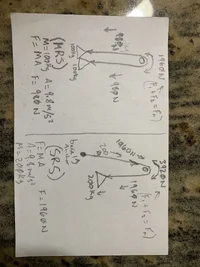
I made a rough sketch as to how to determine the force on the rope at your TIP assuming no friction and disregarding angles and bend radius of the rope.
At 200kg, a climber using an MRS system places 1960N on their TIP while hanging. This is the same force placed on your line at that point.

At 200kg, a climber using SRS with a basal anchor system places 3920N at their TIP while hanging, again, this is the force placed on your line at that point.

Honestly though, in order to get the true force being applied, you would have to take into account the radii of the TIPs and any angles caused in the system. It starts to get much more complicated, but that being said, increasing the size of your TIP will put less stress at that point, while acute angles in a system will decrease the force as well

 

New threads New posts

Kask Stihl NORTHEASTERN Arborists Wesspur TreeStuff.com Teufelberger Westminster X-Rigging Teufelberger
Back
Top Bottom