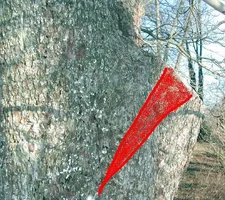
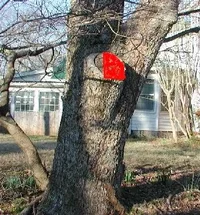
cutting a co dominant

[ QUOTE ]
I should have left a big stump of a stub so that there would be a buffer zone of wood to rot before rot sets in on the rest of the trunk.

I dont know, is this the case? What is the proper end cut in a situation like this?

[/ QUOTE ]

Once again, this was the original question asked and yet there's debate on whether or not subordination was an option ... put that away in your tool box guys.

Is it a target cut or a stub cut? That's what this is all about ...

So Glens, the reason I didn't cut that decaying stub off to the collar was that the collar had extended and new growth surrounded the stub, I cut to within 1/4" of that which is pretty good considering the thing was jagged. To go any closer I would have cut off that growth and created a new wound.

Regarding the quality setting, I'm restricted to one pic a post here and a 5MB limit per pic ... as I have broadband I pig out coz it's a nice change from all the restrictions and you can't stretch the page here. If the moderators feel that's inappropriate they can either restrict the board size of pics, edit it and adjust accordingly or PM me ... and since neither has occured I saw no reason to change.

Finally, regarding the spirited discussion perhaps fued ... yes, the same ole same ole jump in with their stubbing theories. Now lets see, Mike Maas, Guy and TreeCo ... there's a few others missing. Yet I'm to see evidence, hard core evidence of their theories. I've showed countless times what happens to stubs ... even here on this thread, just big bug invites. Also disected the wounds and wella ... walled off decay ... something many seem to overlook. I wonder too, when they prune or subordinate the branch do they do target cuts on that part or leave stubs all over that as well. Shigo is an American isn't he?

TreeCo, you want to know how bad the decay is in that wound on the Pecan, either drill it (resistograph) or cut it down and discet it, coz at the moment you're only looking at the outside.

I saw the pics of the Pecan and like I said before, I'm not getting into the subordinate argument but I do believe that was the best you could get for that situation, it is difficult when your saw is jammed between a bunch of leaders and you have to do an angled cut using your "minds eye" for where the rear of the cut ends up.

I will say from personal experience and pics of Pecan trees I've seen that 4 legged one was off to a handicapped start anyway ... perhaps they're all off an old stump or something, all I've seen had one solid trunk.

So, that's what this threads about and the debate is on.
 
[ QUOTE ]
Ekka being you seem like you really know what you are talking about then please guide me for a sec. I recently removed a co-dominant lead from a maple about 18-20". There were about 5-6 other leads that came out aound the same area, wish I had a pick to show. When there are so many leads and you cannot make out the bark ridge line because of other rot and the other leads are in the way. Is there and guide or correct way to remove the lead without affecting the rest of the tree, exspecially being water will puddle at the space inbetween where all the leads shoot out from.

[/ QUOTE ]

Ok, sorry I didn't answer this earlier.

Remember that subordination is not an option and the cut must be made. That's the gist of this thread.

From what you have written there is already decay/rot in the area where the leads all join up (not good). Access to saw it is difficult so pulling off a target cut is no good. How much stub will be left if you saw it off as best you can?

Dont forget that compartmentalization internally will still occur providing the health and vigor of the tree is good. The other nearby leads may be a good source of resupply to the barrier zone.

It's a big wound, and if you leave a big stub then you'll still have a big wound and possibly a bigger bug invitation. I would go for the best cut you can do closest to target and stress the importance of health and vigor to the client. You also may be able to install dynamic cabling through the remaining leads.

Also, dont forget that the figure of min 30% wall thickness is pretty much accepted as safe enough on most trees, it's the cambium that needs to grow and develop. By leaving a stub you may inhibit that process.

How often have you seen new cambium decayed? It's the strongest barrier and is resupplied by the tree.

On and 18" dia tree that means you can have a cavity (hollow) of 12 inches. so there's a few more things here than meet the eye, closure is important, and every inch of cambium growth is doing a ton of work.

Just today I bid on a huge co-dom tearout, they do fail naturally too and trees stay up and alive for ages after those natural disasters too. This one tore down the side of the tree to the ground ... aint much we can do with that.

As the tree ages you may have to check the extent of the decay, if it's advancing quicker than the rate of cambium growth to the point of hazardous you may have to reduce those remaing leads to lower the mast and sail. The fact that you have cut this lead off not cut the tree down means the client is into tree care, just inform them of future care and things to look for ... like fibre buckling on remaining leads to indicate stress.

I'm sure with a common sense approach all will be fine.

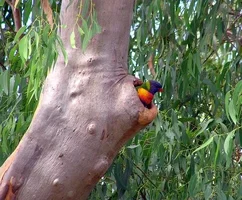
Here's a pic that shows what lives in some of our hollow trees. The parrots actually gnaw out the wood to make the hollow, on some fresh cuts they get right into soon after, now that outer cambium growth is adding strength and support.
 

Attachments

  • 40075-rainbowlorikeethabitat-1.webp
    40075-rainbowlorikeethabitat-1.webp
    82.5 KB · Views: 37
[ QUOTE ]
the reason I didn't cut that decaying stub off to the collar was that the collar had extended and new growth surrounded the stub ... To go any closer I would have cut off that growth and created a new wound.

[/ QUOTE ]
Did the collar extend or was it merely "normal" new growth on the limb? I'm not a botanist but I'd say it was merely as much normal growth as the tree could muster, and I would treat it as nothing special. I would take it off to the collar. Sure, it would be "new wounding" but it would be a better wound and in the big picture there would be better healing as a result. Not to mention that more habitat-for-nasties would also then be removed.

[ QUOTE ]
Regarding the quality setting, I'm restricted to one pic a post here and a 5MB limit per pic ... as I have broadband I pig out coz it's a nice change from all the restrictions and you can't stretch the page here. If the moderators feel that's inappropriate they can either restrict the board size of pics, edit it and adjust accordingly or PM me ... and since neither has occured I saw no reason to change.

[/ QUOTE ]
The 5MB limit for attachments is reasonable when the attachments are movies, complex documents, or archive packages of some sort. That's not to say that 5MB single images are a good idea.

Did you directly compare your original and my rendition of the same image on your monitor? If so, did you see objectionable degradation? If you didn't compare, why not?

The only reason to deal with such high quality images is if they're going to be printed or manipulated in some way. Printers have much higher resolution than monitors and every time you do something with a JPEG you lose image integrity. When you upload unnecessarily high-quality images simply because you can you're saying "piss off" to everyone else, especially those who would like to see them but for whom it causes undue hardship. You could spend 20 seconds one time to make them reasonable and by doing so save every dial-up user 90 seconds every time and everyone everywhere else in the chain the bandwidth/storage requirements.

I wish I could have a high-speed connection here but even if I did I would still try to be responsible with it. I'm the kind of guy who dims his high-beams when going around a curve if they shine on someone's house, or who pulls to the right or left of the lane as much as possible prior to making a right or left turn so those who are following will be inconvenienced the least possible (and activate my turn signal several blinks worth of time before touching my brake so those behind me know ahead of time why my brake lights came on). I know there's no rule that everyone else must do the same kind of stuff, but is it too much to ask?

[ QUOTE ]
I will say from personal experience and pics of Pecan trees I've seen that 4 legged one was off to a handicapped start anyway ... perhaps they're all off an old stump or something, all I've seen had one solid trunk.

[/ QUOTE ]
It sure should have been "fixed" back when it could be done with a lopper, that's for certain. I don't believe hickories rejuvenate themselves so successfully from a stump, but I live a lot farther north than Dan and that may be a factor.
 
[ QUOTE ]

Once again, this was the original question asked and yet there's debate on whether or not subordination was an option ... put that away in your tool box guys.

Is it a target cut or a stub cut? That's what this is all about ...

[/ QUOTE ]

Ekka, how is the weather there in Japan?

Ekka lives in Australia.

When a question contains what may be an incorrect underlying assumption on the part of the questioner it should be addressed.

Ignoring the fact that target pruning has serious limitations when applied to large trunk wounds can lead to poor advice and damaged trees.

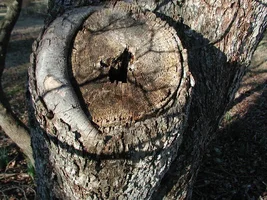
Attached is a photo of decay entering the main trunk of a pecan in my side yard. When this cut was made it was predictable that decay was inevitability going to be a problem. Now I own this tree and the damage is my problem.

Dan
 

Attachments

  • 40087-LargePecan2.webp
    40087-LargePecan2.webp
    186.7 KB · Views: 52
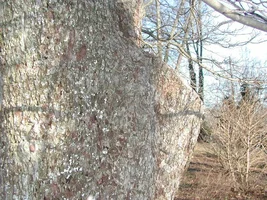
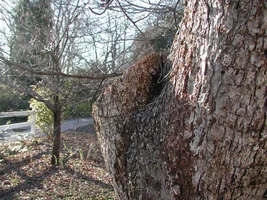
A view from the right side. Not a good target cut for sure but is does show that pecan does not close wounds well.
 

Attachments

  • 40089-LargePecan3.webp
    40089-LargePecan3.webp
    201.4 KB · Views: 43
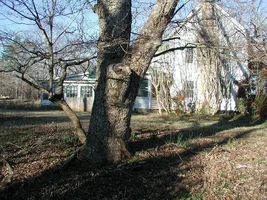
A view of the whole tree for scale with the house in the background.

Large wounds on pecans do not close well.

I do not know what this tree looked like before this limb was removed. I strongly suspect that some type of subornation on this leader may well have prevented decay form getting a start on the main trunk.
 

Attachments

  • 40090-LargePecan5.webp
    40090-LargePecan5.webp
    220.4 KB · Views: 47
TreeCo,

How do you know the decay isn't walled off inside the stem like shown? And just like the nook the parrot lives in it's no big deal.
 

Attachments

  • 40107-treecopecan_thumb.webp
    40107-treecopecan_thumb.webp
    121.5 KB · Views: 41
Also, the right side of that target was missed big time, have you considered re-cutting it like shown so the stub is removed and there's a better chance of getting some wood around that hole?

PS: Glens, do you like the file sizes now? See, no-one has to piss off nor was that intentional ... are you guys a bit touchy lately or what? Geez.
 

Attachments

  • 40108-treecopecan2_thumb.webp
    40108-treecopecan2_thumb.webp
    61.1 KB · Views: 43
[ QUOTE ]
Also, the right side of that target was missed big time, have you considered re-cutting it like shown so the stub is removed and there's a better chance of getting some wood around that hole?

[/ QUOTE ]

Because codominant stems do not have protection boundaries I try to avoid removing them if at all possible.

Yes the right side of the target was missed but not by as much as the photo makes it look. Because chain saws cut in a plane it would be hard to make the perfect cut. If I could sharpen a chain so it cuts predictable 'potato chip' shaped cuts I might be able to do something. Have you any experience sharpening a chain so it cuts like that? /forum/images/graemlins/grin.gif(I do).

The reason I have not made a "recut" is because callus has formed about 1/2 inch below the visible cut on the right side and I do not want to damage this callus. This callus is also in an irregular shape which would be hard to follow.

Also the pocket of decay that has formed is about 2 feet deep at this point in time and is quite a bit large than the surface hole suggest. Another point is that even if the wound were to as you say 'getting some wood around that hole' it would not prevent the spread of decay that is already inside the tree. Pecan also do not 'getting some wood around that hole' very well especially in wounds this large.

Thanks for saying something to Glens. That bloke is a rascal!

Dan
 
Maybe I am a bit touch lately, but thanks for the consideration anyway; they came in like gangbusters. The image quality factor is perfect and the image dimensions are fine for my 1024x768 display. Some may have displays twice that dimension and they would find the smaller image dimensions (like the second one) troublesome. Can't please everyone all the time! :)

Hickories are notorious for decaying quickly. Bugs love the sapwood: note all the pecker holes in Dan's last pics! Your suggested pattern in the first pic would probably hold true for most any other species in comparison, but isn't likely accurate in this case. That tree will most likely succumb to the "pruning" (at least it would up here at 40°N).
 
Dan, if a guy had the time and a coping saw large enough for the task at hand, he could get pretty creative.
 
East coaster here, We all seem to have a giggle when a preson wants a big codom removed, I have yet to see one actually even start to get some decsent callusing going, even in pines.
Unless of course its a willow or box elder you just cant kill those things Unless you prune it 2 inches off the ground.
 
[ QUOTE ]
Dan, if a guy had the time and a coping saw large enough for the task at hand, he could get pretty creative.

[/ QUOTE ]
Not alltogether a bad idea. I know I'd hate to visit a surgeon that only used a bone saw. Right now in my pruning arsenal I have; hand snips, loppers (for fruit trees), shears, hand saws(fine and rough), pole saws, pole loppers, some chisels, and of course chainsaws, but perhaps this isn't enough. Irregular large cuts are sometimes in order. maybe our pruning tools need to evolve to match the knowledge base at out disposal. just a thought.
 
I'll have to go back to a job I did some 6 months ago now and take a pic of the "jewellers" cut I did.

A multifaceted cut on a big dead stub some wanker left sticking out of a gum tree, I carefully sawed in all different angles to get close to the new wood that was getting bunged on.

<font color="#666666">(See, after Mike Maas and Guy's interlude I'm not sure if it's callus, woundwood or just wood /forum/images/graemlins/crazy.gif) ... like flamin librarians at a footy match they gotta correct ya gramma and stuff (oh please) /forum/images/graemlins/smirk.gif
</font>

Anyway, we don't have hickory around these parts but they do use it for mattock handles and stuff coz it's real hard and tough ... surprised to here it's vulnerable to decay.

Hey TreeCo, do you know what exactly is causing that decay?

If that hole gets any bigger we might have to send a guy down there to check it out, you know, like to scrape around the wound ... apply phosphite, coat of plastic paint and some expanding foam ... wella, a new tree! Hey, we can even paint it in your favourite colors. /forum/images/graemlins/grin.gif The ole timers used to fill em up with concrete, that's a real dumb idea, wait till you hit that with your chainsaw.
 
Like this?

Geez if a guy's not careful he could actually learn somethin' here.
 

Attachments

  • 40161-Concrete.webp
    40161-Concrete.webp
    67.1 KB · Views: 45
[ QUOTE ]
Hey TreeCo, do you know what exactly is causing that decay?

[/ QUOTE ]

I assume it's fungal decay but I've never seen any fruiting bodies.

Very little strength has been lost due to decay at this point and I am keeping a watch on it. If this tree were farther from the house I would not worry as much but if there is a main failure it's going to reach 30ft. to the house easily.
 
[ QUOTE ]
<font color="#666666">(See, after Mike Maas and Guy's interlude I'm not sure if it's callus, woundwood or just wood /forum/images/graemlins/crazy.gif) ... like flamin librarians at a footy match they gotta correct ya gramma and stuff (oh please) /forum/images/graemlins/smirk.gif
</font>


[/ QUOTE ] Here's a great link to help you out:&lt;a href="http://www.treedictionary.com/" target="_blank"&gt;Tree Dictionary&lt;/a&gt;
 
The type of cut you make is of much less importance than the size of the cut, along with the spieces and condition of the tree. I'd much rather have a 1" stub cut than a 2" target cut, or a any sized collar injury cut.
When you get into bigger cuts, wounds to heartwood will rarely compartmentalize well because there is no living cells there. The only decay prevention heartwood has is what was left there as the tree aged.
Just because a wound "seals" over, means very little to decay advancement, other than to make onlookers feel all warm and fuzzy. Shigo proved this years ago. Otherwise, we'd still be painting wounds.
At a recent arborist meeting, the technique of stubbing a branch, waiting until the bark was loose, and returning to make a proper prunning cut was touted as a good way to make sure you're on target.
Here's a great site with more on wood decay and tree injuries:
http://www.na.fs.fed.us/spfo/pubs/misc/treedecay/page1.htm
 

New threads New posts

Back
Top Bottom