cutting a co dominant

[ QUOTE ]
I will say this though, If you follow your rule book to the letter when dealing with ice damaged trees like Guy has, you will have no tree left. Dan

[/ QUOTE ]

And that may very well be a better alternative than a epicormic eye sore in the name of preservation that requires abundant maintenance and still a strong possibility of decay and failure further down the track.

Guy is a serious advocate for preservation at all cost, sometimes a prune at the stump and a grind is more logical and a better proposition financially than saving an abomination for the sake of being green.

Many times after bushfires trees are felled and cleared due to their poor recovery. Each case on it's own.

Of course subordination or heading back a co-dominant is the preferred answer but in this scenario we are not to entertain that option.

You are forced, for whatever reason, to remove one leg of a co-dominant, where do you cut is the question. Leave a stub? Or target cut?

If the ability to seal over a target cut is impossible, then are you saying that the ability to seal over the stub (some 16" dia cut) is any better?

Once again I'd like to see supporting pics showing cuts ... not scrapes and excavation damage, proper cuts and how they faired. I've given you my pics and diagrams, video etc. Lets see what you've got ... target cuts vs stubs. And lets stay focused on co-doms not branches and stuff ... so, grab your camera and start looking. /forum/images/graemlins/grin.gif

Look at the attached pic, what's the future of this junk? and where would you cut it, pretty clear to me, in fact it's almost called follow the dotted line!
 

Attachments

  • 39777-no1houseside.webp
    39777-no1houseside.webp
    96.1 KB · Views: 77
Well I should check the buzz more often it seems. Thanks Dan.

First of all, using selective heading cuts on storm-damaged trees is not an unproven theory. It's gone through several reviews by the ANSI folks at TCI and by reviewers at ISA who started out rather skeptical, to say the least.

This does not endorse leaving stubs when removing codoms--different ball of wax there entirely. I always look to reduce them instead; could that sharply leaning elm lead over the house been shortened anywhere? If not, a steep angle as has been shown here seems to anticipate where the tree will callus. If it will not callus then it is time to experiment with a sealant imo.

Leaving a long stub in the hopes a collar will form; I've seen that work on big oaks, but you've got to remove the stub before rot spreads out of the stub and into the stem. Aftercare is needed on every tree; let's not skip techniques that will work, on the premise that we're the last ones who'll touch the tree.

Ekka and I have chatted on this before--eucs are different than what we have. Nodes are hard to find, and closure is rapid. different strategies for different species. Three notes for Ekka--
1. i don't preserve at all costs; I condemn trees to death quite regularly.
2. Growth from dormant buds is not an epicormic eyesore but it is ENDOcormic, with well-anchored branches growing in a natural pattern determined by the tree not me.
3. It is for the owner to judge what is an abomination and what is an asset. Aesthetics are very personal. Any tree that is reasonably healthy and safe in the owner's eyes is more of an asset than nothing.
 
[ QUOTE ]
Here's bit of a vid that shows what can happen if you are not spot on the targets.


[/ QUOTE ]

The general tone of the video seemed to indicate that you believe the wound closure, and how fast a wound closes is very important. You also mentioned that there is no callus wood at the collar of stubs.
Let's talk about the second point first.
The collar is a swelling of wood made up of both trunk and branch parts. When a branch dies slowly, or is stub cut and dies, there is not really any callus wood. Callus is tissue that forms as a result of injury. There's just the trunk tissue trying to grow. The collar is still there, and there is pressure exerted on the dead limb by the living wood of the trunk, so as the dead stub slowly decays away, the trunk fills in the area where the branch once was.
I'm sure you have all seen all the stages of branches that have died, slowly decayed and fallen, and then been covered up by new wood. What most arborists don't consider, even though this is a time consuming process, it is very effective.
This brings up my first point. How fast a wound closes over has little to do with how effective a wound compartmentalizes. In fact, there may be a reverse relationship. Consider the work Shigo did with flush cuts. It used to be thought flush cutting was the preferred method, because the wounds "seal" up so much faster than "target cuts" or stub cuts. Upon dissection of these fast "sealing" wounds, it was found the decay was much worse.
When you make a cut and see a rapidly closing doughnut a short time later, what you are really seeing is Callus wood, a reaction to an injury to the trunk, definitely not on "target". It is a direct indication that you have hit the collar with your saw!
 
[ QUOTE ]

When you make a cut and see a rapidly closing doughnut a short time later, what you are really seeing is Callus wood, a reaction to an injury to the trunk, definitely not on "target". It is a direct indication that you have hit the collar with your saw!

[/ QUOTE ]

Mike you make some good points but this last is not always true. And if Ekka said there is no callus at the base of stubs he too is wrong. The main problem seems to be you all's use of the term "Callus wood". Callus is undifferentiated tissue that forms in response to a wound. Callus can differentiate and lignify, turning into woundwood.

These terms are clearly defined in the ISA Glossary, and thoroughly explained in Modern Arboriculture. As Voltaire said, if we define our terms carefully we will have little to argue about. And you know I hate arguing... /forum/images/graemlins/laugh.gif
 
I tried to be careful about my use of the word "callus". And I looked at how Ekka used it, it seemed correct to me also.
My point about the stub cut was that there wasn't callus wood around the collar. This is why Ekka claimed there was a problem, he just saw that fast growing, whiteish, undifferentuated wood, and though, "Hey, that's gotta be good!"
That wood is good for an injury, once lignified it is strong! The better bet might be to not injure the tree in the first place.
 
Great discussion all! haven't checked out the board in some time, and this is the sort of debate I love to see. Personaly when I'm actively pruning a tree, I try and shake the static notion of what a proper cut or a properly pruned tree is supposed to be. working as an arborist, and espescially working with Bonsai has taught me (painfully)that patience is the name of the game.trying to make a tree perfect in one setting can be a frustrating and flawed approach. tree growth is a dynamic process, and I try to keep my pruning dynamic as well. When I'm dealing with a large codominant limb, I go for initial subordination... then eventually removal. As we all know , when a tree sheds a limb of its own accord it goes through its own process of keeping rot in check. When I'm in the situation where I'm not totally comfortable about inflicting a large chainsaw wound, I try to mimic the same natural process the tree would go through shedding the branch on its own. just my two cents.
 
Yes Jason we can learn a lot about tree work by practicing other arboriculture like bonsai and shrubs amd nursery work.

Mike I hate to be picky but tissue is not wood until it is lignified, is it?

Ekka I just looked at that last picture of yours; a candidate for a bolt if I ever saw one. I would not call it junk or advocate a basal cut for it; judge not lest ye be judged, as the man said.
 
Words, words ,words ... still no pics or vid evidence! That's well over a year now listening to this debate and no show of proof, nothing.

I have vigilantly disected, watched/observed etc in my pond the difference and have concluded that the target cut is better. The species has varied ... eucs, melaleuca's, jacarandas, tulip trees etc etc.

Stay focused here. We are talking about removal of large codominants and not alternatives. The question was raised if you have to cut it ... where

On that pic I put up I was hoping to see a line where you would cut it. Also, unlike a stub left for a branch cut I am yet to see internal trunk tissue grow and wall off something like this.

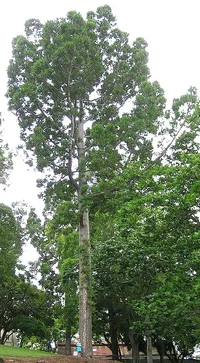
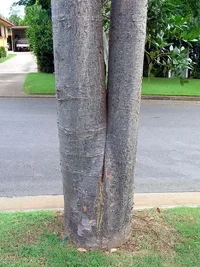
Here's a pic of what you can expect those trees to grow to Guy, both are in Brisbane and to give some perspective that's my kid standing next to it. No offence but I think bolting and cabling is a joke on something that has this potential ... the right thing would have been to cut off that co-dom years ago but as you can see it's not too late to start an alterantive strategy or bite the bullet entirely and cut it off.

Of course I also think planting such a tree in that location was also foolish ... but hey, that's developers and council.
 

Attachments

  • 39849-kauri.webp
    39849-kauri.webp
    262.8 KB · Views: 68
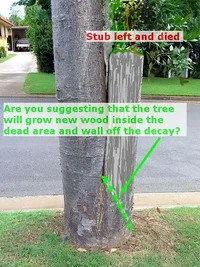
Also Mike

See the attached pic and answer the question please.
 

Attachments

  • 39852-no1houseside2.webp
    39852-no1houseside2.webp
    98.9 KB · Views: 70
[ QUOTE ]
As we all know , when a tree sheds a limb of its own accord it goes through its own process of keeping rot in check. When I'm in the situation where I'm not totally comfortable about inflicting a large chainsaw wound, I try to mimic the same natural process the tree would go through shedding the branch on its own. just my two cents.

[/ QUOTE ]

Jason

I think I found a link that may help you in your approach. /forum/images/graemlins/wink.gif

http://www.aie.org.uk/trunkline/aie_tr_coronet.html
 
Eric sorry about the lack of pics here, no excuses. I totally agree with the green line in your last pic; the stub if left would build up inoculum to infect. After the cut the tree will tend to deposit chemicals like phenols and terpenes to wall off against the inward spread of decay.

Will that effort be successful on that tree? Probably not, as stressed as it is jammed into that little place with no doubt poor soil etc. If the tree is left it may likely hollow out but only to the diameter it is now, because the tree will resist outward spread of decay more successfully. In the wild that would not be such an issue, but there it will.

What to do about it? If you're the manager, replacement makes longterm sense if the tree will outgrow its place and cause other problems.
 
[ QUOTE ]

I have vigilantly disected, watched/observed etc in my pond the difference and have concluded that the target cut is better. The species has varied ... eucs, melaleuca's, jacarandas, tulip trees etc etc.

On that pic I put up I was hoping to see a line where you would cut it.


[/ QUOTE ]

Ekka your pic of where to cut to remove the co-dom is straight out of Arb 101 over here. Very basic arboriculture.

Predicting if decay is going to compromise the structural integrity of the tree is a much more difficult question.

Extrapolating the behavior of trees 'in your pond' and believing the exact same textbook examples apply to trees anywhere on the globe is a large leap of faith!

So listen up mate! Even though we make the correct 'target cut' on co-doms here in the states many of us have the experience to know that decay is eventually going to invade the main trunk of the tree and compromise structural integrity.

The photo you sent and your suggestion as where to cut is right on.......but your conclusion that the tree is going to make out fine and resist decay misses the mark for most of the tree species in North America.

The original question of 'leaving a stub' or 'target pruning most likely contains an underlying assumption that the whole leader needed removing.

IMO if at all possible avoid large wounds to the trunks of all trees, not just trees with co-doms............and trees with co-doms that need attention it is better to maintain that co-dom even if it means some 'not in the textbook' pruning is required.

Dan
 
Ekka,

A co-dom kauri planted that close to the road in a residential neighborhood?!

Ack! Mayday, mayday! Basal pruning! Replace, replace!
 
Dan, Mike, Guy

This is good. I like it.

And between you all if you can get some footage it would be great. I'll keep an eye out my end too and if I see something relevant I'll take a pic.

Dan, if you leave a big stub like on that last pic will it decay into the main trunk? Yes.

If you target cut or stub will the result be the same as far as advancement of decay into the remaining section? And if the cut were to target there would have to be some growth around the wound ...

... on that Kauri I pictured here, it would be totally sealed off in about 5 years depending on the rain factor ... perhaps even quicker. Not that it would be my prefered method of dealing with it but we are talking about co-dom removals.
 
Hey Jason, please do me a favor, after having to just modemly endure the fetch of your 1.3 MB "avatar", of fetching this attached version, then uploading it in place of your current one.

Thanks
 

Attachments

  • 39885-213.webp
    39885-213.webp
    3.6 KB · Views: 41
Hello all, I have been trying to do research on how trees compartmentalize and block decay, etc... Everything that I have been finding leads right back to branches forming branch protection zones to compartmentalize. The thing is... when the co-dominant is so close to the ground, this zone, where the two limbs combine, continues down into the roots of the tree. In this area also, there really is no branch protection zone when it comes down to it because the inner zylem (heartwood) is completely fused, and I have not seem any examples of areas like this being able to compartmentalze. Now what do you do in this situation? I personally think that an air spade should be used to remove some of the soil around the trunk of the tree in the area below the cut becuase the tree will try to isolate itsef from that branch once it has been cut, and the dead wood will extend into the soil. This is why the rot comes from the base of tree when stubs are left. However, if the soil is pushed away from the wood that will die off, then air can get to the area and keep bacteria away.
 
"tree growth is a dynamic process, and I try to keep my pruning dynamic as well. When I'm dealing with a large codominant limb, I go for initial subordination... then eventually removal."

Jason, I agree with all you said, except the commonly written implication that every limb that has been subordinated must eventually be removed. That does not happen in nature and that need not happen at our hand either. Ekka's link was mostly about coronet cuts, a mutilation technique of hacking into dead wood to create habitat for rare bugs and fungus. Not relevant for arboriculture.

The last bit though was very relevant to the discussion, and very close to what Dr. Gilman espouses when he describes crown reduction. The term "Retrenchment Pruning" sounds like a WWI term about retreating under attack to a new line of defense. Very apropo here, and entirely responsible in terms of risk management:

Retrenchment Pruning

By Neville Fay

Retrenchment pruning
Retrenchment pruning is term coined by Paul Muir of Treework Environmental Practice to describe the technique that has been developed in the field of environmental arboriculture to imitate the *natural* process of ageing. Crown retrenchment is used to describe the way in which peripheral dieback occurs as the tree redirects energy and growth to the formation of a consolidated lower region of the crown.
Crown retrenchment pruning is used to extend tree viability, both in terms of vitality and stability, whilst retaining habitat features associated with ageing. Retrenchment pruning is a technique that can be used to reduce the potential for a fully mature, late-mature or ancient tree to collapse or ‘fall apart’ under its own weight due to excessive end weight on long or weakly attached limbs.

It is also applicable in trees where incipient decline appears to result from excessive transportation distances from the root system to the crown periphery. While this technique may have a general value, it is especially useful for managing formerly pollarded trees (lapsed pollards) and mature trees showing signs of dieback. Retrenchment pruning gives best results for suitable tree species and growth conditions.
The practice of retrenchment pruning involves the reduction of the tree height and the extent of crown growth over a protracted period of time.

This usually involves at least three return treatments allowing re-growth to occur in the interim. This process is intended to promote early crown stabilisation and reduce the risk of traumatic structural failure by reducing the lever arm while at the same time increasing light penetration to the inner crown framework.
The process is intended to promote internal and lower crown rejuvenation through reducing apical dominance provides the means to redirect hormonal growth regulation (resulting in epicormic and re-iterative stimulation). Eventually retrenchment pruning will create a reduced crown framework over a period of time.
 
I guess I should have clarified. Sometimes subordination is a first step in dealing with a codominant limb, sometimes it's also the last. I guess what I was trying to get at is that when I am dealing with a living, moving, growing organism I try to be flexible. not every crossing branch, included union, or codominant limb has to go through chipper the second I see them. I think we all agree that decision making involvig trees has to be made with an extended timeline in mind. only after thinking 5,10,50 years into the future can we determine whether to cut, cable, spray, or run screaming into the woods.
 
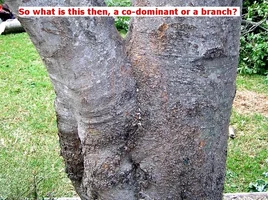
Another quiz

See the picture then answer the question. /forum/images/graemlins/grin.gif
 

Attachments

  • 39974-what'sthis.webp
    39974-what'sthis.webp
    229 KB · Views: 50
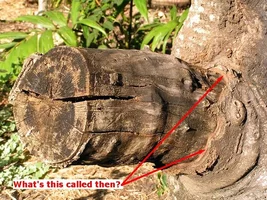
2nd quiz, see the pic and answer the question
 

Attachments

  • 39975-stub.webp
    39975-stub.webp
    190.7 KB · Views: 48

New threads New posts

Back
Top Bottom