Current market for firewood?

A cord of split and delivered doug fir is around $450 dumped in a pile here, plus hourly to move and stack if requested.

I've got a friend with a giant firewood processor you can load like 10 logs at a time with an excavator and then it cuts, spits, and conveyer belts the pieces into the back of a dump-truck. To me, if you don't have that level of mechanization, making and selling firewood just doesn't add up given the labor it would otherwise require.
 
@27RMT0N agreed. I supply myself with firewood and sell surplus on request for $200/face cord delivered within 10 minutes of my house. That works for me because I was going to split that wood for myself anyways. I also have neighbors that are serial wood beggars and they don't realize that it adds up. I'm a good neighbor though and I know it will come back to me eventually.
 
I simply refuse to haul ANY wood on tree jobs, and I'll NEVER deal in split firewood.

Without an excavator or other flexible-type heavy equipment, loading a 100' fir into a truck by hand is just a stupid amount physical work. And to even have that equipment means a dump truck/trailer built to haul logs, the machine to actually lift and move them, a trailer to haul the excavator/loader, and a truck to tow it all. Yes it's doable, but I'd rather make the higher hourly rate doing actual tree work and putting that material on the ground, rather than cleaning it up. I love walking away from a mess.

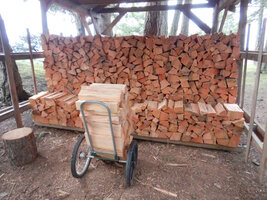
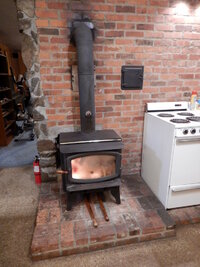
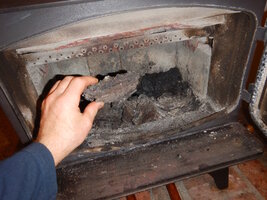
In the theme of firewood, this is my woodpile with some seasoned wood starting last year. A 25 year-old stove I got free from a customer, ash buildup from the last 4 months of burning. This is about the first time I've let the stove burn out and cool down in that whole time, and I've never emptied the ash until now.

00 wood 01.jpg

00 wood 02.jpg


00 wood 03.jpg
 
Tradeoffs.


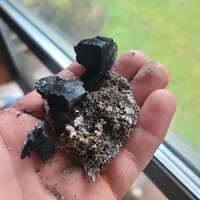
Clinker (r) and partially burnt wood (L) gone cold.

Oak makes lots of clinker, I believe.

Silver maple made this.
 

Attachments

  • 17068059709605362753524913226962.jpg
    17068059709605362753524913226962.jpg
    502.4 KB · Views: 10
I probably haven't had as many days of burning in woodstoves as most of you guys, but I don't recall seeing much, if any of that in a stove. I haven't burned of any one thing to have observed any patterns really, but I will pay much closer attention now.
 
A clue to clinkers. One time I actually had the odd orange spark from my chain cutting dead oak. buddy told me sand/dust was ingrained in the wood. Melting sand/dust in kiln like conditions inside the firebox. They clink like glass or lava rock.

Envy the ash free operation. How's the burn time, is it gopher wood?

What's the biggest metallic birthing you've found in the ashes that got by stealth through the splitting process? I found an anchor plate with screws and attached clevice/turnbuckle.
 
Last edited:
I lurnt something from google. Thought I'd share. News to me.

What is the difference between clinker and ash fusion?​

Can you tell the difference between clinker and ash fusion in your biomass boiler system?

Although easily mistaken for clinker, ash fusion is a sign of good quality wood fuel. This is caused when ash melts. This means your biomass fuel is burning even hotter than the ash melting temperature so it begins to liquefy. So essentially it's burning twice! Ash fusion looks similar to pumice and is easy to break whereas clinker has a shiny molten look and is rock solid.


Aside from that I found random variation in the descriptions of ash composition, with crystallization of calcium carbonate and the odd mention of silica (glass/sand) but with no consistent answer. A few answers mentioned the kiln-like action at very high burn temperature.
 
I lurnt something from google. Thought I'd share. News to me.

What is the difference between clinker and ash fusion?​

Can you tell the difference between clinker and ash fusion in your biomass boiler system?

Although easily mistaken for clinker, ash fusion is a sign of good quality wood fuel. This is caused when ash melts. This means your biomass fuel is burning even hotter than the ash melting temperature so it begins to liquefy. So essentially it's burning twice! Ash fusion looks similar to pumice and is easy to break whereas clinker has a shiny molten look and is rock solid.


Aside from that I found random variation in the descriptions of ash composition, with crystallization of calcium carbonate and the odd mention of silica (glass/sand) but with no consistent answer. A few answers mentioned the kiln-like action at very high burn temperature.
that is super interesting
 

New threads New posts

Back
Top Bottom