What's that good for at 60'? Radius

Navigation
Install the app
How to install the app on iOS
Follow along with the video below to see how to install our site as a web app on your home screen.
Note: This feature may not be available in some browsers.
More options
You are using an out of date browser. It may not display this or other websites correctly.
You should upgrade or use an alternative browser.
You should upgrade or use an alternative browser.
CRANE!! AM I DREAMING?
- Thread starter ROYCE
- Start date

Royce, take a little time and get your dunnage level, and dont spanblock like that. Boom trucks use that extra wide spread instead of counter weight and puts a lot more leverage on your cribbing, you will spit it out from under the float like that
Royce, take a little time and get your dunnage level, and dont spanblock like that. Boom trucks use that extra wide spread instead of counter weight and puts a lot more leverage on your cribbing, you will spit it out from under the float like that
What do you mean. I realize that it needs to be more level. I actually went back and fixed it. I should have taken a picture. What do you mean in regards to not span block? Don't have a gap on the lower level like I have?
No gaps, especially if your useing pt pine and not oak or a good hardwood. Pretty sure the book wants 1 percent of being level on the floats. The pic where you dug out the ground and it looks perfect is fine. The other one looks half on half off the driveway crooked, spanblocked and sketchy even if your not picking over that corner it needs to he sound, and if it gets light on a bad stack like that it can move when it comes back down

Jeff
Branched out member
- Location
- Marlborough, MA
I was surprised by the pine - never seen softwood used, although a number of other Buzzers mention SPF timber:especially if you're using pt pine and not oak or a good hardwood.
http://www.treebuzz.com/forum/threads/crane-cribbing.19470/
I guess so long as it's straight, solid and not bridged you're ok. This list specifically "prefers hardwood" under item #1:
http://www.iti.com/pro-rigger-mike-...es-for-Blocking-Cribbing-after-Rigging-a-Load

KYAPLE
New member
Congrats Royce! Looks sweet can't wait to see it lettered up
No gaps, especially if your useing pt pine and not oak or a good hardwood. Pretty sure the book wants 1 percent of being level on the floats. The pic where you dug out the ground and it looks perfect is fine. The other one looks half on half off the driveway crooked, spanblocked and sketchy even if your not picking over that corner it needs to he sound, and if it gets light on a bad stack like that it can move when it comes back down
Great! Thanks for that I will work on that. The PT timbers are all I could get. I am waiting for some hemlock to be milled for me. It just takes a few weeks to get them.

Lol....welcome to crane world!!!! You'll be farther away from half the crap you have to pick in the tree care industry!So some questions. Take a look at picture number 4. I was really more over the side than the rear. I was okay with this until I had to reach the butt log. I had to boom way down off the side to clear the house. The opposite side- outriggers came up off the ground. This is what my load chart looked like. Obviously I was boomed down way too far off the side. What is a good rule of thumb to not drop down to off the side?

classictruckman
Participating member
- Location
- Ottawa Valley, Ontario, Canada
If the site allows it try to pick over the rear, I know this isn't possible with every setup but you will feel more solid and less likely to lift an outrigger.
If the site allows it try to pick over the rear, I know this isn't possible with every setup but you will feel more solid and less likely to lift an outrigger.
Yeah, I couldn't really work off the back for the butt log on this particular job. In the future I am not going to boom down as far off the side. Today I set up and worked off the back. SOOO much smoother and stronger.
Attachments
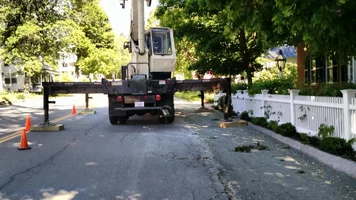
No gaps, especially if your useing pt pine and not oak or a good hardwood. Pretty sure the book wants 1 percent of being level on the floats. The pic where you dug out the ground and it looks perfect is fine. The other one looks half on half off the driveway crooked, spanblocked and sketchy even if your not picking over that corner it needs to he sound, and if it gets light on a bad stack like that it can move when it comes back down
@stumper120 So today I set up on the street and did what you said. No gaps. Now if I wanted to go higher I would just add another layer, but still no gaps between any of the dunnage?
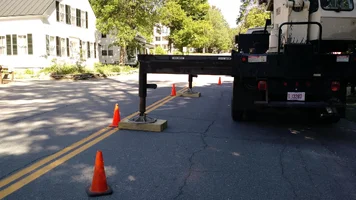
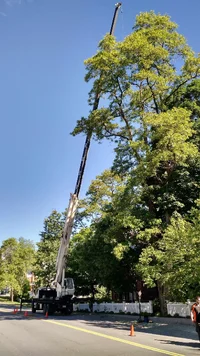
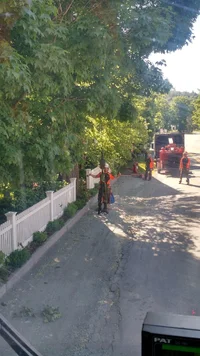
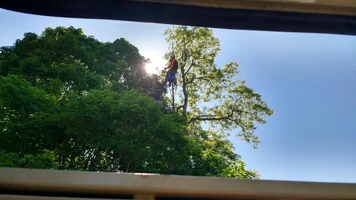
We took down this locust today because the high winds lately have caused the main stem to crack. It has a n old crack an decay that was getting worse. Job went slick. I really enjoy owning my own crane. I like that I can jump on these jobs quick with out having to schedule a crane from a rental company.
Attachments
Jeff
Branched out member
- Location
- Marlborough, MA
That's what she said!Today I set up and worked off the back. SOOO much smoother and stronger.
Jeff
Branched out member
- Location
- Marlborough, MA
Exactly. Depending on the width of the dunnage, we use 4 or 5 pieces, so that it is at least wider than the float, pushed tight together like you did. Then 4 or 5 more, turned 90° to the first set. If you need another layer, turn them 90° to the previous set. Often we'll put a piece of 1" ply on top just to smooth it off before putting the float down.No gaps. Now if I wanted to go higher I would just add another layer, but still no gaps between any of the dunnage?
Last edited:
Exactly. Depending on the width of the dunnage, we use 4 or 5 pieces, so that it is at least wider than the float, pushed tight together like you did. Then 4 or 5 more, turned 90° to the first set. If you need another layer, turn them 90° to the previous set. Often we'll put a piece of 1" ply on top just to smooth it off before putting the float down.
Great! I get what your saying and will do that from this point forward. So I have determined that I need another 40 or so pieces of dunnage. Its amazing how fast you use pieces when your trying to get level.
So here is an LMI question for some of you operates. So when I read the LMI I am good for say 3500 lbs. Now, what is that telling me? That if I pick more than 3500 pounds the crane will tip or the boom will break, correct? Because it seams to me that my LMI shuts me off too soon. When I am good for 3500 and I put about 2K on the scale, it shuts me off around 21-2200. I feel like I should get more out of it than just the 2K. I mean there is a safety factor developed into the 3500, why cut me even shorter?
Also it feels like my LMI might not be calibrated to my load chart. My LMI seams to be about 500-800 pounds off of what my load chart says. My load chart today said I should of been good for 4500, yet my scale read 3800.
Also it feels like my LMI might not be calibrated to my load chart. My LMI seams to be about 500-800 pounds off of what my load chart says. My load chart today said I should of been good for 4500, yet my scale read 3800.
Jeff
Branched out member
- Location
- Marlborough, MA
Someone posted a photo on here once (Cameron Lyon, maybe?) that I thought was a GREAT idea. They had the regular amount of dunnage on the crane, but they also had a 10' or 12' landscape trailer, completely loaded with extra dunnage, plywood, mats, etc. Then when you get 1 of those jobs, hook the trailer up to the back of the crane and you're all set. Also easy to unload because it's only 18" off the ground. For the cost of a little trailer, just to leave it sitting in the yard loaded with a tarp over it, I thought it seemed like both a big time and headache saver.So I have determined that I need another 40 or so pieces of dunnage. Its amazing how fast you use pieces when your trying to get level.
Someone posted a photo on here once (Cameron Lyon, maybe?) that I thought was a GREAT idea. They had the regular amount of dunnage on the crane, but they also had a 10' or 12' landscape trailer, completely loaded with extra dunnage, plywood, mats, etc. Then when you get 1 of those jobs, hook the trailer up to the back of the crane and you're all set. Also easy to unload because it's only 18" off the ground. For the cost of a little trailer, just to leave it sitting in the yard loaded with a tarp over it, I thought it seemed like both a big time and headache saver.
Thats a great idea!! We talked today about getting a plywood trailer for those big jobs. Mine as well just add some dunnage to it.
Are you deducting the weight of your ball in your figuring? Net weight vs gross weight . your load chart is in 2 parts. Above a bold line or below. Or shaded or non. This separates structural failure vs tipping over. I will snap a picture of the pads I made 3x3 that consists of 2 layers of 1" ash opposing. Sandwich between 2 pieces of 3/4 plywood. Glued and screwed. Never mark a driveway and set up on lawns safely. Individual pieces cribbing takes to long to set up especially when you need to move a few feet.
New threads New posts
-
test2
-
 KBNest -Midline Attachable SRS Canopy Anchor.
- Latest: Steve Connally
-

-
-
-

-

