Break Away Lanyard Question

I don't think we'll ever see this in the ANSI A300:

"Positioning lanyard attachments meant to fail under load must be backed by 2 separate rope systems (e.g., DRT, DSRT). Lanyard systems meant only as positioning lanyards on hazardous trees must break in at least two locations (at the Dee Rings) and each attachment is not to exceed in breaking strength 1/2 the weight of the climber."

I don't think so....do you?


When I read that the first time I thought it came from the Z. You got the lingo right!

If you think that the idea has merit I'd suggest that you submit it to the Z committee. We have a meeting in mid-April. I'd love to hear how the rest of the committee reacts to the suggestion. Too many would dismiss it off-hand but there are enough of us that still have dirt under our fingernails and sawdust in our socks that the discussion would go around for a while.

I'm serious...submit it. If you need help with the submission send me an email.
 
I was thinking that there may be no need for additional regulative language since what this statement suggests is somehow already there already hidden in the existing A300 text. Two safe attachments are required, no? That's it. If you are using a positioning lanyard as a secondary tie in point in a hazard tree, you are already violating the A300. This is because the climber has not created a "secondary point of attachment". You are expecting the tree to fail already and cannot trust the existing positioning lanyard (around the hazard tree) as a secondary point of attachment.

All the rest about failsafe tolerances and such is something no regulatory agency would really care to get itself tarred up with. Additionally, others may loathe the additional restrictiveness--the heavy handed paternalism.

I have learned something, however, from all of these suggestions and I am grateful.
 
I like the discussion. I have been in this situation and have used pull cord, and break away saw lanyards in different situations. I'm still looking for my favorite. I'm thinking a lanyard using 100lb rope and a climbing hitch with no stopper on the lanyard.
 
rope grab style device and a wire core lanyard. at low loads, it functions as we are all used to, but at a certain load, it will cut the rope, letting the steel core feed through the device, that way just a shock load might engage, but not disconnect the climber from the tree, but with a long steady pull (like a tree failing) it will pull itself right off the tail of the lanyard.
 
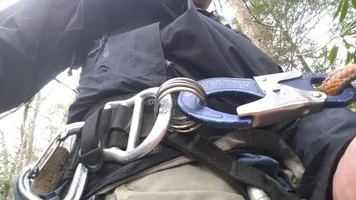
I had I idea this week that I think this thread has missed the obvious, the petzl caritool carabiners could be the answer to this dilemma, although they are not rated much, it takes a lot more to bend them out of shape, I suppose you could use 2.
 
I had I idea this week that I think this thread has missed the obvious, the petzl caritool carabiners could be the answer to this dilemma, although they are not rated much, it takes a lot more to bend them out of shape, I suppose you could use 2.
The caritool has been mentioned twice in this conversation, Feb 13 and Feb 15, now three times but that is ok because we are all just thinking.
 
That's good, Rawtree. What force will your body take before the four rings pull open? Worth testing, IMO. Might be a bit more than your body wants. I don't know. Simple to start hanging weights on the 4 rings until failure in a test scenario, not on your harness.
 
It would be a good idea to test them. My brain doesn't work with numbers so the number of split rings I chose to use just "felt right". I have to admit that I'm very hesitant when I'm on the system but that's what keeps me totally present to the situation I am in (still I should at least test them on a pole to see what I can get away with when I want to lean back into them harder). My mantra is, "Born to Climb : Destined to Fall"! In my older age I how found that I like to keep myself scared because I don't heal as fast as I used to. I can not afford an accident! That's why I quit paragliding for the time being. I'm a bit dyslexic and you can't make too many mistakes in the final 300 feet!
 
Last edited:
I was just driving along thinking of ideas for a breakaway lanyard, what about a bungee cord, or at least the metal/plastic ends of them? I haven't tested the breaking or bending strength. However, I feel as though you could get one which would break, or at least bend and come unhooked at a low amount of force.
 
I agree Mark. There are also lots of devices out the in other fields that are designed to disengage at a given force. What we need is hard to find or specify to a manufacturer until we can figure out the force we want it to seperate at. By default I would think that number is much lower than many of us will like. I'm thinking around 300 to 350 pounds, only because anything more is going to hurt. However as compared to the swing your going to take after it breaks maybe slightly higher would be better.
 
I'm thinking around 300 to 350 pounds, only because anything more is going to hurt. However as compared to the swing your going to take after it breaks maybe slightly higher would be better.
Conversely, I believe the opposite would be true.

Higher would mean that you are carried further and harder from the parent tip prior to the intended failure. Thusly, a longer, harder swing back.
 

New threads New posts

Back
Top Bottom