Bracing Equipment?

This has been kicked around in other threads. These drills are not spec'd for our use and we really max them out compared to other industries. The superhawg has a clutch that keeps it from ripping your thumb off when the drill bit binds in the hole. The hole hawg does not have that. I'm n9t sure whether the Makita has it, but usually people go with the superhawg because no other large drill has a clutch. The Superhawg clutch has, for me, been the deciding factor in buying solely Milwaukee tools instead of another of the very reputable brands out there. This has extended even out of the "powertools" and into the chainsaws, weedeater, air compressor, etc. For me, the Superhawg is the safest large portable drill for vertical mulching, bracing, grcs-ing, etc.
The clutch also keeps you from breaking a 6 foot bit off inside the tree!
 
My "regular" Milwaukee M18 drill has an adjustable slip clutch... Not sure if when it is set to slip if it allows for enough torque though?
 
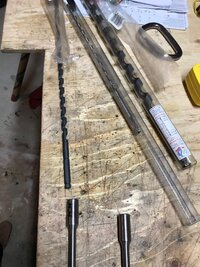
After trying out the battery drill gig I went back to my trusty old 3/4" DeWalt with the torque handle of rotary doom. Enough torque to break things - easily. Have a reel with 200 feet of 12/2 heavy duty rubberized cord (Dewalt came with warning to use a heavier extension cord than 14/2). Have drilled thru even > 48" of wood with auger bits and extensions no sweat, including thru some unseen knots somewhere way in there. Bit extensions (can be a lifesaver).
Also I carry a long straight 1 X 1 and some string to the bracing job. I tie this across the two stems above the first bracing rod, lower down on the tree crotch - it's kind of a sighting aid for the second higher drilling job to get it a little more level and straight/ centred thru the two stems. If someone has a better trick for this I'd like to hear. Cheers
 
Last edited:
After trying out the battery drill gig I went back to my trusty old 3/4" DeWalt with the torque handle of rotary doom. Enough torque to break things - easily. Have a reel with 200 feet of 12/2 heavy duty rubberized cord (Dewalt came with warning to use a heavier extension cord than 14/2). Have drilled thru even > 48" of wood with auger bits and extensions no sweat, including thru some unseen knots somewhere way in there. Bit extensions (can be a lifesaver).
Also I carry a long straight 1 X 1 and some string to the bracing job. I tie this across the two stems above the first bracing rod, lower down on the tree crotch - it's kind of a sighting aid for the second higher drilling job to get it a little more level and straight/ centred thru the two stems. If someone has a better trick for this I'd like to hear. Cheers
Can you please elaborate on the extensions? Where the extension connects to the bit it would have to be a smaller diameter then the bit itself. When looking up bit extensions, I don’t see that they list the smallest diameter it can fit through?
 
Can you please elaborate on the extensions? Where the extension connects to the bit it would have to be a smaller diameter then the bit itself. When looking up bit extensions, I don’t see that they list the smallest diameter it can fit through?
Surely, I pretty much use an 11/16" bit as far as I can go, then switch to a smaller 5/16 inch bit and extension(s) to drill a pilot hole out the other side of the stem. This bit fits the drill bit extension(s) end with the retaining screw (and sometimes a couple Hail Mary rounds of electrical tape) and lets me get thru the biggest stem diameters I've had these parts and out the other side. Then I go thru the other way with the bigger bit to finish the hole for the threaded rod. It's just a matter of monkeying around with bit sizes that'll fit the extensions and the diam of cable you're using a la ANSI - they give you a 1/16" tolerance I think it is. You're right, trick is getting the larger diameter hole thru far enough you don't bottom out the extension. There are some really long auger bits too if you hunt around for em. Log home builders use all sorts. Just gotta hunt around a bit (sorry)!
Had some EHS cable feed nightmares in trees like spruces which have flooded the hole I just drilled with sap/ pitch/ goo. I found that Olive Oil on the cable helped in these cases feeding the cable, but it still was a pitch fest. Wouldn't use motor oil or anything like that though.

 

Attachments

  • IMG_1807.jpg
    IMG_1807.jpg
    604.1 KB · Views: 12
Last edited:
Surely, I pretty much use an 11/16" bit as far as I can go, then switch to a smaller 5/16 inch bit and extension(s) to drill a pilot hole out the other side of the stem. This bit fits the drill bit extension(s) end with the retaining screw (and sometimes a couple Hail Mary rounds of electrical tape) and lets me get thru the biggest stem diameters I've had these parts and out the other side. Then I go thru the other way with the bigger bit to finish the hole for the EHS cable. It's just a matter of monkeying around with bit sizes that'll fit the extensions and the diam of cable you're using a la ANSI - they give you a 1/16" tolerance I think it is. You're right, trick is getting the larger diameter hole thru far enough you don't bottom out the extension. There are some really long auger bits too if you hunt around for em. Log home builders use all sorts. Just gotta hunt around a bit (sorry)!
Had some EHS cable feed nightmares in trees like spruces which have flooded the hole I just drilled with sap/ pitch/ goo. I found that Olive Oil on the cable helped in these cases feeding the cable, but it still was a pitch fest. Wouldn't use motor oil or anything like that though.
We’ve used those very same extensions. Just keep them out of the hands of the less mechanically inclined folk. You don’t want to strip out the drive or the threads.
 
This has been kicked around in other threads. These drills are not spec'd for our use and we really max them out compared to other industries. The superhawg has a clutch that keeps it from ripping your thumb off when the drill bit binds in the hole. The hole hawg does not have that. I'm n9t sure whether the Makita has it, but usually people go with the superhawg because no other large drill has a clutch. The Superhawg clutch has, for me, been the deciding factor in buying solely Milwaukee tools instead of another of the very reputable brands out there. This has extended even out of the "powertools" and into the chainsaws, weedeater, air compressor, etc. For me, the Superhawg is the safest large portable drill for vertical mulching, bracing, grcs-ing, etc.
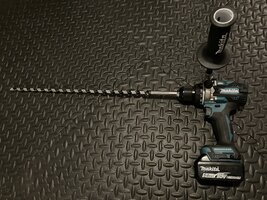
Looking at the Makita now. Info reads as clutched and two speed. I have the Milwaukees and am crying but want x2 lifting power for the GRCS.
 
Looking at the Makita now. Info reads as clutched and two speed. I have the Milwaukees and am crying but want x2 lifting power for the GRCS.

The grcs comes with an ~40x mech advantage handle, right? Do the drills come close to that or exceed it and is the grcs designed for that? I think it's supposed to break at 3500lbs. at the bolts that hold the winch to the aluminum plate. Do you want lifting speed or torque?
 
The grcs comes with an ~40x mech advantage handle, right? Do the drills come close to that or exceed it and is the grcs designed for that? I think it's supposed to break at 3500lbs. at the bolts that hold the winch to the aluminum plate. Do you want lifting speed or torque?
With my battery superhawg I can still get a little more after it maxes out with the hand crank. Sometimes that is what is needed, but its rare and the drill gets me so close anyway
 
The grcs comes with an ~40x mech advantage handle, right? Do the drills come close to that or exceed it and is the grcs designed for that? I think it's supposed to break at 3500lbs. at the bolts that hold the winch to the aluminum plate. Do you want lifting speed or torque?
Torque. The Mil Superhawg does great a lot of the time but one job it didn't do the last part of several big pine limbs we were lifting from over power lines. So 30 or 40 cranks per limb got the rest - and my arms were played out.

Then I saw the video posted here where a Superhawg will lift 1,000lbs regerstered on a load cell but the Makita double battery was lifting 2,000 on the load cell - FMe.

Did you see that video Cory?

I have another big limb pine job middle of January over a deck and house, and two over the water tank. Want to find the best price by then.
 
Torque. The Mil Superhawg does great a lot of the time but one job it didn't do the last part of several big pine limbs we were lifting from over power lines. So 30 or 40 cranks per limb got the rest - and my arms were played out.

Then I saw the video posted here where a Superhawg will lift 1,000lbs regerstered on a load cell but the Makita double battery was lifting 2,000 on the load cell - FMe.

Did you see that video Cory?

I have another big limb pine job middle of January over a deck and house, and two over the water tank. Want to find the best price by then.

Very interesting news. I haven't seen the video yet. Makita is such a great power tool maker. Love to see them bring it to big drills.
 
I can attest through first hand experience, the Makita RA drill is an incredible tool. The dual battery version is the ticket. Unfortunately mine grew legs when an electrical crew came to upgrade the lights inside the shop I used to rent. But I do have a wonderful pair of batteries and a charger to remind me! Soon I will get a Makita replacement drill along with a second GRCS and aim for total world domination.
 
@Muggs posted this video on TreeBuzz before. Have you been using the Makita Muggs?

@oceans They don't show the dual battery 36v through normal sales channels that I see - maybe ebay.

Anyone have experience with the single battery 40 volt? Both power and clutch are questions I have. It turns out the spell on it doesn't say anything about a clutch to protect your wrist, it says something else dubiously similar in my mind. (Avoiding liability?)
 
The grcs comes with an ~40x mech advantage handle, right? Do the drills come close to that or exceed it and is the grcs designed for that? I think it's supposed to break at 3500lbs. at the bolts that hold the winch to the aluminum plate. Do you want lifting speed or torque?
My SuperHawg was maxing out and I could still get much more with a double handed winch handle - albeit at great effort.

I don't have a load cell but looking at the limbs we were lifting and breaking them into 100lb guesstimatsions I would guess their weight after watching the above video at about 1k. This video shows the Makita making 2k, that's still well under the GRCS limits.

As a heads up the guy in the video said the double battery Makita had a low RPM of 350...the new single battery states 400RPM - so possibly higher gear ratio equals less torque. Also, "Built in clutch reduces gear damage by disengaging gears if the bit binds".
 
@Muggs posted this video on TreeBuzz before. Have you been using the Makita Muggs?

@oceans They don't show the dual battery 36v through normal sales channels that I see - maybe ebay.

Anyone have experience with the single battery 40 volt? Both power and clutch are questions I have. It turns out the spell on it doesn't say anything about a clutch to protect your wrist, it says something else dubiously similar in my mind. (Avoiding liability?)
I bought mine from a small local retailer that outfits professional carpenters, builders and woodworkers. I don’t think you can find these in box stores. Makita does show it on their website.
 
I bought mine from a small local retailer that outfits professional carpenters, builders and woodworkers. I don’t think you can find these in box stores. Makita does show it on their website.
Glad you caught that. My bad for starting my search on Makita website from the wrong premise.


This is the only comparison video I can find on YouTube. With the only applicable hard facts in it being the reviewer stated the 36v ran 50 rpm slower in low gear and 100rpm slower in high gear. As stated in the Milwaukee vs Makita lift video above that lower rpm may be a part of the reason for more lifting power - lower gearing.

The 36v appears to be about $100 cheaper right now so I suspect I'll go for the 36v double battery for certainty of power and benefit by the cheaper price.
 

New threads New posts

Back
Top Bottom