Bowline slippage

A bury splice is when a hollow rope is tucked back into its own hollow for a run. Any rope used for professional application should have an accompanying splicing specification, and in at least some specs for dyneema a bury is called for. I don't use dyneema for anything but slings and throwline, but a cursory review of this video:


seems to indicate that a specification is likely to include two brummels as well - at the union - followed by a bury. Brummels are easy too. Since the guy takes 18 minutes to do the splice, I'm going to retract my earlier statement that implied that splicing would be fast enough to replace knotting. In part, I think it's slower than I thought because he's carefully tapering the buried end, as mentioned in other posts above.

I would also look into a soft shackle as a possibility in your application...

The mineral fibre and shortener both look cool. Kind of interested to know what you use them for...
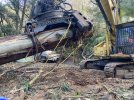
The application was to continually shorten the rope link as the 42 ton harvester pulled the large log up the slope in sections. 3/4 wire rope sling on the end of the log ensured that the soft dyneema wasn't crushed and damaged under the log. Cutting and splicing the rope into many short slings reduces its use in future.

150' of one and an eigth dyneema is expensive for one use to be cut up. The rope is trashed anyhow so in future I will use my extensive range of wire ropes, slings and chains.

Finding this boundary of useing knots on some fibres makes my consider other latent issues.
 
IMG_7155.JPG
Once close, trunk sections can be grabbed and landed. Whilst rated strength is high for dyneema its application has limits. Pleased I didn't find out when it really mattered. I wonder what else is ticking away?
 
Last edited:
And yes, I did break it at the knot earlier when I prevented it slipping. (Tappered end of the rope) under the shackle on the head. We were leaning on it. Haven't looked up the break on it but at 65% its still up there.
 
The application was to continually shorten the rope link as the 42 ton harvester pulled the large log up the slope in sections.

In the situation you describe, a bollard on either end would have been more likely to succeed without rope damage.

This experience should not make you doubt a Bowline, just clarify where it can and cannot be used.
 
https://fb.watch/v/1fNdHh49a/
Saw an event today that has rocked my confidence. Bowline slippage on a dynema rope about 30mm. We were asking a bit, however... I always considered the bowline reduced in strength but sound.
The rope was compramised so we continued the task. Some of the standard bowlines came undone. Maybe all bowlines need to have a "keeper" knots applied to enable maximum strength retention.

The Shackle coming into shot in the end is the result of the failure of the lifting lug on the 34 ton harvester pulling.
No doubt I lost a fairly sizable pine top some years ago on a bowline that slipped out. Thought I must have miss-tied it. But had the whole thing on video and when I reviewed the tape it had been tied correctly. Now, I just go with an extra-long tail, which will allow for plenty of slip without fail.. generally over a foot as a habit and closer to two feet on anything heavy. .. never thought about a stopper knot. makes a lot of sense. You could also use the Yosemite tie off but the stopper knot is quicker on and off.
 
From ABoK
Lesson# 478 "There is unsuspected virtue in a few turns of line." -In the The Tree Surgeon section
Lesson#1732 "There's a lot of virtue in a round turn." -ABoK shows in quotes like from another
Lesson#1669. "Round Turn on the Standing Part adds materially to the strength of the knot."
.
Dyneema itself is a tough one here;
but even on a normal day i always go with DBY as working class, anything less is a shortcut; not generally taken
>>and heavily weighed and measured as to why
.
The clamping power of a Round Turn(RT) on Load side of host is MUCHO greater than single Turn ON THE LOAD SIDE OF HOST.
Like as an Anchor Hitch upgraded from a Half Hitch(HH).
The conversion of nipping from under a 90 degree arc of Half Hitch or even RT + HH
>>to an 180 degree arc for nipping is incredibly so much more.
Even with RT + HH have the RT reduction of force that would promote Bitter End(BE) from becoming a freebird,
>>but still the clamping nip on the BE to be an HH grade 90 degree arc
>>converts to Anchor Hitch by instead taking nip under an 180 arc
So now BE is more secure for less propensity to pull out and MUCHO more clamping force too.
.
The upgrade from 1x180 arc of single Turn to 3x180s of RT pretty much removes tail in our out for Sheetbend and Bowlines etc. as it resolves both weaknesses of either the innie or outie strategies of BE nipping.
.
For me RT bases are the working class minimum tool; instead of simple Turn.
A simple Turn for me is more of a household(?) not working class solution.
i only depend on as a get by or purposeful pass of force to next position,
by purposefully not reducing the force passing thru the greater reducer of the RT to output.
And per
Lesson#1720 "If a spar is small a RT is preferable to a single turn. It makes a stronger knot and dissipates the wear."
as another attribute, that seems would carry into RT around the Standing Part (SPart).
.
Yosemite tie off seems logically to give more security than strength efficiency.
But, beyond that, i really like the clean open eye presented to work with.
.
i call ABoK Lesson#s and not knot numbers purposefully;
for many times there is so much more to focus on than a knot,
so to me is a Lesson#, not a knot#.
 
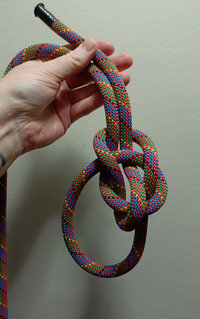
Resurrecting this thread because I just read a fascinating (well fascinating to me) 80 page paper on bowlines from a professional climbing instructor in Australia named Mark Gommers. Coming at it from an angle of using the bowline as a life safety knot in sport climbing and discoveries and variations made. There are soo many variations! If the technical stuff doesn't interest you you can skip to the end for his list of the inherently safe variations. I think the Scott's locked bowline is easy enough to just do forever any time I'm going to tie one for a critical purpose from now on (although it looks spooky after being loaded on yale kernmaster with a big hole you can see through the middle lol). Way more secure than a classic Yosemite tie-off
IMG_20231220_171640.jpg
shown loose before loading so you can see what's going on

http://www.paci.com.au/knots.php check out article number 4, first in the technical section. Free for personal use and download, as the page directs just put the word 'copyright' in when it asks for a password and you can peruse the pdf at your leisure. I highly recommend
 
From ABoK
Lesson# 478 "There is unsuspected virtue in a few turns of line." -In the The Tree Surgeon section
Lesson#1732 "There's a lot of virtue in a round turn." -ABoK shows in quotes like from another
Lesson#1669. "Round Turn on the Standing Part adds materially to the strength of the knot."
.
Dyneema itself is a tough one here;
but even on a normal day i always go with DBY as working class, anything less is a shortcut; not generally taken
>>and heavily weighed and measured as to why
.
The clamping power of a Round Turn(RT) on Load side of host is MUCHO greater than single Turn ON THE LOAD SIDE OF HOST.
Like as an Anchor Hitch upgraded from a Half Hitch(HH).
The conversion of nipping from under a 90 degree arc of Half Hitch or even RT + HH
>>to an 180 degree arc for nipping is incredibly so much more.
Even with RT + HH have the RT reduction of force that would promote Bitter End(BE) from becoming a freebird,
>>but still the clamping nip on the BE to be an HH grade 90 degree arc
>>converts to Anchor Hitch by instead taking nip under an 180 arc
So now BE is more secure for less propensity to pull out and MUCHO more clamping force too.
.
The upgrade from 1x180 arc of single Turn to 3x180s of RT pretty much removes tail in our out for Sheetbend and Bowlines etc. as it resolves both weaknesses of either the innie or outie strategies of BE nipping.
.
For me RT bases are the working class minimum tool; instead of simple Turn.
A simple Turn for me is more of a household(?) not working class solution.
i only depend on as a get by or purposeful pass of force to next position,
by purposefully not reducing the force passing thru the greater reducer of the RT to output.
And per
Lesson#1720 "If a spar is small a RT is preferable to a single turn. It makes a stronger knot and dissipates the wear."
as another attribute, that seems would carry into RT around the Standing Part (SPart).
.
Yosemite tie off seems logically to give more security than strength efficiency.
But, beyond that, i really like the clean open eye presented to work with.
.
i call ABoK Lesson#s and not knot numbers purposefully;
for many times there is so much more to focus on than a knot,
so to me is a Lesson#, not a knot#.
Could you point me toward a DBY
A link or how you tie it
 
DBY and a friction hitch are my test knots
>>if rope does not lend and seat well, to hold well
>>am probably not interested in it w/rare exceptions
>>fishing like don't, has own class of knots
>>prefer Bull Rope to pass test, but have carefully worked with them when don't
>>stopper knot, but even then...
.
i prefer the slip knot/inversion method to tie Bowlines, where the mountain bends, comes thru Turn(s) to Mohamed and pulls back into place w/Turn(s) now around it
>>functions kinda like one of those wire sewing needle eye lacers, especially reeving thru 2 turns easily.
The DBY is more secure, a bit stronger seems
>>but also presents an open, clean space, fixed eye; clean as connecting to eye splice
>>w/o 'tail' in the way as when falls inside the eye >>GREATER USABILITY
Some old cut down ropes used for utility on ground, dragging etc. would place/keep permanent DBY in at least 1 end
>>with end taped down w/contrasting color , and also as anti creep marker
>>if both ends DBY, different color ends>>bring me red end of blue(rope)plz.
Even without the eyes, would always have ends taped 2" contrasting color, showing how much of tail should stick out of knot and again could ask >>bring me yellow end of speckled(rope)plz.
practice until can tie behind back
>>won't help people see it like in their own hands tho like i once thought
>>seems to melt thru brain fuse that you can do it
>>for different type of fun, especially if talking fast too..
.
i also think that any time take the pattern geometrically from single turn (not counting ends coming off first or final turn) to an RT/Round Turn is like an upgrade from minimal simplest to pro of more loaded for bear.
>>Like Half Hitch tie off to Anchor,
>>each side of Girth Turn leg give RT upgrade to Prussic as each side of Clove to Tautline
>>Fisherman's to Double etc. etc. as key upgrade pattern
Arcs are keyplayers, linears are passers/connectors with perhaps some NOMINAL changes taxing along the way
>>linear, with end pulls in opposing directions, even with some deformity between ends is a lot simpler
>>totally not in the same league as an arc180 or even arc90
>>so Turn = 1x180, i call 'a Round' as 2x180, then take 'Round' add another turn to say RT /Round Turn 3x180.
>>link >> personal naming convention for where round, dbl.round, triple round fit in to Turn, RT, Dbl.RT, Coil of more common speak
The upgrade of keyplayer Turns count takes it to another class, of just not increased compounded frictions
>>but also, perhaps more important increase dimensionally in the grip
>>from a 1D only pull dimension of 1x180 to a pull 1D and grip 2D of 3x180 architecture
>>personal dimensions of arc pulls /classes for sequential turns:
Force-dimensions-4of4-multi-dimensional-load-needs-multi-dimesnion-support-from-rope-etc.png

Can show math, ALL works from same universal(meaning way bigger than fly speck Earth) cosine scale/pattern of dimensional change, as like yin/yang
>>everything in the universal domain is subject to change, cosine scale shows the pattern in increments
>>math is a language of logical functionality
>>can pull back curtain and see the simple wizardry under the hood
>>squint (like Clint) to compare thru the gloss of wax and chrome blinding skin overs to the real works under the hood

 

New threads New posts

Back
Top Bottom