big shot max height

Excellent example of going too far! Heat will help sling tubing perform up to normal when it's cold out, it's the only way if you want to use a slingshot in cold winter conditions. Easier ways than installing faucets though ;-) It does give me ideas though, haha! Let's just say it involves a turkey baster and a small backpack stove. I'll report back.
-AJ
 
Richard, can you measure with your enforcer what you average pull is to get a 100 foot shot on an average day. It's pretty cold here now
 
Add the weight of your throwbag in there also Rich. Type of line would be nice but probably not as critical unless you are using fishing line.
 
Was shooting rocks out of my "big shot" last night, in the 4-5 oz range. Had them going easily 200 feet with not a whole lot of draw. My impression is that the velocity is there right? So adding another band would allow it to manage the considerable weight of a throw bag and string. My understanding is limited on this
 
Yep.
That's assuming both have the same elasticity (e.g. old one mixed w/ a new one); and they don't interfere w/ each other (e.g. tangles, etc)

I've only shot throw balls on the heavy side.
I always wanted them to come back down if I was going that high.

I see the light bulbs turning on, and the wheels turning !
 
Last edited:
I've been using Zingit and a ten ounce bag. In warmer weather I've easily been able to clear the target branch at 75' to 80' with the BigShot. The other day was a little chilly, and my shots kept smacking into the the target branch, so I switched to an eight ounce bag, which easily cleared it.
 
Definitly finding that there is a limit to the current big shot bands. Accuracy is not as good as the apta or at least there is more skill involved in being accurate. Hand throwing still seems to be the winner for me in my local trees at least. I have not been able to find better or even equivalent bands as the big shot. So I have been using bigshot bands. Sometimes trying to reinvent the wheel leads you in right back where you started. Trying to solve a problem that doesn't need fixed.
I have also found that tree will is correct that using an archery trigger is not able to shoot as high as hand release and I beleive that it is because of the longer time spent at full stretch. Hand release is better for higher shots although it may be harder to be accurate. with my ten ounce bag I think I am just breaking 100 feet. Not much better than my hand throw.
Two bands is my next experiment.
 
Try spearfishing world .com they have rubber bands for spearguns that may be of some use.
Great Minds ? ? ?

I contacted my local scuba instruction school yesterday.
They are supposed to send some links.
I also asked about the advantages / disadvantages of double bands on a spear gun.
(Some guns have 2.)

One advantage may be that you could load one band w/ less force.
Then load the second band.
 
Greg, do you mean that you would have two different kinds of bands? One to provide force and the other to provide velocity? one downside I see of two is the very high force required to draw. It's actually a little scary working with these bands as there is some scary forces stored up. I see the potential for incredibly high shots Using rubber. The issue is how to channel it and store it.
 
Alrighty then. If we want to break it down from the ballistics aspect of a long range rifle shot then I feel compelled to add my 2 cents worth. I look at it like this. There are three types of ballistics involved in this. #1. Internal ballistics. #2. External ballistics and #3. Terminal ballistics.

Internal ballistics deals with everything that happens up to the point where the projectile is fired. In the case of a rifle shot then we are dealing with bullet weight and type, the powder charge and the rifling of the barrel. Every thing needs to be constant. Even the lot number of the ammo is taken into consideration. Temperature is a factor because hot powder burns hotter thus creating a higher than normal muzzle velocity. It has already been stated that cold rubber tubing creates less velocity that warm tubing and a lighter projectile will also move faster than a heavier one. The release/trigger pull should be consistantly stable and smooth, that is a given. (has anyone thought of fabricating a bi-pod for their Big Shot yet?)

External ballistics include air temp, humidity, elevation above ground level, wind and drag on the projectile. In the case launching a throw ball, I prefer a 14 oz bag with 2.2 mm zing it. These are the constants for me. Thinner lighter line is going to cause less drag than something like parachute cord or that old school slick line. I know that there are now more aerodynamic throw weights on the market today that look like dimpled golf balls.

Now we come to the terminal ballistics part. Terminal ballistics is everything that happens after the projectile hits the target. Again, I like the 14 oz weight because it is heavy enough to come back down through the canopy and doesnt hang up in twigs and rough bark. I dont see the point of launching a throw ball 100+ feet into a tree and not being able to manipulate it back down to the ground. The point of this exercise is to set a rope correct? Also what happens when a small 6 oz flies off its mark and lands on some ones car two blocks away because the end of the line wasnt tied off to the cube or bag? Just sayin'.

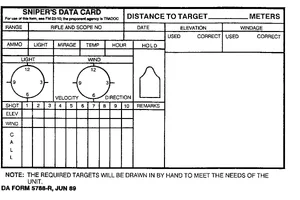
Back in the day, every shot at the range was logged on a data card and stored in a data book. The reason being is that you could always look back at your DOPE (data of previous engagement) and be able to look up what weather data you fired in the past. I dont keep data books on throw line shots but I always have the DOPE in the back of my head and adjust with a very complex technique called Kentucky Windage.

Shoot Straight Brothers.snipers-data-card1.webp
 
Not necessarily two different bands.

But different bands could be used like multi-stage boosters on a rocket. (as in video above)

F = ma (Force = Mass X Acceleration)

The bands imparts force. Two bands = more force.
For a given mass; more bands equal more acceleration. The longer length this is applied; equals more final velocity at release.
Multiple stages starts getting very complicated.

For a standard Big Shot, and for a single throw ball weight, I think 2 bands would impart a small increase in height.
The bands would contract at the same rate; with no additional length.

Keep in mind the bands are also constantly decelerating rapidly.

i.e. The same initial acceleration (which is relatively high), but decelerating; and the mass is relatively small.
 
Last edited:

New threads New posts

Back
Top Bottom