Ash drop

Something about going too deep.

Reg I bet your right. Why else would he of done that? That is a cool trick but it doesn't come with a gaurantee. It would be worth using in our work.
 
[ QUOTE ]
So much back and forth. What was the original question?

[/ QUOTE ]

I believe it was about the standard 20% depth of the notch.

Evidently it could be compared to maintaining a 10:1 safety factor in your lines....you may not need it but you have piece of mind that it affords margin for error. You can cut a 20% notch in either forward or backward leaning trees and know that in doing so the tree will generally stay put, yet afford us some room for correction if need be.

With pull lines readily available and so easy to install its a pretty safe rule-of-thumb for residential tree work.
 
There are very valid reasons for making face cuts that go beyond the 50% mark, just not for felling whole trees though.

I do it quite often chunking down extremely fat vertical spars in the 3-4 ft dia range so I don't have to bust my guts pushing them off. By exceeding the halfway point with my facecut, the finish cut allows the section to go where I want it to without me touching it at all.

The same technique can be used to control the number of times a cut spar section flips in the air to ensure it lands on the ground flat each time. Variations in the angles and depth of your notches can be used to help logs land flat as well.

jomoco
 
Interesting measuring contest...

I believe (I started to research it and got far enough to say...) sapwood is not as lignified as heartwood. I seemed to remember that fact being given to me at some point in my career.
The depth while notching is not deep in order to retain a higher percentage of sapwood in the hinge. Lignin is more rigid, less flexible therefore doesn't bend quite as well.

I will look further tonight for a reputable source for the composition percentages differences in sapwood and heartwood.

I make a habit of cutting the heartwood out of the hinge (would give most of the patrons here a heart attack). Makes things bend better ;).
 
Lignin deposition is completed during vessel or tracheid differentiation. This is all in sapwood formation. But indeed, the moisture content of heartwood is frequently much lower than that of sapwood, at least in uninfected wood. So there could well be differences in structural performance, but it's not due to differences in lignification.

Of course, I could be wrong on this, but I don't know how lignin could be added during transformation of sapwood into heartwood. Addition of ergastic substances, sure, but I don't think they add to strength.

I don't usually wander out this particular limb of treebuzz, but I'll try to remember where it is!
 
What about the live cell / dead cell discussion regarding heartwood? As I recall some refer to heartwood as deadwood there only for structural support. But there is still so many live cells remaining that we can't properly call it dead.

Without getting too biological I look at the stump and you can see which fibers snapped and which bent and did the holding work.
 
I had heard of a type of facecut very early in my career called a boxcut.

I had no idea what the heck it was, or what it's purpose was, until I met a third generation logger in Lake Arrowhead by the name of Matt Allen. Matt was subcontracting me for my roping and speedlining skills to help him remove dead cedars on the Arrowhead shoreline. Many of these very large dead cedars were of the boat docks and mansions of bigtime celebs like Kevin Costner, Winona Ryder, Vanna White, etc.

One particular tree however was not dead, nor was it a cedar. It was a fairly larger(160ft) live Coulter pine, leaning over a three story mansion on the lake's shoreline. The tree had three main leaders, a five foot dia base, and was covered in ivy two thirds of the way up into the tree.

Matt had been impressed enough with my skills in the trees and on the ground to give me the job of removing this monster, and suggested I put a bull line it and fall it towards the beach, despite it's rather serious lean over the mansion.

It took me half the day to get one end of my 150ft bull line into the left leader, and the othe end of it into the right leader. Then I placed a pulley block onto that line and attached my 300ft bull line onto the block and trailed the othe end of it downhill towards the beach, attaching that end to a big tracked cat skidsteer that would pull the whole mess over onto the beach.

I was feeling confident that things would go well right up until I cut the ivy from the tree's base revealing a huge cavity that I could literally walk into and raise both my elbows laterally inside the cavity! There was only about 8 inches of sound wood on each side. Needless to say I was getting real nervous about dropping such a monster in that condition.

I called Matt on my cellphone and told him of the trees condition, and my nervousness about dropping it, suggesting a crane might be the best alternative. But Matt said "Nah Jon, just put a boxcut face on it, and leave about six inches of hinge at the top of the box with your finish cut".

I had never chickened out on any removal at that point in my career, but this hollow monster over a celeb's mansion was too much. And besides, I didn't really know what the heck a boxcut was. So I politely insisted to Matt that he come out to the job with his 084 and show me how a boxcut is done. "Oh alright Jon" he grumbled to me.

And sure enough, Matt arrives, grabs his saw, and cut a perfect box facecut, using a plungecut on each side, with a 36 inch bar, about one third into that monster. Then started a finish cut on one side that would meet the top of the boxed face, leaving six inches of hinge. Then did the same on the other side, stopping again with six inches of hinge. I had the skidsteer op tension my bull lines previously before matt had even showed on the job. The tree had not moved at all after matt had finished his cuts. Matt cooly nodded at me to signal the skidsteer op to back up slowly. My ropes got noticeably skinnier before that monster finally moved towards the beach and fell bingo inline with the skid.

I asked Matt what the advantage of the boxcut was in that situation after all the hooting and hollering was over. He told me it allowed the hinge wood to hold to the stump much much longer as the tree traveled to where he wanted it. And indeed I had noticed that the hinge hadn't broken from the stump almost until the tree had hit the ground, and we were on a downhill slope!

And yes I had cleared all the celebs, and household staff out of the mansion before tensioning the bull lines.

jomoco

 
Jomoco you could write a very interesting book with all those short stories I love them, you make me listen everytime you post. Such cool knowledge and adventure. Box cut got to check this out, probably never use it as our trees down here are tiny with comparison.
 
After a quick google search on "box cut" it appears to be a common name situation with different regional interpretations. A bore cut or letter/mail box cut seemed to make the most sense.
 
Think of the triangular piece that comes out of a traditional face cut guys.

The piece that comes out of a boxcut is almost perfectly square. Which is why a boxcut cannot be made without making atleast one vertical plunge cut for small dia trees, or two vertical plunge cuts when the dia of the tree exceeds your bar length.

Please bear in mind that boxcuts are pretty much useless for hardwood trees. But work great in most conifers that tend to bend without breaking better than most other tree species.

jomoco
 
Soooo...two parallel face cuts, top and bottom, joined by a vertical plunge cut for the apex? Is that it?

Where do you line up your backcut? Top/mid/bottom???

What advantage using the box over a pie shape variation?
 
You've got it Tom.

You line your finishing cut to exactly meet the top parallel cut of the box.

The advantage is it's ability to hold onto the stump much longer than a traditional pie cut face.

That Coulter pine held to it's stump for well over 90 degrees of travel before letting go.

One thing I noticed about very good pro loggers is that they are totally anal about the precision of their felling cuts. Tom Craven went so far as to use a huge carpenter's square to make dang sure his cuts were true and bingo on the button. There really is a science to what they do.

jomoco
 
works great in the tree as well Jon, as I'm sure you know, for folding horizontal limbs to miss a target....they hang on till the death. Cut a normal face on the underside of the limb, then use the saw to shape the diagonal into a box or block-out.
 
jomoco,

your description was perfect i think.

I invisioned it as you described it without any problem.

At least, I sure think I did.

I learned something tonight for sure.

Never did a box cut.

Makes sense with hollow trees that the sap wood hold well. Like, spruce and many conifers but also , hickories, white oak, osage orange, elms, sweet gum and maybe silver maple.

Thanks for posting, I surely don't know everything.

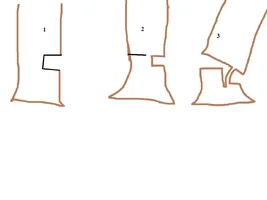
attached is quick diagram I what I think it looks like.

I drew it really fast and not accurate, but close enough I think. holding wood a little thin, but close enough i think.

is this the box cut?
 

Attachments

  • 314977-boxcut.webp
    314977-boxcut.webp
    16.1 KB · Views: 109
Yeah X-man, you nailed it.

Just don't expect too much from it in anything but a conifer.

Work safe guys. My worst nightmare is describing a technique that gets someone hurt.....or worse.

jomoco
 

New threads New posts

Back
Top Bottom