Any SRT canopy anchor that's rescue "retrievable/release-able"?

I'm a bit wary posting this, I'll delete the post if people freak out, no problem ;-)

I've already been through "someone will die" comments on my hand-sewn eye thread. I provide a suitable skull and crossbones warning in this vid. Don't try this unless you're an expert climber, you could die if you don't get it right. It's very simple, effective and safe but you have to pay attention and take good care of your life. Putting on my flame suit now.

The rebuttal to this is make a simple continuous loop with a spiked knot/blocker, attach a sling and hardware of your choice to make a releasable anchor. I like the all rope version, simple. I use it primarily for woods/rec climbing once in a while for work climbs, it has blown the mind of a ground worker or two ;-)


Note: unrelated to the discussion, my comment about Yale 11.7mm vs. Tachyon is backwards, Tachyon is less supple and therefore starts self-tending quicker getting off the ground with my Pantin/footlock technique.

-AJ

Moss that’s brilliant! I love it! And Id definitely use that, the only issue that I see is if other people on the ground somehow manage to yank that apart. But my guess is with my fat gut hanging on that- it ain’t getting pulled out easily! Really Moss I like this very much! Thanks for sharing that.
 
Stephen are you describing the basic remote-set canopy anchor, the one that's the basis of the Texas Tug? I like how that's retrievable once on the ground, but I was attempting to describe something that could be reliably released if climber is injured, hanging on line.
Yes
 
I always have a groundie, so none of this matters to me really, but for shits and giggles and another way to make a wheel, Mosses basal anchor is killer ( pardon the pun Moss)
 
I have some view pruning coming up, could be handy when the other guy is 200 ft away in a different tree and you want to switch to a top tie!
 
I have some view pruning coming up, could be handy when the other guy is 200 ft away in a different tree and you want to switch to a top tie!
Yes indeed ! The key to this though is it is temporary, clearly not intended to be worked on. You would not be doing a good thing by dumping a branch or 2 on the release line.
 
I always have a groundie, so none of this matters to me really, but for shits and giggles and another way to make a wheel, Mosses basal anchor is killer ( pardon the pun Moss)

It's not so much a work technique but thought it might move things along towards better ideas. I've been in a situation with three climber, one groundie, I used it then, groundie was already running around too much, took a load off. Another trick in the mental toolkit.
-AJ
 
Moss,

Have you ever had a difficult time releasing the remotely releasable basal anchor that's shown in your video from the canopy? Have you had a time when it won't release?

This topic reminded me of the video below. Not my idea or video, just sharing...Thoughts?

I've never had it hang up or not release. You want to make sure the first stage release loop isn't hockled and I suppose you could tighten it so hard on setup that it won't release when you slack the system, I haven't figured out a way to do that. The thing is, if it fails to release you can always lock off the rope where you are in the tree and descend and take care of whatever problem occurred.

Also want to emphasis this is an access technique, not intended to be worked off of etc. The advantage over setting a canopy anchor from the ground is the anchor/redirect point in the tree doesn't have to be isolated.
-AJ
 
Moss,

Have you ever had a difficult time releasing the remotely releasable basal anchor that's shown in your video from the canopy? Have you had a time when it won't release?

This topic reminded me of the video below. Not my idea or video, just sharing...Thoughts?

Yes that video shows using a separate anchor on the tree and a knot blocker (Pinto in this case), completely valid concept. Just more gear.
 
This forum rocks, I really appreciate all the replies here. It sounds better to K.I.S.S. And to steer clear of those "hopefully it's as strong as it looks" really high TIPs. I strive for the best pruning possible, and on those scary-weak willows, white pines, etc I have to remind myself my life is more important than getting that one wild hair of a branch way up/out there.

I've also never used an SRT system to work the tree before, just getting my gear this week, so I'm very curious to experiment with Not isolating the TIP and distributing the load.


Take production pressure out of it. Go rec climb with minimal gear to be able to crotch-hop more easily, and work through the bugs.

A good rope-walker set-up is invaluable. Skinny rope and big hands makes for regular use of your foot ascender a wrist-saver.
 
I have only climbed a few times on my own property (old guy with a late mid life crisis) and was always nervous about getting hung up or hurt and needing rescue. The problem was that when climbing other than calling 911 I only had my roommate (older female) to rely on for rescue if I got hung up and of course I was reluctant to trust her handling a rope over a crotch to lower me. What I did was to tie a basal anchor and attach my climbing line to that with a blakes hitch for release, but with a knot about 6 inches below the blakes hitch so that if while cutting etc. a branch hit the blakes accidently releasing it I would only drop 6 inches. But if I needed to be lowered from the tree my roommate could release the unloaded knot and then use the blakes hitch to lower me instead of having to trust her to be able to handle the weighted line.

I had her practice with the system several times (with a backup system of course) and she never had an issue doing a smooth slow drop.
 
You NEVER double the TIP load, NEVER EVER. Ever.

I've about had slack sometimes on the base-tie in extreme cases, and at most, with an natural crotch Redirection Point/ Primary Suspension Point, you're Probably looking at 175% load. Trees are Strong as Snot. A good TIP doesn't break. Don't go for 100' PSPs that are hard to see, and 3" in size.

Thanks for the post! I meant to ask what PSPs stands for?
 
Been trying to get my head around this too. One of the things I'd suggest maybe watching Ob2, in it's entirety is Richard Hattier's TreeStuff video at:
He makes the point several times that treework is one of the few work at height disciplines that doesn't have engineered tie points. For me he sets context for the climb. There's lots of discussion on this forum elsewhere about rescue and lowerable access systems too but it's all a moot point if the climber is lanyard'd in (esp wire core). And also if the system isn't rated for two climbers.

Aside: See also section 3.8 pp16 in UK Arboricultural Association A Guide To Good Climbing Practice which calls for some form of "cuttable" webbing or rope sling between the harness connector and mechanical adjuster of a wire core lanyard so the climber can be rescued - maybe UK practice but not common practice in N. America that I've ever seen.

After fiddling with this all in my head a bit, I have come down on the side of just dragging up another different colour rope and choking it around something I know/ can see is bomber. Richard shows some options as well. But I want my own to be KISS system.
Also, he makes a great point I think about not shooting always for the highest tie point right away but for maybe the second or third one down if the wood looks thicker/ more sturdy, then moving up when you have a chance to check out the neighbourhood a bit more. Richard does a great job in the video I think, and he did even better when he came up to Calgary and put on a day for us. Don't know if this helps. Stay safe out there.

Addenda:

Thanks Ghostice! So many good and detailed replies here it's taking me awhile to get through them :)
 
I'm sure this is patently obvious to the experienced folks on the forum but here goes anyway - I've wanted to post these for some time - about the tie points/ crotches with included bark thing.
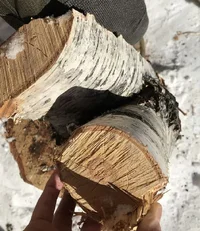
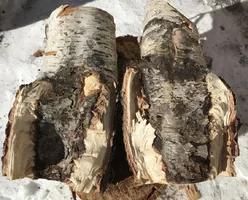
Last year I was disassembling a couple of birch trees that were starting to drop branches - one that had a hack job done years previously way up the crown, leaving rotting stubs. Parts of the tree still looked quite sound however and I was able to get up and do the deed around the power and cable service to the house and the usual complement of garden gnomes. But when I was splitting the wood up in the spring, I made a point of looking at both some of the crotches I had been climbing on and some from the sadder parts of the tree I had scampered around on, but with tie-ins elsewhere. A couple of crotches were surpirising for the amount of included bark in them, once they had been split open - it was really just a thin band of wood on either side of the stem that was holding things together higher up the tree. One side was a good four to five inch diam and the other was eight or more - would most of us tied in higher up somewhere on the larger stem? Dunno. Scoping this out with glasses from the ground showed nothing much.
From the outside:
BirchIncludedBark1s.webp

After splitting open:
BirchIncludedBark2s.webp

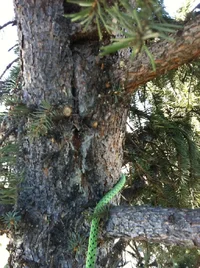
In a similar vein, some of the spruce I've worked on looked like healthy stems all the way up. Till I got up there to survey the real estate a bit more. The picture below shows one of these having a cracked stem about 12-15 feet below the twin tops. In fact, the stem on the right was only holding on by about 2-3 inches of good wood to the right of the stem crack ( just above the lanyard). Change of plans and the top(s) were blocked down from there along with an extra hundred pounds or so each of sappy spruce cones. Point of this is, just as Richard says in his video and lectures in person - you never know about your tie point till ya get up there sometimes. In trees, it really isn't an engineered tie point, ever. Careful out there.

StemCracks.webp
Sorry if for some, this belabors the obvious.
Cheers
 
Thanks for the post! I meant to ask what PSPs stands for?
I have only climbed a few times on my own property (old guy with a late mid life crisis) and was always nervous about getting hung up or hurt and needing rescue. The problem was that when climbing other than calling 911 I only had my roommate (older female) to rely on for rescue if I got hung up and of course I was reluctant to trust her handling a rope over a crotch to lower me. What I did was to tie a basal anchor and attach my climbing line to that with a blakes hitch for release, but with a knot about 6 inches below the blakes hitch so that if while cutting etc. a branch hit the blakes accidently releasing it I would only drop 6 inches. But if I needed to be lowered from the tree my roommate could release the unloaded knot and then use the blakes hitch to lower me instead of having to trust her to be able to handle the weighted line.

I had her practice with the system several times (with a backup system of course) and she never had an issue doing a smooth slow drop.

New2Trees that sounds like an excellent system! Do you have a photo you could share? What were the major drawbacks of that setup?
 

New threads New posts

Back
Top Bottom