another notched spar descent accident

it is very regretable to hear this. all this could have been avoided by choaking his climbing line off to the spar, rapeling on it then pulling it out before felling the stick. pretty simply system solves the hazzardous situation. sorry to hear about his fall.
cheers tex
 
ropes live a life of cycles. a rigging line goes through some pretty tough living. why take a chance? just use a climbing line...

peace,

mk
 
this has all been very interesting.

Especially since I do cut a groove in the top of a spar and rappel on my climbing rope. (well untill now) I think that I always make the groove deep enough that it couldn't possibly come out, but what if some day I don't. So, I'm willing to learn a safer method.

An experienced climber making a mistake makes me think.

I like the idea of maybe backing up my climbing line by running a prussic down the tag line too.

I'm interested in this false crotch though. Can someone draw or explain it better?

You can't do a false crotch with caribiners or rings and leave them in the tree during felling; cause who knows what damage they will recieve when they hit.

So, how do you do a retrievable false crotch on a spar??? (And a fast setup an removal).

A drawing or good explanation would be most appreciated and I'm sure there are others out there that would like to learn too.
 
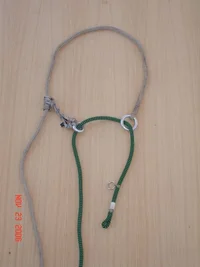
Xman, here's a pictre of a retrievable/adjustable false crotch, courtesy of Mahk. The small ring prusiked to the climbing line above the eye is used for retrieval.
 

Attachments

  • 72642-AFC2.webp
    72642-AFC2.webp
    35.2 KB · Views: 105
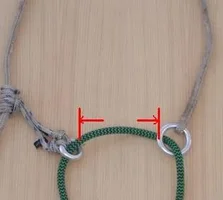
The distance between the rings is important.
If they come together it becomes a battle to separate them which allows the line to exit the large ring, at least when using a knot on the end of the climbing line.
 

Attachments

  • 72664-spacingtherings.webp
    72664-spacingtherings.webp
    8.7 KB · Views: 83
[ QUOTE ]
So, how do you do a retrievable false crotch on a spar??? (And a fast setup an removal).

[/ QUOTE ]

X:

The photo that Leon showed is from this thread:

http://www.treebuzz.com/forum/showflat.php?Cat=0&Number=61178&page=0&fpart=1&vc=1

Go to page 2 of the thread and look for my post that begins "This is long..." The photo is from that post and my following posts detail (with photos and description) how to set up and retrieve the system.

That thread also has discussion on using an SRT system to work a spar (which Mark C., Tod K., and others use) as well as discussion and comparison of the two different systems.

For even more discussion look at these threads:

http://www.treebuzz.com/forum/showflat.php?Cat=0&Number=67904&page=0&fpart=1&vc=1

http://www.treebuzz.com/forum/showflat.php?Cat=0&Number=68077&an=0&page=4#68077

http://www.treebuzz.com/forum/showflat.p...=true#Post69244

Hope this helps.
 
Leon, Kevin and of course, Mahk,

Thank you very much.

Using an Adjustable Friction Saver is what I needed.

At the risk of sounding dumb: I wasn't thinking of that. Very simple and easy to make. I just haven't used one before. It's funny how simple things like this are missed by some people that don't get out and mingle with other climbers or read everything on tree buzz. Despite climbing for many years.

When I use a friction saver, it's always been a fixed length one. And that's what my mind was stuck on.

and I don't use it all the time, just on thin bark trees or in the spring time or if I want to use a french prussic.

I will make an Adjustable Friction Saver (AFS).

Another point: All these abreviations can be confusing to some people that don't read these discussions all the time. Especially if it's not written out once in a thread. And it might cause people to not grasp what is being talked about and quit reading.

In your tutorial you spelled out RR (retrieval ring) which was great, but that was because you named it yourself, so you had too. The terms you guys use all the time, may click in your head immediately, but for the guys that read things like; SRT for the first time, may not know what the heck it means. We should all spell it out once in a while, especially while teaching others. Oh, SRT means Single Rope Technique (at least I think so).
 
[ QUOTE ]
It's funny how simple things like this are missed by some people that don't get out and mingle with other climbers or read everything on tree buzz. Despite climbing for many years.


[/ QUOTE ]

Island Syndrome.....its everywhere, some companies live by it in order to restrict growth and development, and to eliminate competitive compensation.
 
AxeKnot..


I suggest you and others get over yourselves and your rulebook ......

Yes, descending with use of an adjustable Friction saver is the best way, if a suitable stub is not available. Also good is to descend by passing your line around the stem, adjusting it till both ends reach the ground, then placing a carabiner midline with a butterfly (or other midline knot) on one side and clipping the line on the other side of the stem to it. Rappel out, then pull down on the side with the biner, and the choked loop will open and the whole shebang will drop to the ground. This technique only works on a smoothish stem. Next best is cutting a bombproof notch.

But I have rapped off on tag lines for 30 years and will continue to do so till I retire. However, when doing so, I keep my flip line loose around the tree and come down slowly. sure it is not textbook, or compliant with ANSI, nor would I train crew to do this, but never in 100 years will a line break under bodyweight.

Sure, dropping a log with a line attached can stress the fibers, if it is pinned against a rock or sharp edge....but rarely have I seen a line fail..unless it is tensioned and over a sharp edge, or is overstressed when pulling with equipment, or shock loaded excessively....never had a failure there that I can recall...save for 28 or so years ago, when I cut a 60 foot spar at ground level..had it tip tied with 5/8th three strand poly, and rigged off another straight gin pole leader. It fell a few feet before coming onto the line. The lead then fell into Lake Sammammish, and we had to tow it to shore where it became a bulkhead, wanted or not.

 

New threads New posts

Back
Top Bottom