Go to canopy anchor?

For the past 15 years I’ve only climbed MRS and am just about to try SRS. I'm planning on using canopy anchoring. I’m wondering if the tree-climbing world is converging on any particular canopy anchor as the “most often used” go to?

There are so many canopy anchor methods:
- Rope on rope cinching
- Captured-ring cinching
- Quickie/Shackle cinching
- Carabiner cinching
- Pulley cinching
- Floating ring
- Floating soft-8
- Texas-tug
- Conventional friction saver with standing-end knot jammed

I realize there are a few different use cases (Conifer/Spar work vs wide-canopy pruning. Advanceable. Redirect friendly, etc.) so there may be a couple different favorites.

My use case is 95% wide-canopy Oak tree pruning. Is there one canopy anchor method that you guys most often use/recommend for this type of work?
 
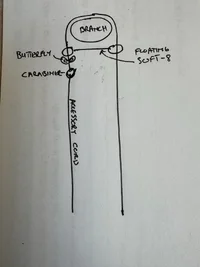
I rarely use canopy anchors anymore, but for me, in deciduous trees, the floating soft 8 is the hands down winner. Homemade one, the commercial ones are too long for my liking. Retrieves easily even with redirects and very simple to set up. I use accessory cordage as a pulldown, don't like feeding my line back down to the ground.
 
I rarely use canopy anchors anymore, but for me, in deciduous trees, the floating soft 8 is the hands down winner. Homemade one, the commercial ones are too long for my liking. Retrieves easily even with redirects and very simple to set up. I use accessory cordage as a pulldown, don't like feeding my line back down to the ground.
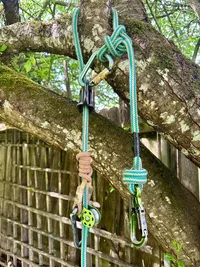
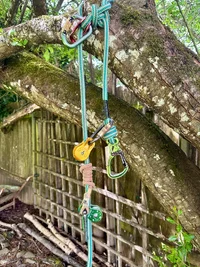
So something like this? That seems like a good setup. Could advance the tie-in easily by just unclipping the retrieval line and untying/retying the butterfly.1.webp
 
Yes exactly, even quicker with a spliced eye, clip accessory cord to the splice. I used to keep a 75 ft 6mm retrieval line in a little linemug bag
 
First day of SRS climbing for me!

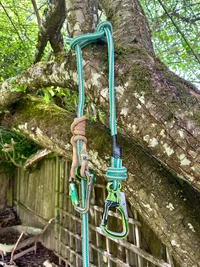
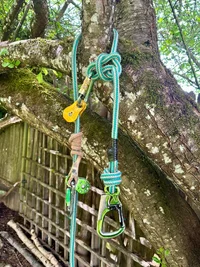
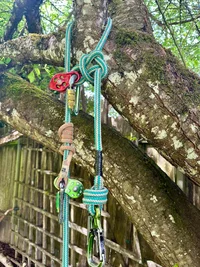
I went outside and tested multiple canopy tie-in methods.
- floating soft-8 jammed with an alpine butterfly
- single floating ring jammed with an alpine butterfly
- captured ring (affixed to alpine butterfly loop with working end of rope fed through the ring) with "Texas-tug" second butterfly 16" lower clipped to a pulley with the working end running through it.

In all cases I inserted three re-directs, the first of which was very close to the same vertical height as the anchor point to present a challenging retrieval path.

The floating soft-8 (Muggs suggestion, thanks!) was the best overall. It cinched tightly and felt stable when limb walking. During retrieval it floated at the same level as the first redirect so the friction over the first redirect limb was reduced.

The single ring didn't work out very well. When pulled into the tree, it ended up under the branch and didn't cinch down very tightly. The loop of rope rotated a lot during limb walking. When retrieving, the friction over the anchor limb was high as the ring forced the rope to almost circle the branch creating a lot of contact area.

The captured ring with the Texas-tug addition gripped the anchor branch just fine but during the retrieval once the lower butterfly was pulled vertically lower than the first redirect, it dramatically increased the friction as the rope was being wrapped around the redirect branch more and more as the working end was being pulled down. The second butterfly/pulley kept the rope aligned well for the anchor branch, but the redirect branch friction was the dominate factor. The floating soft-8 was so much easier since it did not try to force the line down lower than the redirect.

So that's my report. I'll be sticking with the small/big-ring floating soft-8. Easy to set. Reasonable retrieval friction even with funky redirects. Able to add retrieval ball/throw-line for controlled removal. Easy to advance by unclipping the accessory cord retrieval leg and untying/retying one butterfly.
 
I'm a little biased, but I use the CMI RollnAnchor primarily. It has a shorter distance between openings than soft eights, and reduces friction on retrieval better than rings (in a soft eight configuration). I've heard reports of climbers retrieving their line after 4 and even 5 natural redirects. There are some funky canobase setups using it as well. Derrick Martin shows a couple on his insta. I'm working on a canobase setup with it that makes the pulley a false crotch when there's only one union in the crown where you want to spread the load, allowing you to incorporate a blank stem, as well as reduce friction on retrieval.
 
here are mine in descending order of preference: knot choke, carabiner+pulley, proper pinto pulley texas tug, hitch-climber eccentric for retrieval like no other. and you can always install a pulley a bit lower to help more with retrieval.
 

Attachments

  • IMG_1520.webp
    IMG_1520.webp
    481 KB · Views: 50
  • IMG_1521.webp
    IMG_1521.webp
    480.8 KB · Views: 45
  • IMG_1522.webp
    IMG_1522.webp
    459.6 KB · Views: 39
  • IMG_1523.webp
    IMG_1523.webp
    449.4 KB · Views: 39
  • IMG_1524.webp
    IMG_1524.webp
    477.9 KB · Views: 44
here are mine in descending order of preference: knot choke, carabiner+pulley, proper pinto pulley texas tug, hitch-climber eccentric for retrieval like no other. and you can always install a pulley a bit lower to help more with retrieval.
Thanks! How do you decide which to go with for a particular job? Is it mainly based on your estimated number/placement of redirects you plan to use?
 
I haven't seen need to deviate from a quickie. Simple, fast. Just go through the spliced eye/no additional knots or hardware. Light weight cord with an accessory carabiner to pull it down. I haven't tried it with more than one redirect, so that could change my thoughts!
 
View attachment IMG_0749.mov
For sprawling deciduous tree prunes, I really like knot blocking an adjustable friction saver with a canopy based anchor setup or "cano-base". This video is showing the "soft" retrieval process with throw line from the ground after taking 3 natural redirects in a Norway maple, treading throw line through the system, and then adding the retrieval device on the retrieval side once the throw line is fully threaded and your rope is retrieved.

Key points, knot block the larger ring on the bottom (figure eight on a bight) and back it up with hardware (carabiner), make sure the first redirect is directly in line with the rings (as illustrated here), think about attaching a throw ball to your friction saver for added weight retrieving it. A few years ago I saw Patrick Fitch (@tiedyeclimber) demonstrate this setup on his instagram social media. Have been running it for larger more involved prunes where I want to retrieve my SRT cano-base without climbing back through 3-4 natural redirects at the end of the climb.

This could definitely be used for sprawling oak climbs. Cheers.
 
IMG_9445.webp
Can see this setup after taking the first redirect in a large black walnut. Typically will advance with moving rope up to the first redirect location and then descend down to a chunky union or trunk below to setup the blocked friction saver. Ended up taking multiple other natural redirects higher out in the canopy to reach some tip weight reduction cuts. Went down for some low deadwood after setting up in the center of the tree before working the tips.
 
Another option would be a ring and ring installed same as for MRS but knot blocked. And retrieved with retrieval ball on working end. Allows for very minimal friction, like pulling a basal anchor out of multiple redirects. I don’t use it much but comes in handy sometimes.

My go to is a soft eight.

Climbing Arborist just posted a quick video about this yesterday:

 
Building on Flyingmosstreen's and 27RMT0N's posts: How about an adjustable ring&ring, set to its shortest length for use as a flintlocker to get you into the tree with minimal fuss. Once into the canopy, If multiple redirects or advancing the TIP are required, just undo the flintlocker, expand the R&R, move it to the top of the TIP branch, and use as a traditional friction saver (knot blocked for SRS).
 
If I’m resetting my main tie in I’ll run a quickie or a basic ring jam. If I nailed my tie in out of the gate I typically run a Texas tug, with a ring or the quickie on the first butterfly and a pinto on the second which eliminates the issues with the pinto being used in the cinching manner. The RollNAnchor is on my watchlist because it eliminates the concerns of the pinto.
I’ve knot blocked the naja as well as the eject but prefer the tug.
A curious one I haven’t played with but I’ve seen tiedyeclimber use is the “nest” canopy anchor.
 
Thanks! How do you decide which to go with for a particular job? Is it mainly based on your estimated number/placement of redirects you plan to use?
I use the pinto 99% of the time esp when set from the ground because it just works reliably and I can move on to the next thing requiring consideration. the soft8 always is always forgotten in the bag, I know it works well but just rarely grab for it.
 
Building on Flyingmosstreen's and 27RMT0N's posts: How about an adjustable ring&ring, set to its shortest length for use as a flintlocker to get you into the tree with minimal fuss. Once into the canopy, If multiple redirects or advancing the TIP are required, just undo the flintlocker, expand the R&R, move it to the top of the TIP branch, and use as a traditional friction saver (knot blocked for SRS).
this gets me all excited
 
First day of SRS climbing for me!

I went outside and tested multiple canopy tie-in methods.
- floating soft-8 jammed with an alpine butterfly
- single floating ring jammed with an alpine butterfly
- captured ring (affixed to alpine butterfly loop with working end of rope fed through the ring) with "Texas-tug" second butterfly 16" lower clipped to a pulley with the working end running through it.

In all cases I inserted three re-directs, the first of which was very close to the same vertical height as the anchor point to present a challenging retrieval path.

The floating soft-8 (Muggs suggestion, thanks!) was the best overall. It cinched tightly and felt stable when limb walking. During retrieval it floated at the same level as the first redirect so the friction over the first redirect limb was reduced.

The single ring didn't work out very well. When pulled into the tree, it ended up under the branch and didn't cinch down very tightly. The loop of rope rotated a lot during limb walking. When retrieving, the friction over the anchor limb was high as the ring forced the rope to almost circle the branch creating a lot of contact area.

The captured ring with the Texas-tug addition gripped the anchor branch just fine but during the retrieval once the lower butterfly was pulled vertically lower than the first redirect, it dramatically increased the friction as the rope was being wrapped around the redirect branch more and more as the working end was being pulled down. The second butterfly/pulley kept the rope aligned well for the anchor branch, but the redirect branch friction was the dominate factor. The floating soft-8 was so much easier since it did not try to force the line down lower than the redirect.

So that's my report. I'll be sticking with the small/big-ring floating soft-8. Easy to set. Reasonable retrieval friction even with funky redirects. Able to add retrieval ball/throw-line for controlled removal. Easy to advance by unclipping the accessory cord retrieval leg and untying/retying one butterfly.
I highly recommend replacing the alpine butterfly with the span loop as your midline knot. It's got the little bowline handle you just pry up for reliably untying every time. Even use it for rigging. fasg and secure and never fight it to untie.
 
  • Like
Reactions: ATH

New threads New posts

Back
Top Bottom