Aerial Rescue

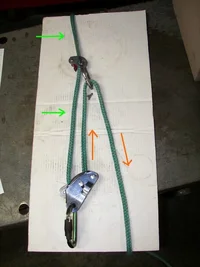
Norm, yes the moving block has two legs but shouldn't the reaction force still be 3:1? I know that it's not, but why? If a 5:1 fiddle block is used to pull a tree over, the moving block has 5 legs and the anchored block has 4 legs; reaction force is 4:1. So take the same fiddle block and rig it opposite. It's now "rigged to disadvantage", 4 legs on the moving block and 5 legs on the anchor. 4:1 output, but 5:1 on the reaction force... right??? Or is it not possible to have a reaction force greater than output force? Anyway, when lifting a victim, the RADS setup in my photo increases TIP load, but doesn't yield a greater MA than just pulling up on the tail by hand.
 
Hey Mark B., no disrespect meant, just trying to think of ways for the ordinary groundie to do these rescues. I think these written words can sometimes be a little confusing, pictures sure help, thanks Taylor.

I think we all agree that there's more than one way to skin a cat, as long as you've practiced first.

Peace
 
[ QUOTE ]
If a 5:1 fiddle block is used to pull a tree over, the moving block has 5 legs and the anchored block has 4 legs; reaction force is 4:1. So take the same fiddle block and rig it opposite. It's now "rigged to disadvantage", 4 legs on the moving block and 5 legs on the anchor. 4:1 output, but 5:1 on the reaction force... right???

[/ QUOTE ]

To calculate the MA, count the parts of rope at the traveling block. Presuming all parts are parallel that is your MA. In the attachment(typical Z rig), the MA is 3 to 1. The end of the rope you are pulling on is also counted. So, in the 5 to 1 set up, if the traveling block has 5 parts of rope, including the end your pulling on, the MA is 5 to 1. If you reverse the blocks, the end you pull on is now on the stationary or anchored end, and the MA is 4 to 1.
 

Attachments

???? Norm wrote:

[ QUOTE ]
Taylor, count the parts of rope 'at the traveling block' (the grigri) (2), that's your MA,(2X) if the ropes are parallel.


[/ QUOTE ]


but then:


[ QUOTE ]
In the attachment(typical Z rig), the MA is 3 to 1.

[/ QUOTE ]


???


And aren't you and Taylor saying the same thing about the fiddle blocks?


Taylor I think you are close in your description of the GG setup. The reaction force can be higher than the MA, and that situation is called 'rigged to disadvantage'.

But I don't understand why you got 2X's at the TIP. I think it's a double whip tackle and should be 1.5X's the load. Try replacing the GG with a pulley and see what you get.
 
My head hurts. I believe I am not seeing the forest for the trees!

Norm, I understand the moving block concept in a simple MA system. Moving = output force. Stationary(anchor) = reaction force. The Grigri moves(output 2:1), so I figured if I had 3 legs opposite it, I should have 3x reaction force. Obviously, this is incorrect.

Mark, my first measurement was over 2x with the Grigri installed so I switched for a pulley. I read 2x with the pulley. The scale could be goofy and I am lifting a light weight so the loss to friction may be high. Anyway, forget that. I am lifting 100% of the load, obviously. During the lift, the static leg(green arrows in attachment) must hold 50% of the load. The other leg comming out of the Grigri holds 50% and I need to pull(down in this case) on the third leg with 50% of the load force. 50+50+50=150%=1.5x the load at TIP.

Works for me!

Goodnight everyone!
crazy.gif
 

Attachments

  • 118237-RADSarrowsStandarde-mailview.webp
    118237-RADSarrowsStandarde-mailview.webp
    51.4 KB · Views: 62

New threads New posts

Back
Top Bottom