Aerial Rescue

Fair points TLH,

I didn't mean to come over as a smart-ar*e.. just a discussion really. I stick by my point that I would prefer to be able to work from above the FL lanyards... I actually came unstuck one time during a demo in France where we were doing access line rescues in one of the arb schools there.

The students were like, "have a go with this guy", so this french kid hops up the access line on a double ascender on a 40cm lanyard. We ended up in an ugly rope snarl and I had to admit defeat, because I was working off my lanyard and there was just no space to work in - it was so cramped . That got me thinking about anchoring above.

But nothing like as bad as another demo performed in France during a kind of train the trainers type thing where they were demoing the old version of access line rescue where the injured persons lanyard is cut. There's this crowd of people watching this one guy going through the motions and when he comes to cutting the lanyard... he falls out of the tree. Whoops. Cut the wrong thing. Just goes to show how freaky things will happen. Yes, of course you're right, we should be staying calm. But you can't always control that. Must have been quite an impressive demo, mind you. Reminds me of that utility pole rescue vid you see everywhere. You know, "C'mon, just cut it!".

But you're right there are many options. I was speaking to Chris before and he pointed out you could lift the injured person on their hitch climber, building an MA system with the hitch climber and the tail end of the line... Then you come down on your line and you can bring down the injured climber on his/ hers.

 
[ QUOTE ]
[...]Rock climbing lines change color pattern at certain points along their length. Maybe we could adopt this to our access lines. [...]

[/ QUOTE ]

I'm all for that. I miss having a mid point markers and dual patterns on my ropes.
 
Hmmm, definitely makes good sense to tie in above both footlock strops; better height above rescuer and less clutter as you point out. Say we have the same scenario except the victim has ascended a single line. Would you still prefer a pick-off, or be more inclined to use an I'd on the victim?
 
Mark;

I'm confused.

After step 4, you lift the victim (to gain slack to tighten the Munter??) then, once the victim's weight is on the Munter you release the victim's Prusik and bring them down minding the Prusik, the Munter, and you own hitch??
 
No.

You have to lift the casualty in order to detach him or her from their footlock lanyard that they're hanging in.

Before detaching the casualty create a load bearing connection between yourself and him/ her. The munter is installed on your climbing system to back up your friction hitch that is now managing the friction generated by you plus the injured climber. Backing up seems advisable.
 
... Savvy?

117980-JackSparrow.jpg
 

Attachments

  • 117980-JackSparrow.webp
    117980-JackSparrow.webp
    53.4 KB · Views: 43
Earlier, I said this:

[ QUOTE ]
I believe a RADS would theoretically increase load at the TIP by 3x!... but I need to check that figure.

[/ QUOTE ]

I checked... a RADS setup to lift a victim's weight off of their prusik creates 2x the load. Working on some pictures, I'll post later.
 
Time for me to chime in here with a little KISS mentality. Not to detract from the above mentioned ideas, they all have merit and are effective with the right tools and training, but...

A groundhand rescuer who does not climb often but needs to saddle up for to save my butt will have to rely on the skills and tools at hand, not some fancy stuff that pro rescuers keep in their pro rescue kit. Of course any potential rescuer should be prepared for the task at hand or stay put on the ground - don't try something you haven't practiced before.

So here goes - in field trials with basic climbing gear I have successfully lowered the mannequin from:

1) Footlocking doubled line with Prusik cord -
After determining that TIP and victim's rope are intact and plenty strong, the rescuer can simply footlock up under the victim, lanyard to victim, install a figure 8 as for normal descent(wrap it twice for extra friction), then reach up and release the victim's and rescuer's Klemheists to descend slow-n-smooth. Another groundie can also keep a hand on the rope to stop speedy descent.

2) Using handled ascenders on a doubled line -
Now it is necessary to actually lift the victim so as to disconnect the tether. There have been alot of good suggestions here but they all have some common components - an MA system for lifting and an anchor for attaching said MA system. IF all the variables are lined up right one COULD use the victim's ascenders as the anchor point and build a simple MA with two biners, two micro-pulleys, and a long enough rope, all of which are probably hanging from the victim's saddle or otherwise readily available.
 
Unless you could simply lower the whole system from the belay device anchored to the base of the tree.

Talk about Keeping It Safe and Simple
 
Eric, a groundie holding the tail of an access line is not a true back-up for a Figure 8. If tensioned hard enough, the line might create a good amount of friction. However, the F8 really just slides down the rope and its function as an abseil device is dependent upon the abseiler's grip relative to the friction created. If the F8 had 3 wraps on it, the groudie could do nothing to release all that friction (except maybe send waves up the rope). Same applies with too little friction; the groundie cannot effectively control descent.
 
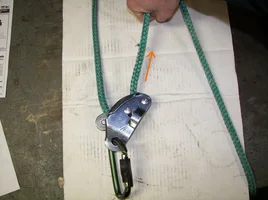
OK. Here's a Gri Gri(what I had in the truck) connected to the victim's harness. Rope running upward on left is attached to the tree. (Single line, doubled-choked line... who cares, this is just a demonstration of lifting methods). Position yourself above victim and pull upward on the tail(my hand). This actually reduces the load on victim's TIP by half because I have transferred half of his weight to my system(orange arrow). Two legs of line, half the load each. At any rate, his weight is off the prusik, which can now be disconnected.
 

Attachments

  • 118016-ARRADS_09arrowStandarde-mailview.webp
    118016-ARRADS_09arrowStandarde-mailview.webp
    62.4 KB · Views: 73
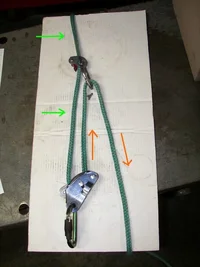
RADS. Green arrows mark static portion of line. To be honest, I'm not sure exactly how this works. I get double the load at the TIP(with a spring scale). The moving part of the system, the victim attached to the Gri Gri, has two legs. The reaction force(non moving), at the ropeman and revolver, has three legs so shouldn't the reaction force be 3x? Maybe my input force is doubled at the revolver and the reaction force is doubled at the GG? Which means...? OK, so I'm supporting half the load on each leg comming out of the GG. This means the whole load is being supported by the static portion of the line, duh. Because I am lifting the entire load via MA at the Revolver, does this mean the load is now doubled because I have a whole load on the static part and the Revolver?

Whew!
 

Attachments

  • 118022-RADSarrowsStandarde-mailview.webp
    118022-RADSarrowsStandarde-mailview.webp
    51.4 KB · Views: 76
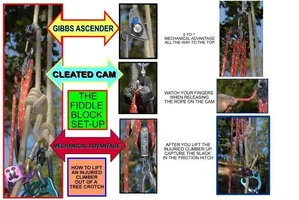
One method for lifting an injuried climber out of a tree crotch. The system is so simple a child could do it if they could climb to the injuried climber.

A fiddle block set-up with one end attached to a Gibbs ascender above the injuried climbers friction hitch and the other end connected to the saddle with a double locking fixed eyed rope snap.

Quick and easy to set up and very easy to disasemble.

More then one way to skin a cat!
 

Attachments

  • 118024-FIDDLEBLOCKSETUP.webp
    118024-FIDDLEBLOCKSETUP.webp
    71.3 KB · Views: 86
As we've all stated now there are many ways of doing this.

Raven,

your speak about specialist equipment and pro-rescuers... errr, the only extra I need on the method I described is the Revolver/ sling combo. I have that on my harness for other purposes anyway... not more complex than your krab/ micropulley idea.

It'll be hard to release a tensioned, cinched down long FL lanyard in a controlled fashion. How do you install the figure of eight whilst hanging in your FL lanyard and still have the reach to release the friction hitch. Surely, part of the idea is to have it so long so as not to be able to reach the friction hitch.

Lowering from the ground is fine. But you do need a device on the base of the tree and a groundworker who is able to operate it competently.

K.I.S.S. is fine by me, but I'd encourage you to go out and actually try this one out for yourself. Because coming up with a theory is one thing, but transfering a theory from keyboard to a practical situation is another.

Right, going to stop there. Too early in the day to get grumpy...
 
[ QUOTE ]
Before detaching the casualty create a load bearing connection between yourself and him/ her. The munter is installed on your climbing system to back up your friction hitch...

[/ QUOTE ]

That's the part that I missed. So you make the load bearing connection, lift the victim, then disconnect their prusik cord from their saddle.

Any suggestions (from Mark or anyone) for how to create the load bearing connection between the rescuer and the victim? Seems this would really be the difficult part. Once the victim is lifted and disconnected from their Prusik, the load bearing connection would have to hold their weight very quickly or else the rescuer would run short on the sling that their foot is in.
 
[ QUOTE ]
The reaction force(non moving), at the ropeman and revolver, has three legs so shouldn't the reaction force be 3x? Maybe my input force is doubled at the revolver and the reaction force is doubled at the GG?

[/ QUOTE ]

Taylor, count the parts of rope 'at the traveling block' (the grigri) (2), that's your MA,(2X) if the ropes are parallel.
The ropeman is stationary.

Your method is the one I was taught. Less gear intensive. We used a cam without 'teeth' though, the Petzl microcender and a footloop prusiked on the running end for added force on pulling the causualty off his/her footlock strop.
 

New threads New posts

Back
Top Bottom