Aerial Rescue

I did in my original post, but not in detail:

ii. If the patient is using mechanical ascenders, you are going to have to lift them up to take the weight off.
1. Alone in the air, this is a difficult prospect. You might be able to footlock the tail of your climbing line to get some of the weight off.
2. We have done some simple MA systems to pick injured climbers off of their lines, but this takes time that you may not have.
 
I said this...[ QUOTE ]
Obviously, you would need to take some weight off of the prusik to disconnect it from the harness but this can be done either with a little muscle or a RADS.

[/ QUOTE ]
 
Eddy does have a panic lock like the I'd. As far as I know it is NOT rated for two person loads though. The lock-off is different than the I'd.

I'll have one maybe two Eddy's next week at the SRT workshop.
 
[ QUOTE ]
I said this...[ QUOTE ]
Obviously, you would need to take some weight off of the prusik to disconnect it from the harness but this can be done either with a little muscle or a RADS.

[/ QUOTE ]

[/ QUOTE ]

Right. I guess your avatar prevents me from really focusing!
smirk.gif
Sorry.

So, when you say a little muscle, what do you mean? Just pulling on the prusik or...?
 
With an I'd installed and clipped to victim's harness, you could position yourself slightly above and pull the rope on the tail side of the I'd. You'd even have a 2:1 MA without increasing load at the TIP. I believe a RADS would theoretically increase load at the TIP by 3x!... but I need to check that figure. Anyone have input on that?

Hard to focus, huh? Try this...

(the attachment is just my avatar)
 

Attachments

  • 117596-Splice059200x149.webp
    117596-Splice059200x149.webp
    8.6 KB · Views: 64
[ QUOTE ]
In the scenario the first poster presented on how to perform a mid-line rescue away from the trunk, an adjustable false crotch would have allowed someone from the ground to perform a rescue instantly.

I will freely admit that I am a big fan of the adjustable false crotch, primarily for this one attribute....It generally takes 15 minutes or so to set up. In most trees I encounter I can set it up faster than isolating both ends of my climbing line and setting a friction saver.

If more thought and effort is put into developing this and other similar techniques such as Tom's SRT systems, I believe tree work in general would be made safer, with reference to rescue capability. It would be particularly useful in controlled preset environments, such as competitions and evaluations.

D Mc

[/ QUOTE ]


Thanks. I was confused by the terminology. I think what you are describing is a type of floating false crotch.
 
I have absolutly no AR experiance, but...
What about having one person throwing a line in while the other starts the climb in what ever way is fastest, get ahold of the first line that was thrown in, tie the vic dirrectly to it and have the ground man belay him down. Then even with the issue of taking the weight off the system, you have two people working on it, or you can just cut his original line.
Obviously this takes two compatent people to do, but it would be the easiest thing I can think of.
 
I've been meaning to join in on this thread for a while... but I guess life got in the way. Still, for what it's worth... here are my thoughts on the topic:

In terms of probability I think a incapacitated climber in the access line is not that low. A dead limb that the climber disloged unintentionally during his/ her ascent that hits them, attachment branch snapping dropping the climber a distance (ask me!) or just plain exhaustion. We should be discussing access in such situations.

Obviously the first thing to consider before proceeding is anchor point strength. And secondly whether you can see and can assess the whole length of the access line and it's integrity.

I think the same should hold true for this scenario as for any other, we try and go as far as we can with equipment we carry on our harness. Good news for some... bad for others. On the one hand because of Murphy and all that you can bet you won't have the specialist piece of equipment you need on site and because it is a high stress situation and you don't want to go handling equipment you're not familiar with in such situations.

I think the attachment above is the most suitable for various reasons:

a) It gives you the most flexibility for manoeuvering.
b) It allows for a range of lanyard lengths of the injured climber. If they are using a short lanyard and you're counting on attaching below their attachment you're really going to struggle
c) There is not risk of attaching to the wrong part of the line

The last point is really relevant - let's assume the climber has taken a fall in to their hitch, it's going to be well cinched down. If you've choked one part of the line and plan to run the rescue off the choked part of the line, how are you going to be quite sure which one it is on a long access? You run the risk of finding out when you unload the injured climbers footlock lanyard. Or cut it... yeouch!

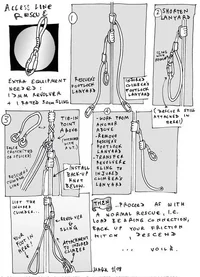
Attached is the way I'd run this rescue, I left out the climbers for clarity's sake . Obviously one of a range of possibilities. In the end the main point is probably finding a way that suits your style, discuss it with the crew and to practice it.

117849-AccessLineRescuesmall.jpg
 

Attachments

  • 117849-AccessLineRescuesmaller.webp
    117849-AccessLineRescuesmaller.webp
    60.3 KB · Views: 59
Duh.. just realised I didn't mention that you use your footlock lanyard passed through the Revolver attached to the injured climber's main attachment point to lift him with by placing your foot in the large eye of the sling.

Lifting the injured person with your own body weight is a method from caving. You can stand up in the lanyard and really give it large, combined with the reduction of friction thanks to the Revolver your can lift some of your own body weight.

Alternatively you can also get your thighs below them and "rock" them up... this will allow you to lift someone heavier than you without having to install an MA system.
 
Norm,

where's that?

For the lanyards? Put a stopper knot below as soon as you've installed the anchor above.

In descent? Back it up as you would anyway in any pick-off rescue scenario!

Am I missing something (not being sarcastic)?
 
People may want a bit more info on "pick off" You stated you need to back up the single hitch,. How are you going to add the friction?
 
[ QUOTE ]
... errr, did I say something wrong. Crash the party, or something?

[/ QUOTE ]
We were having fun with our own ideas 'til you came in and smashed the Hi-Fi!
grin.gif
At first, it didn't click that you were setting up for a pick-off. I like the modular use of the rescuer's strop. I see your point about the victim's prusik obscuring which leg is static in a choke set up. However, I find (as in any stress situation) if you are calm and calculated, details can be determined and pre-checked prior to commitment. Rock climbing lines change color pattern at certain points along their length. Maybe we could adopt this to our access lines. Anyway, the main reason I like the SRT/I'd method is: slightly less equipment, and rescue can be performed without increasing load on access line. If the rescuer can safely use the victim's access line (as in your illustration), then increased load is a moot point and I like your method.

Also, how about a krab and pulley added to the rescuer's strop with a ropeman in lieu of the friction saver above? You've posted that somewhere before.
 

New threads New posts

Back
Top Bottom