Aerial Rescue

[ QUOTE ]
When I footlock a doubled line that is set over a limb (not set through a ground belay), I always choke the limb or crotch with an alpine butterfly. This way I have one leg that is readily available for SRT should a mid-ascent rescue be needed. Also, when I leave the ascent line and work the tree, a rescuer has the immediate convenience of accessing by either doubled rope or SRT.

[/ QUOTE ]

That's a nice technique, hadn't thought about it until just now... but wouldn't you need about a third again as much rope to slide the butterfly up to the limb?

One of the reasons I hesitate to use SRT for access is that it generally means a second rope in the tree... which is good for rescue, but it takes extra time. I liked it until I became reasonably proficient at footlocking then I was able to save the same time and energy by placing and ascending my lifeline alone.

I haven't experimented with an FFC except for aerial rescue. Maybe I'll give that a try sometime soon to see if SRT access make more sense for me.
 
You're all right, thanks for the great thread.

Seems like no matter what skills and training you have, if you're confronted with something unfamiliar, you may be unable to help, if you haven't practiced a given type of technical rescue then you shouldn't attempt it when lives are on the line, secure the area and make room for the ladder truck. Unless it were as easy as lowering from the base of tree.

Oh yeah, Mahk, can you clarify AFC or FFC?
I've called it a Floating False Crotch, at least in rigging situations, but I see Jepson has it as Adjustible FC.
Which is which?, same thing? durn turminolojy enyway
 
[ QUOTE ]
but wouldn't you need about a third again as much rope to slide the butterfly up to the limb?


[/ QUOTE ]

Yes, you need 3x the height of the TIP. You can get away with only 2x if you add the BF around the throwline as the rope end reaches the crotch. I like to have 3x with me anyway, so...
 
[ QUOTE ]
if you're confronted with something unfamiliar, you may be unable to help, if you haven't practiced a given type of technical rescue then you shouldn't attempt it when lives are on the line, secure the area and make room for the ladder truck.

[/ QUOTE ]

Good point, Eric. As with many things in arboriculture, don't bite off more than you can chew.
 
[ QUOTE ]
[ QUOTE ]
With what we now know and the equipment available to us why does footlocking at competitions, training seminars and evaluations not always incorporate a self-rescue component? This is something that is doable.


[/ QUOTE ]

Could you explain what you have in mind?

[/ QUOTE ]

In the scenario the first poster presented on how to perform a mid-line rescue away from the trunk, an adjustable false crotch would have allowed someone from the ground to perform a rescue instantly.

I will freely admit that I am a big fan of the adjustable false crotch, primarily for this one attribute. I am an older climber whose ground crew consists of my five foot tall, 100 lb wife. We work in out of the way locations most of the times. I started using this technique with some reticence thinking it was going to be just one more pain-in-the-a$$ thing to do before I was able to start working.

This became a nonissue very quickly. It generally takes 15 minutes or so to set up. In most trees I encounter I can set it up faster than isolating both ends of my climbing line and setting a friction saver.

If more thought and effort is put into developing this and other similar techniques such as Tom's SRT systems, I believe tree work in general would be made safer, with reference to rescue capability. It would be particularly useful in controlled preset environments, such as competitions and evaluations.

D Mc
 
Back to the original scenario, what about keeping a medium length prusik in the rescue kit specifically for this. One would reach the climber by the appropriate method and attach the prusik to the victim and his line, set it, the rescuer climbs higher(one pick)to release the victims prusik and descend normally working both prusiks. A hard attachment to the victim should be made and a micro pulley could be employed to work the victims knot as well. I see one fault right off, the rescuer would need to have some way to descend on something other than the FL prusik, a figure 8 maybe- setting this up may burn valuable time and would be risky locking it off to work the victim. A gri-gri or I'd may work.
 
There are some good solutions being shared here.

In order to make them work in the real world everyone on your team needs to practice and be familiar with their part in a rescue.
 
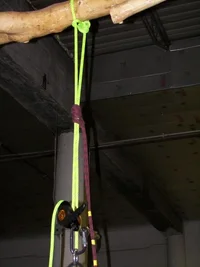
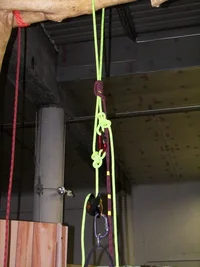
Here are a couple photos...

When footlocking an isolated limb or crotch, I like to choke with an alpine butterfly. Doubled access is no different but the SRT option is there for rescuer ascent or midline attachment of victim.

The spacing of components is compacted here for photo's sake.
 

Attachments

  • 116700-Splice019Standarde-mailview.webp
    116700-Splice019Standarde-mailview.webp
    37.3 KB · Views: 117
If doubled line is not choked, butterflies and carabiner can be used to create SRT setup below footlock prusik.
 

Attachments

  • 116702-Splice028Standarde-mailview.webp
    116702-Splice028Standarde-mailview.webp
    50.7 KB · Views: 124
What about footlocking to a point where you can set a line natural crotch above the victim, connecting the victim to said line, cutting his line and lowering him with a figure 8 or I'd/Gri-Gri attached to your saddle (soft locked in the figure 8 case).

I really like TL's ideas, could you describe the 1st picture more please?
 
Hey here's one:
Safely access the climber as necessary. Provided the TIP for the victim is appropriate and the climbing equipment undamaged, attach the victim to one side of his or her doubled line. A figure 8 on the bite and a life support carabiner would work well, perhaps an ascender. Have your ground personnel attach a suitable lowering system to the other end on the victim's line. The rescuer then disables the victim's prussic. Some heaving on the part of the ground crew may be necessary. Lower the victim down.

Just a different Idea.

Tony
 
[ QUOTE ]
could you describe the 1st picture more please?

[/ QUOTE ]

Yeah, the purple rope is the victim's footlock prusik. The green access line is choked to the limb but still has two legs. So the victim footlocked up the two legs and got into trouble and is now hanging on the prusik. Rescuer accesses tree somehow, moves to victim, and installs SRT device(here an I'd) on the static leg of the green line and clips that to victim's harness. Obviously, you would need to take some weight off of the prusik to disconnect it from the harness but this can be done either with a little muscle or a RADS.

Also, I like the butterfly choke because a rescuer will have an immediate setup for either footlocking or SRT should they choose to use the line for access.
 
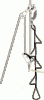
RADS=Rope Ascending Descending System

There are many different gear configurations but the illustration should give you a template.

In a rescue kit make sure that the rap tool is rated for a two person load. The Grigri is NOT a good choice for a rescue tool.
 

Attachments

  • 116968-rad-large.gif
    116968-rad-large.gif
    4.9 KB · Views: 56
Tom, I agree the Gri Gri is not the best for rapping an injured climber, and good point about two person load. Does the Eddy have the same panic function as the I'd? Also, can you lock the cam like the I'd?

Pancake, the shop is M+I/Fresco.

Oh, and for the record... only the victim is attached to the I'd. Rescuer would operate the I'd while descending on his own system.
 

New threads New posts

Back
Top Bottom