Advice pruning Oak trees

There was a thread years ago about trying to reproduce the look of a broken top or branch by using a cornet cut, leaving a jagged looking appearance rather than the regular smooth. If I remember right, the theory is nature knows best.

That was Fay's theory, but in practice that has not proven successful. I keep asking for positive results, but they have none, and I have seen none, in England or Sweden or anywhere. Generally, the stubs tend to die back to the next healthy node.

Scheffa, got any pics?
 
That was Fay's theory, but in practice that has not proven successful. I keep asking for positive results, but they have none, and I have seen none, in England or Sweden or anywhere. Generally, the stubs tend to die back to the next healthy node.

Scheffa, got any pics?
Will get some photos tomorrow as we are starting the job In the morning, picked up some neem oil from the local hardware store to add to the bar oil
 
A.V. Duthrie, Wound healing in Q pendunuclata (Austrian oak) Bot. Annual, 22: pp132-221
I.V. Bailey, Traumatic Oak Wounds
Bot. Gaz., 50: pp374-380
Groom, P. The Evolution of Annual Ring and Medullary Rays of Quercus.
Ann. Bot. Vol. XXV, No. C 10-01-11

In all, pectin plays a major role in that dead cells stimulate cell divisions in the cambium, endoderms, cortex, and cells surrounding the phone and xylem so callous forms which fragments the necrotic tissue from live in as short as hours after injuries occur. In vivisectioned vascular tissues the tears in cell walls from methods used in separation vary from incised vs. ripping in samples used. Ripping stimulated callous response where incizing stimulated a confused metabolic response. In short.
 
A clean cut hours/days later simply presents an additional infection court after remediating storm wounding. In that window newly opened is where cut sterilization is critical. We're exposing the tree twice.
 
Tree Responses to Stem Damage, Claudia Romero, ©2006 PhD dissertation, Grad School U of Florida
It's a 300page intensive on compartmentalization and cultural vs. storm damage. Insights on insect/fungal entry ports. Good read also.
It took what, 22 years before non-sealing pruning cut advocacies on oaks became standard?
 
Thanks; those are new to me!

I definitely agree that if it's too long after the storm, it's usually best to let nature continue her work.

O and that sealing pendulum may be swinging back--tick, tock...
 
That's why we started the Neem treatment on bar oil. For a time I sprayed the wounds and generally returned with optics to assess attraction or not on 2-inch or larger cuts, it got old fast. Bar oil was 2birds with one stone-throwing thing. I had a lab with growth chambers, grew the isolates in potato/agar and peanut-butter medias, comparison analysis for pathogens, and used virulent growths for infection inoculum on "healthy" trees to simulate infection. Neem and wilt do not get along well plus the reputed vector, natidulids, jumped off and left the neighborhood when presented with minute residuals of the chainsaw applications alone.
Back in the day, on industry trends, I had a dangling leaking pot of asphalt and a drippy brush to slop wounds. Texas A&M was pushing tar and trenching (T+T) as they had been since 1938. We only saw rot and egg deposits as a result, necessitating an alternative.
 
"The Secret Lives of Plants" and "...of Soils" are mandatory reads to understand the paradigms I start with. I also browse archives of Luther Burbank for genetic examples of disposition..and one science hardly ever browsed in understanding CODIT response is engrafting species for applied response to desirable outcomes...hybrids for resistance.
There are symbiotic organisms that are critical to tree health, Americans don't generally understand this.
 
"limb breakage from trauma of weather leaves wounds much more able to seal effectively than a chainsaw cut...studies have shown." What studies showed this??????
I don't believe it. Branches that kindle out naturally, sure they heal quickly because it is a natural process. But storm damage healing faster than prunning cuts? I don't believe it.
 
Really cool idea to add Neem to bar oil... What about using Neem in bar oil for all pruning as a rule? Would ya'll consider that excessive, pointless? For a guy like me who doesn't have the encyclopedic knowledge of such things, but the desire to provide the best tree care possible, it seems a bit of Neem is the least I could do... Thoughts?...
Neem is a homeowner chemical
That's why we started the Neem treatment on bar oil. For a time I sprayed the wounds and generally returned with optics to assess attraction or not on 2-inch or larger cuts, it got old fast. Bar oil was 2birds with one stone-throwing thing. I had a lab with growth chambers, grew the isolates in potato/agar and peanut-butter medias, comparison analysis for pathogens, and used virulent growths for infection inoculum on "healthy" trees to simulate infection. Neem and wilt do not get along well plus the reputed vector, natidulids, jumped off and left the neighborhood when presented with minute residuals of the chainsaw applications alone.
Back in the day, on industry trends, I had a dangling leaking pot of asphalt and a drippy brush to slop wounds. Texas A&M was pushing tar and trenching (T+T) as they had been since 1938. We only saw rot and egg deposits as a result, necessitating an alternative.
Oak wilt protection from neem oil mixed with bar oil? Neem is garbage for commercial use. Has little persistence, quickly decays in sunlight, and usually requires multiple applications to be effective at all. Also neem formulations vary wildly so any data you may have produced must be viewed with caution. And, what of hand saw cuts. Just treat oaks like bearing fruit trees and prune in winter, problem solved.
 
Neem oil and a derivative, Azadiractin, absolutely have have professional applications. This is especially yrue in the organic market segment.

Neem aside, the original question regarded when and how to prune these storm damaged oaks. My experience with English oak is that they are a strong compartmentalizer though the upright cultivars are quite prone to storm damage here. I still wonder about them being appropriate for Australian summers but they've lived this long...
 
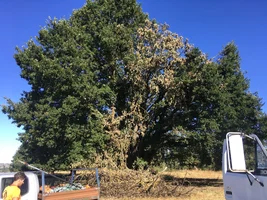
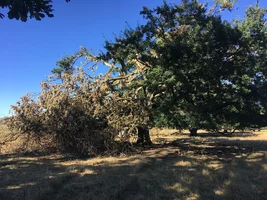
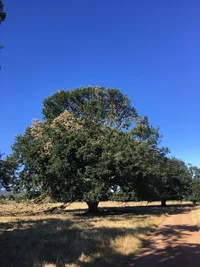
7752628E-EC6A-4D57-8F7A-EA6BCCE95723.webp The English oaks appear to thrive here, I should take some measurements tomorrow, these trees were planted in 1936 and would measure at least 1200mm dbh if not much more, they probably stand 20-25 metres tall with a canopy spread of about 20m.
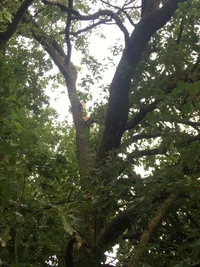
Photo is an attempt to show one of many leaders with the top snapped out at about 18” diameter
 
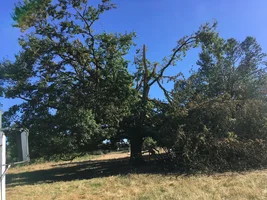
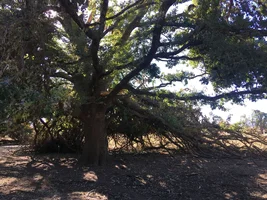
E2B3199C-0C95-4C14-B16E-364B364CD632.webp 33892D23-AFF8-4A23-882B-F17A45C9124B.webp A859C619-AD9E-47A3-BD16-26765FE6605C.webp 94E2DD16-3F56-41A5-B6C9-67CCBF9F8692.webp 796D6587-289F-4FD8-ABCB-B3A23C42522E.webp 0A23888E-E274-40AE-90D1-BB32A9F5D917.webp YSome photos from today, these better show the damage that winds did to these trees, this is only a glimpse of the total devastation to this row of trees.
 
Remove the broken limbs and reduce any limbs in immediate danger of failure due to exposure. Leave all structural limbs that are firmly attached and do not cut back to laterals. If you are going to chip the brush, spread it out under each tree that you work on.
 
Accepting loss, remediate what's left from the wind storm.
Given the weather extremes, especially the last few weeks of what might become the most destructive Summertime on record for Australia, I don't know what else to recommend.
Those pictures paint what we've become used to in the Southern U.S. but more so, a ranch environment that also supports livestock that browse amongst the stands of trees, reaching up for fodder and wounding the canopies often. I tend to support the fact that those oaks stress on multiple wounds frequently, but that said..also have successfully healed from years of challenges. In a way, have become well versed in exercising CODIT repeatedly so have modified resistance to repeat trauma. I'm of the school of thought that they harbour a strong systemic reaction to stresses from acquisition.
The soil is calciferous, probably a 7.5 or higher pH value. Do not fertilize but soil amending to include the nutrient boost of ferrous materials, sulfite's as well.
Ferrous sulfide is a dirty iron, soluble and available which includes copper which would enhance the tree's anti-fungal abilities. Moisture is important to avail the treatments but that's difficult on range trees. Rainfall is critical but irrigation can be used hopefully.
Let me know if you want to initiate a programme. I can coach it from here.
 
As far as "homeowner chemicals", yes. Ferrous sulfate is not regulated but it's more importantly not toxic except for sheep/goats who have livers which are highly susceptible to copper toxicity. Controls need to be followed until weather dilutes the dripline applications. Koalas and kangaroos haven't been studied but cattle are cool with it.
It's a new approach for your area but things have changed globally. The old school doesn't apply much anymore.
 
The trees pictured appear to be quite healthy, just hammered from a storm. Without more information, I would not be changing the mineral composition of the site.
 

New threads New posts

Back
Top Bottom